Updated March 4, 2026 09:17AM
One of the most talked-about labels in cycling and triathlon gear in 2026 has to be “3D Printed.” You see it on saddles, aerobar parts, hydration mounts, helmet concepts, and even complete bikes. And usually, right next to that high-tech label, you see a higher price tag.
So, what does it actually mean? And is it worth the investment?
In triathlon, 3D printing is not just a cosmetic trend or a premium buzzword. At its best, it is a superior method for designing and manufacturing the parts that matter most to your comfort and aerodynamics: your contact points. These are the critical interfaces where your body interacts with the machine – mainly the saddle, armrests, extensions, and cockpit components. These are the things you touch and touch you.
If you can improve those person-meets-machine details, you can usually improve both comfort and performance – who doesn’t want that?
First: A few simple definitions
Before diving into specific products, we need to clear up the terminology.
Additive manufacturing
This is the industry term for what most people call “3D printing.” “Additive” simply means the part is built layer-by-layer from a digital file, rather than being cut away from a solid block of material. That is the opposite of “subtractive” manufacturing (like CNC machining), where you start with a block of aluminum or steel and remove material to reveal the final shape. Think: making something with strips of papier-mâché versus chiseling from a block of marble.
Why this matters: Additive manufacturing frees designers from the constraints of traditional molds. It makes it easier to create complex internal structures, hollow parts, and one-off custom shapes that would be impossible or prohibitively expensive to machine.
Lattice structure
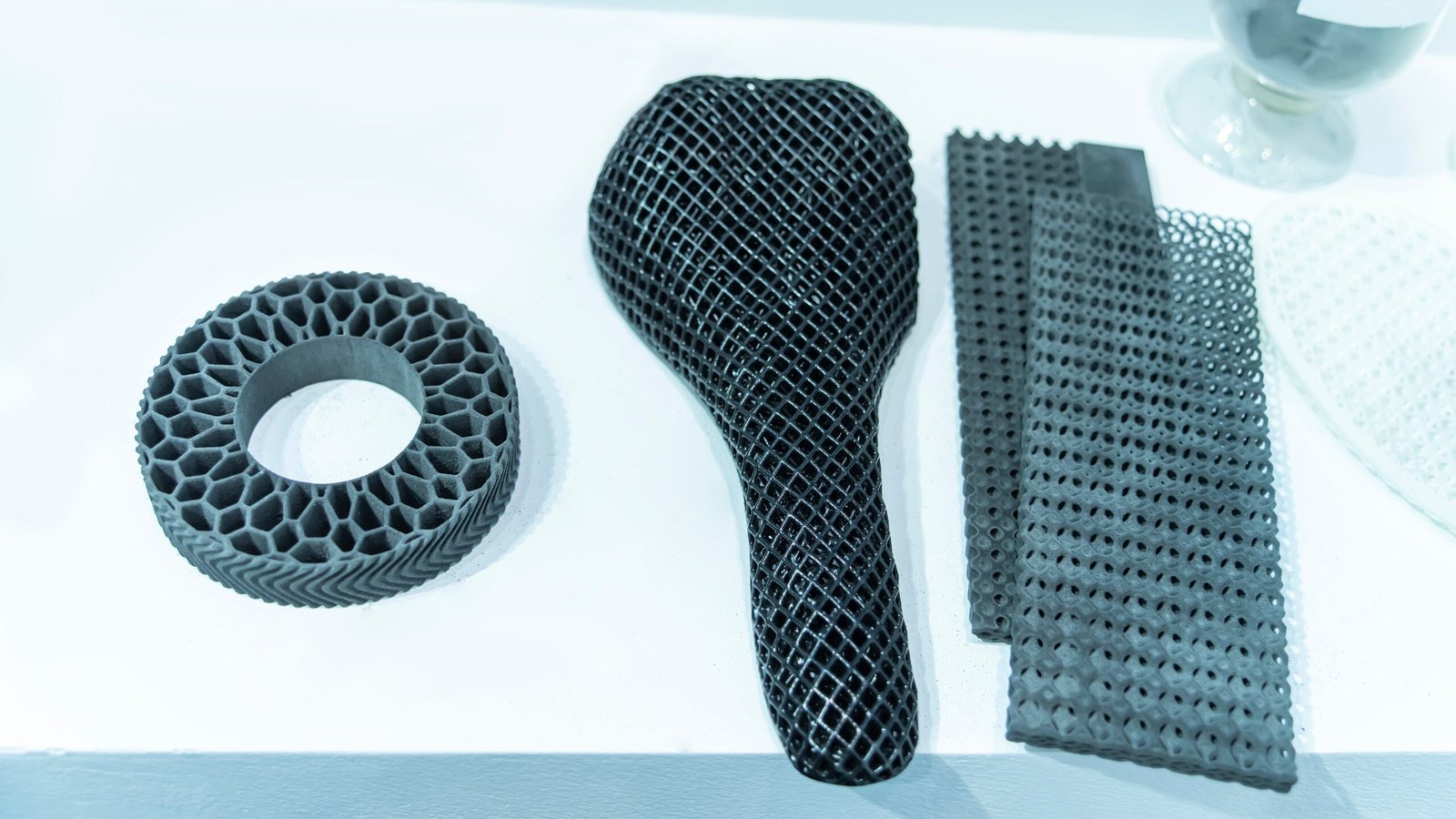
A lattice is a repeating internal structure, looking much like a 3D mesh or honeycomb. In cycling, you will most commonly see this replacing the foam in high-end saddles.
Why this matters: A lattice is programmable. By changing the thickness or density of the lattice struts, a manufacturer can make a saddle nose firm for stability while making the sit-bone area soft for compliance, all in a single, continuous piece. This “zonal tuning” is notoriously difficult to achieve with traditional foam density.
Why triathlon is the perfect match for 3D printing
Triathlon is arguably the best sport in the world for additive manufacturing because our gear is so uniquely fit-dependent.
A road cyclist can often get away with “close enough” on many components. A triathlete usually can’t – we “plant and grind” in one position for hours on end. Then we have to go for a run.
In our sport, position is everything. Small changes in pad width, extension angle, forearm support, or saddle shape can drastically affect power output, ability to digest nutrition, breathing, how long you can hold an aero tuck, and how you perform coming off the bike.
Critically, those needs aren’t universal. What works for a flexible 25-year-old draft-legal racer may be torture for a stiff 45-year-old Ironman athlete.
That is exactly where 3D printing shines:
- Low-volume production runs
- Rider-specific geometry
- Fast iteration and prototyping
- Complex, ergonomic shapes
- Custom integration
In other words, it solves specific triathlon problems that mass production ignores.
Saddles: The most mature category
If there is one category where 3D printing has clearly graduated from “prototype” to “mainstream,” it is triathlon saddles.
Most “3D printed saddles” are not fully printed. Usually, the printed portion is the padding layer. Saddles typically have a complex elastomeric lattice structure bonded to a conventional carbon shell and rails. As mentioned above, the lattice is the magic in the sauce. It allows brands to tune support and pressure relief by zone without chafe-inducing seams or different foam densities that can create different sets of problems.
Carbon (a Bay Area behind-the-scenes tech company, not the material) has played a massive role here, and you’ve probably never heard of them. Their Digital Light Synthesis (DLS) process uses light and oxygen to cure liquid resin into solid structures. This is the tech behind the famous “Adaptive” line from Fizik, as well as other familiar saddles from Specialized and Selle Italia.
I personally use a Fizik Vento Argo Adaptive saddle on my road bike. For me, the value is not hype; It’s pressure management. A good 3D-printed saddle doesn’t just feel “soft.” It feels controlled. It supports you where you need stability and gives way where you need relief.
Helmets: The next frontier of custom aero
While saddles and cockpits have paved the way, the newest and potentially most impactful application of 3D printing is happening right on your head. Brands like KAV and Hexr are replacing traditional EPS foam with custom 3D-printed polymer lattices, and the benefits for triathletes are massive.
To understand why this matters, you have to look at the traditional aero helmet compromise. Usually, you are forced to choose between speed and heat management. A smooth, teardrop helmet with no vents reduces aerodynamic drag, but because standard EPS foam is a literal insulator, it traps heat. Over a 112-mile Ironman bike leg, an overheated core temperature will cost you far more watts than a slippery helmet will save.
3D printing changes that equation entirely. Instead of relying on massive external vents that disrupt smooth airflow, 3D-printed helmets use open-cell honeycomb structures inside the shell. This lattice suspends the helmet slightly off your head and acts as a thermal scaffold, allowing air to flow seamlessly through the helmet’s core.
You get the aerodynamic benefit of a closed, smooth outer shell, but with passive ventilation that dissipates heat much faster than traditional foam. Furthermore, because these helmets are often made-to-order based on precise head scans, they feature a slimmer profile and reduced frontal area, directly lowering your aerodynamic drag.
If Carbon is the behind-the-scenes additive manufacturing name powering many of the best-known 3D-printed saddles, Jabil (a Minnesota-based additive manufacturer) is a similar behind-the-scenes player on the helmet side. Jabil partnered with KAV Sports on custom-engineered materials and additive manufacturing, while KAV remains the “rider-facing” brand selling the finished product – helmets like the Rhoan: CORE, an aero road model built around a dual-density 3D-printed honeycomb structure (and manufactured in Buffalo, New York).
Cockpit contact points: Where it gets interesting
The front end of a triathlon bike is where the engineering gets complicated fast. You are juggling armrest shape, width, extension angle, hand position, shifter placement, hydration, and computer visibility, all while trying to keep the rider’s wrists comfortable and the drag low.
Traditional manufacturing works well when you want to make 5,000 identical spacers. But triathlon front ends often need custom solutions. I’ve personally tested AeroCoach hydration systems, BTA mounts, and aero extension mounts, and I’ve seen firsthand how much these “small” parts affect the rider. If a 3D-printed adapter allows you to tilt your extensions up an extra 5 degrees to relieve shoulder tension, that is a massive performance win via a relatively tiny piece.
This is why brands like WattShop, Uniqo, and Predator are so interesting right now. They aren’t just selling parts; they are selling fit solutions.
WattShop
WattShop has done a great job showing what a proper additive workflow looks like, especially in their custom extension systems. They measure the rider, design to the fit, prototype, test, and then build the final version. That “prototype-first” mindset reduces the risk of buying an expensive carbon part that doesn’t fit.
Uniqo
Uniqo is a Spanish brand with popular aerobar solutions found on many pros’ bikes. The process is surprisingly simple and shows exactly why additive manufacturing is so valuable. It starts with a form detailing the rider’s general measurements: angle, elbow width, hand width, preferred hand tip style (mono or dual), and the overall style of the bar.
From there, Uniqo sends the customer a 3D-printed prototype for fit verification. If it’s not perfect, they can do multiple iterations until the fit is completely dialed. Only then is that 3D print turned into a functioning, final carbon aerobar.
Predator
Based here in the US, Predator represents the high-performance side of custom aero systems. They combine fit-driven design with serious fabrication capability, boasting of an 8.5-watt improvement using their integrated fit system. That is a significant number in a sport decided by seconds.
MOST (Pinarello)
At the extreme end, you have products like MOST’s custom 3D-printed extensions for Pinarello. This is the halo version: highly customized, rider-specific, premium manufacturing, and premium pricing. It proves that the highest levels of the sport are treating contact points as engineered systems, not generic accessories.
The “boring” parts: SILCA
SILCA is an important part of this conversation because they show that 3D printing isn’t only for “super-bike” projects. They have embraced 3D-printed titanium for small but meaningful parts: derailleur hangers, cleats, computer mounts, and tools. This is a great reminder that additive manufacturing is perfect for durable, high-stress components that are too complex to machine and too low-volume to cast.
The verdict: Is it worth the money?
So, should you upgrade to 3D-printed gear?
Usually yes, if:
- You have a saddle pressure issue that traditional foam hasn’t solved.
- You need a cockpit adapter or mount to fix a specific integration problem.
- You are an experienced rider looking for a custom front-end solution to optimize a dialed fit.
Usually no, if:
- You are buying it just because “3D printed” sounds cool.
- Your bike fit isn’t dialed yet (custom parts lock you into a position).
- The brand can’t clearly explain what problem the design is solving.
The technology itself is not the value. The value is what the technology enables.
3D printing is changing triathlon contact points because it gives builders a better tool for solving the problems triathletes actually have: comfort, fit, and integration. It is a manufacturing shift that happens to be perfectly suited to our sport. And in a game where small details make huge differences, that is exactly where it belongs.