
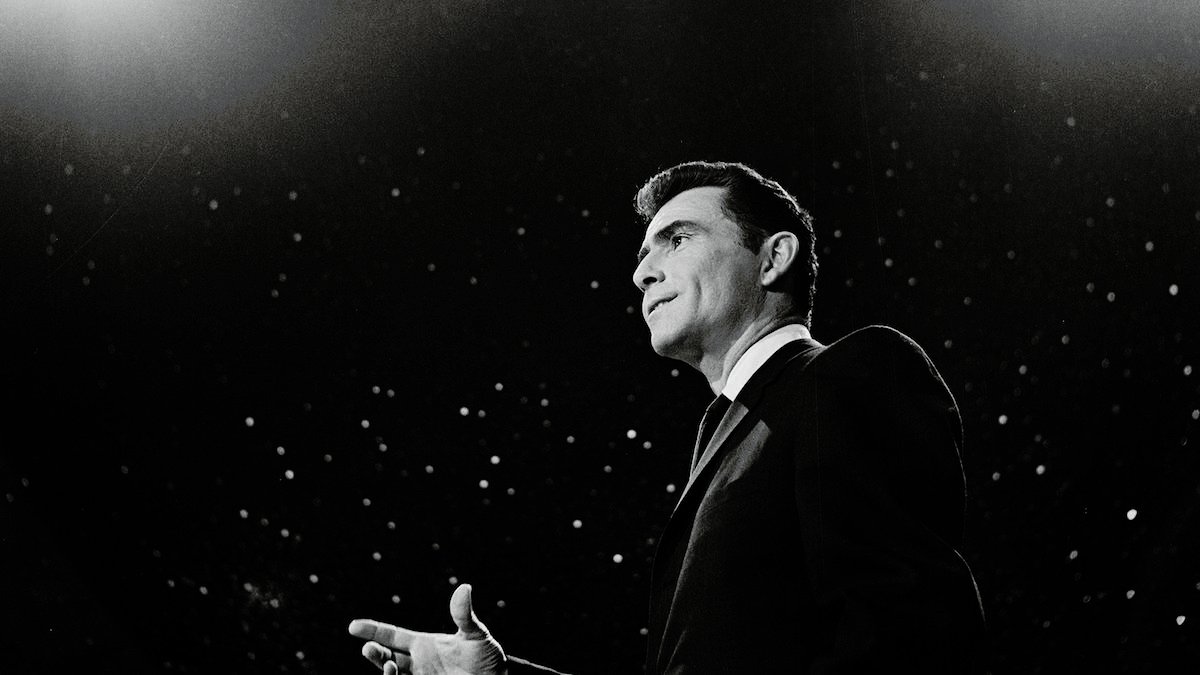
Years before he created The Twilight Zone, Rod Serling tried to tell a story inspired by Emmet Till, the Black teenager lynched in Mississippi in 1955 for allegedly whistling at a white woman. TV executives had some notes, which were actually demands.
If Serling had to do it, they said, could he do it without mentioning the South? Or Black people?
The ridiculousness of the experience was one of Serling’s motivations to create The Twilight Zone, in which he shrouded stories of social justice within the protective cloaks of genre and metaphor. He couldn’t talk about struggling immigrants on network TV, for example. But he could talk about aliens. Or even tell stories in which we were the aliens. The goal, always, was expanding empathy.
The entrancing new documentary Serling, which premieres Monday at SXSW, pulls off the cinematic miracle of having Serling narrate his own life story. Director Jonah Tulis came upon the idea when he realized what a wealth of audio recordings Serling left behind when he died in 1975, at only 50 years of age.
“Because of the extensive archive of recordings we uncovered, we were able to tell this story almost entirely in Rod Serling’s own voice. We didn’t use any AI to recreate his voice, and we didn’t bring in an actor to imitate his voice,” Tulis tells MovieMaker.
The film uses hours of footage from Serling’s TV appearances, including introducing each episode of The Twilight Zone. It also stages remarkably effective re-enactments that feel very much in the spirit of the beloved show, which ran on CBS from 1959 to 1964 and has thrived in syndication and streaming in the decades since.
“We shot visual atmospheric recreations — in 4:3, black-and-white just like The Twilight Zone — using an actor,” Tulis adds. “But what you hear in the film is all Rod Serling, speaking in the moment. Allowing Rod to guide the audience through his own life felt like the most honest way to tell this story. And ultimately, who better to tell the story of Rod Serling than Rod Serling himself?”
We asked Tulis about Serling’s striking relevance today, how Serling circumvented censors and critics, and making the film with Leonardo DiCaprio’s productin company, Appian Way.
Serling Director Jonah Serling on Rod Serling and The Twilight Zone

MovieMaker: You’ve said that Leonardo DiCaprio and his company Appian Way were essential to this film happening — that they had been in talks with Serling’s estate and helped find financing for the doc. Why did they tell you they thought you were the right director for it?
Jonah Tulis: We all knew that Rod Serling had an extraordinary life and career that deserved to be told on film, but the challenge was figuring out how to tell it in a way that felt fresh and cinematic. Many of the key figures from that era have since passed away, so the traditional talking-head documentary approach was never going to fully capture the energy of who Rod was.
I did some preliminary research and uncovered some truly incredible archival materials, much of which has never been seen or heard before. It included dictations from throughout Rod’s life including letters, script notes and personal reflections. It became clear that Rod had, in a sense, left behind his own narration of his life. I realized at this point that Rod’s own voice could tell the story. The idea then became: what if the film unfolded almost entirely through Rod narrating his own life?

When I shared this approach with Appian Way, the Serling family and our partners at Verdi Productions, they immediately understood the creative strategy. What they responded to most was the idea that Rod himself would guide the audience through the film. His voice, his thoughts, and his words would be the spine of the documentary. They felt that approach honored who he was as a writer and storyteller.
Ultimately, they told me they believed I was the right director for the project because I wasn’t just interested in making a biography, I was interested in building a cinematic experience that let Rod Serling speak directly to audiences again.
MovieMaker: What similarities and differences do you see between Serling’s fights with TV executives — when he was trying to talk about racial justice and other progressive ideas — and the modern clashes between TV stars and their networks? I’m thinking especially of Jimmy Kimmel being pulled from the airwaves temporarily, and Stephen Colbert’s show being cancelled.
Jonah Tulis: These similarities are actually one of the main reasons I think telling this story today is more important than ever. While Rod worked in a very different television landscape than today, those same elements of control and censorship exist across all media. Networks and platforms still operate within commercial realities, and creative voices sometimes clash with those boundaries.

The big difference is that today artists often have more outlets which allows for more freedom. The Twilight Zone was very much birthed from these boundaries though, as he used the allegory of science fiction to tell these stories of race, politics and humanity.
MovieMaker: Why do you think Serling had such a strong sense of fairness and justice? He seems like one of the most outspoken white people of his era in favor of equality and Civil Rights.
Jonah Tulis: Rod was deeply affected by his experiences in World War II and that shaped his worldview profoundly. Rod came back from war with a deep skepticism and a strong belief that society had a responsibility to confront justice wherever it appeared. His work was initially very much a way for him to “get it out,” but it evolved into something bigger and more important to him.
Rod believed storytelling wasn’t just entertainment, it was a way to ask difficult questions about the world we live in. He seemed to feel that if you had a platform as powerful as television, you had a responsibility to use it.

MovieMaker: Some celebrities avoid politics today out of simple fear of offending anyone and hurting their marketability. But others just don’t want to lecture audiences or preach to the choir. Did people in Serling’s time accuse him of whatever the early ’60s equivalent was of being “too woke”? Did conservatives accuse him of being a communist, or whatever they said about people who supported racial equality?
Jonah Tulis: Absolutely. Many of Rod Serling’s views on war, politics, and racial injustice were incredibly controversial for television in the late 1950s and early 1960s. Sponsors and networks often pushed back on his scripts, and several of his early teleplays were rewritten or softened because executives worried about offending advertisers or viewers. In that sense, the tensions he experienced feel very familiar today.
At the time, some television historians and critics even labeled him the “young angry man” of television. But that characterization misses the point. Serling wasn’t angry for the sake of being provocative, he was simply a writer who spoke his mind. His stories rarely delivered simple ideological messages and instead, they posed moral questions. They asked the audience to consider what it might feel like to be the outsider, the marginalized person, or the victim of injustice.
Serling premieres Monday at SXSW and plays again throughout the festival. You can read more of our SXSW coverage here.
Main image: Rod Serling in a promotional behind the scenes image from The Twilight Zone. CBS



