
Dalia Rooni and Lauren Noll were impressed by each other’s work ethic long before they became creative partners on the new SXSW standout, Same Same But Different.
“Lauren and I actually worked as personal trainers at Equinox Hollywood before we worked together as filmmakers,” Rooni recalls. “We both watched each other write, crowdfund, and produce our own first short films while maintaining a full roster of clients. We recognized that grit in each other.”
The pair went on to compete in two short film challenges, and then made a short together, “Gen V,” a comedy thriller that follows a young vampire girl navigating high school. The film, which includes LGBTQ+ themes and an allegory about being Muslim in the United States post 9/11, won a development deal with Adi Shankar’s Bootleg Universe.
“We always found a way to prioritize each other’s identity and POV in what we did,” Rooni says.
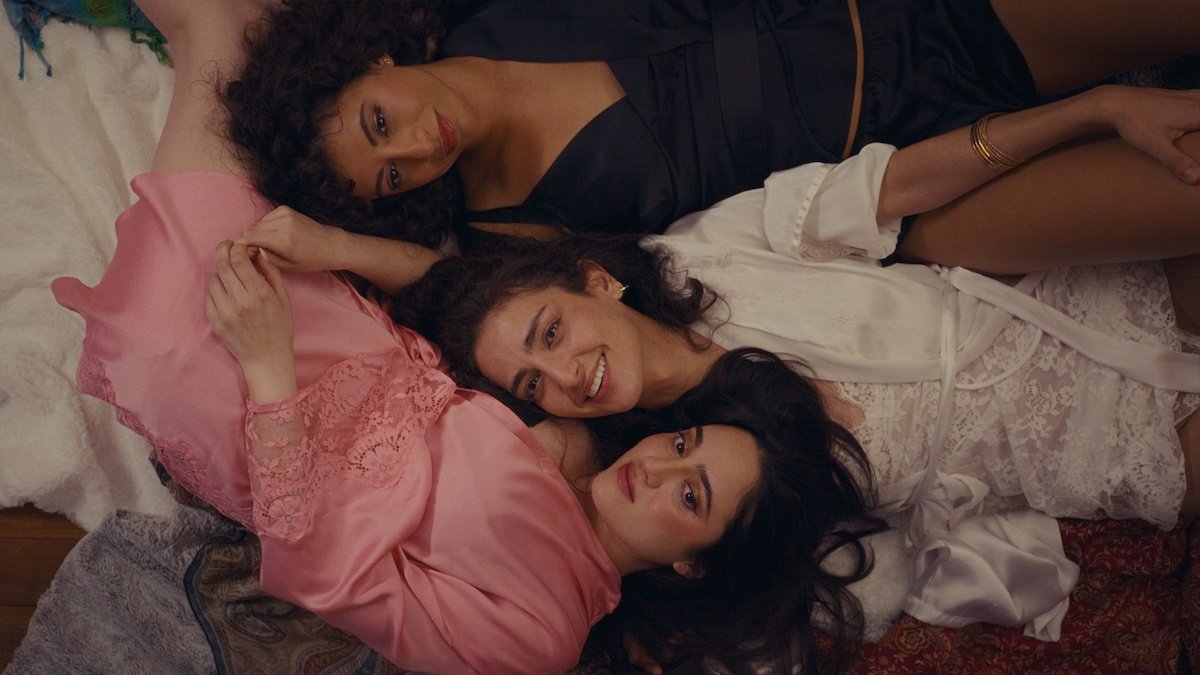
Same Same But Different, which Rooni wrote and Noll directed, follows three Iranian-American women: Rana (Medlion Rahimi), Set (Layla Mohammadi) and Nadia (Rooni). Rana is looking forward to returning home to Iran after a job in Cape Cod working for a wealthy family whose patriarch is dying. She’s also neatly tying up a summer fling with his son, Adam (Logan Miller) when Adam hits her with an out-of-nowhere wedding proposal that would allow her to stay in the U.S.
Her friends Set and Nadia arrive with their partners in tow, and all stay in the same beautiful seaside house for the wedding weekend. The cast also includes Kevin Nealon, Joey Lauren Adams, and Noll in key roles, as well as Nicholas Coombe as Set’s lawyer-turned-plumber partner, Nolan, and Michael Baszler as Nadia’s best friend turned boyfriend, Ryan.
We asked Rooni, who wrote Same Same But Different, and Noll, who directed the film, about life informing art.
Dalia Rooni and Lauren Noll on Making Same Same But Different
MovieMaker: Can you talk about how Same Same But Different came to be?
Dalia Rooni: Same Same But Different was inspired by a real weekend that I now see as the turning point of my life.That weekend, in a sprawling summer house perched on a perfect stretch of beach, I came face-to-face with profound realizations about who I was and who I wanted to become. In many ways, we all did. Alongside the joy, there was something else, something that felt almost like grief. For the first time, I understood what it meant to lose my innocence. I felt the quiet, painful threshold of becoming a woman.
Lauren Noll: Dalia and I wanted to work on our first feature together, and when she told me this story, I knew it was the one. Within days, we were brainstorming in a coffee shop over Dalia’s first draft. That was two years ago now. Dalia calls Nadia the version of herself she was when she and I first met.
Many of Nadia’s wildest moments in the script are pulled from real-life stories that I was in the room for, including the moment when she realized she was in love with her best friend, “Ryan.” I’d been third-wheeling the real Nadia and Ryan for years, so I was incredibly invested in these characters before they even hit the page.
MovieMaker: I can’t imagine the mix of emotions having your film about the complex dynamics of three Iranian-American women coming out at SXSW at the same time the United States and Iran are suddenly at war. How are you holding up and trying to process all of this?
Dalia Rooni: You know, I wrote this film around the time the Woman, Life, Freedom movement began in Iran. That moment was very much the emotional backdrop for what Rana was going through, and for the push and pull so many Iranian immigrants were feeling — the tension between where you come from and where you are, and the helplessness of watching history unfold from afar.
So it’s surreal and honestly heartbreaking that the themes of the film feel even more urgent right now.
There’s a statistic I think about a lot: 80% of the roles portrayed by Middle Eastern actors on television fall into negative or threatening stereotypes. That reality makes it even more important to tell stories about Middle Eastern characters that are joyful, complicated, and deeply relatable.
It’s not enough to “humanize” our characters only in stories that tie MENA people to grief, war, oppression, or trauma. We also have to liberate them on screen! To let them be funny and messy and flawed and free. To let them live full lives that look a lot more like everyone else’s.

MovieMaker: One thing I found fascinating about this film was that the lead, Rana, really misses Iran — it isn’t the typical immigration narrative where the protagonist is desperate to live in the United States. Can you talk about that layer of complexity, and how it factors into her decision to accept a green card marriage proposal?
Lauren Noll: I mean, we’re speaking to exactly why Rana is so torn up about this. Dalia feels that green card marriages are too often spoken about shallowly, and it was very important to her to honor the true stories of immigrants who, yes, may decide to take this path to stay in the States, but who feel the toll of not only the moral gray area of the decision but also giving up another piece of themselves.
Finding belonging in that in between is challenging. Rana feels she belongs to Iran still, even though her dream will be more easily pursued in the States. So, we put Rana through the ringer in the story to make this very decision.
Of the three women, she’s the most pure of heart. She’s someone who is driven by her intuition; she’s in tune with her gut. She’s been guided by it through her life to this point without fail, but in this moment, she can’t hear it. For Rana to do something without a clear conscience is a big deal. Even up to the night before the wedding, she’s looking for that peace of mind about this choice. She tries talking to her friends, hiring Adam’s shaman, calling her mom – all to no avail.
She doesn’t want to take advantage, and she doesn’t want to “be saved.” She misses her mom. She doesn’t know if she’ll ever love him. She can’t tolerate lying. How does she ensure that she doesn’t lose herself and her own identity in the process? Does marrying this American boy make her less Iranian? She knows this could solve one big problem, but it will leave her with hundreds of new problems. We just dug into the humanity of it all.
MovieMaker: I’m a big fan of your line producer, Alecia Orsini Lebeda, who I see all the time at festivals and Massachusetts film events. Can you talk about working with her and the rest of the team to find all these great Cape Cod locations? And why Cape Cod?
Lauren Noll: Who doesn’t love Alecia?! We just wouldn’t have been able to execute production without her. The rest of us are based in L.A. and South Carolina. We needed boots on the ground. I went to Woods Hole Film Festival with my short “The Heart of Texas” in 2024, and I was on a mission to find my line producer for this project while I was there, and in walked Alecia to deliver a killer panel about filmmaking in Massachusetts. I cornered her and the rest is history.
I not only found us a line producer in Massachusetts, I found us the line producer in Massachusetts. The crew that arrived to work on this film are a testament to her and the kind of leader she is. They all flocked to work on an Alecia Orsini Lebedi project, and we were so grateful to show up Day 1 to an incredible team who love the work they do as much as they love Alecia’s lunch time announcements.
Carley Byers was brought in to secure the locations we still needed (the home had been found prior and is another fun story in and of itself), and she killed it. All we had to do was show up. Truly, they made our lives so easy so we could focus on the rest of the hard parts of making an indie.
Cape Cod was central to the event in Dalia’s life that inspires the story and it holds the spirit of the film. It couldn’t be anywhere else.
MovieMaker: What was your biggest challenge on this movie, and how did you solve it?
Dalia Rooni: Ha! Just one? For me it was the fact that a week prior to production we found out that a McMansion was actively being built next door to the home we were filming in and tears were not enough to stop the build. And I’m not sure if you know this, but construction workers aren’t the most…communicative.
We ended up creating a “indoor vs outdoor” shoot schedule that was color coded with RED (do not bang on things) YELLOW (sometimes bang on things) and GREEN (bang on as many things as you like), to share with the contractors and hopefully work around each other’s schedule. For this plan to work, everything needed to go according to plan: the weather, the actors, the shots, the light. Someway, somehow, it was a success.
Lauren Noll: Around the same time we were solving the above, I was sitting on the floor of my living room literally taking scissors to my 1st AD’s schedule and rearranging it (sorry, Tishna!) to make sure I could accommodate four different actors’ schedule conflicts. We had finally landed our dream cast and I wasn’t about to let a single one of them go. Tishna took it back from me and made my unrealistic Frankenstein schedule turn into an actual working one that accommodated all! My hero!
The money came together one Lego block at a time — a little here, a little there. We didn’t know until three weeks before shooting that we actually had what we needed to roll cameras.
We had to make you believe these actors in bikinis on the beach in April in Massachusetts were warm, so our post had a big job and they came in at the 11th hour as well. Every piece of it was a new problem to solve and a new miracle to answer.
Same Same But Different premiered at SXSW and plays again Wednesday. You can read more of our SXSW coverage here.
Main image: (From top) Dalia Rooni, Medlion Rahimi and Layla Mohammadi in Same Same But Different. Courtesy of the film.



