
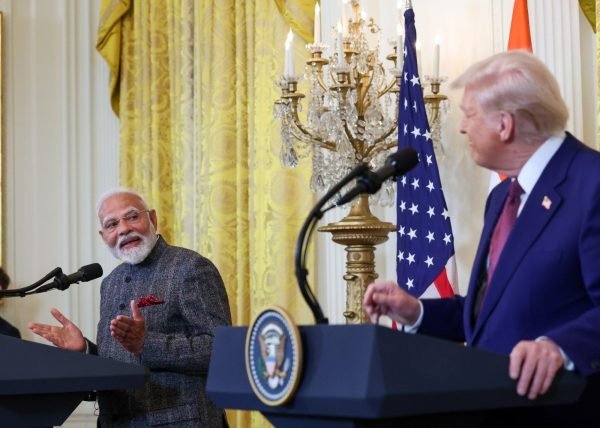
While announcing the still amorphous trade deal with India, U.S. President Donald Trump on February 2, 2026 posted that “He [Modi] agreed to stop buying Russian Oil, and to buy much more from the United States and, potentially, Venezuela.” Trump further touted the supposed pledge as a way to end the war in Ukraine.
The White House press secretary repeated a version of the same claim on February 3, while emphasizing that Indian Prime Minister Narendra Modi had committed to $500 billion investments in the United States.
To say that neither of these ostensible commitments seems likely would be an understatement. Nevertheless, they illustrate the rectitude of the classic maxim: if you want to be in the dance, you have to pay the piper.
On February 4, Indian Commerce Minister Piyush Goyal spoke in Parliament. He reiterated that the energy security of 1.4 billion Indians is the “supreme priority” for the government. The statement could be read as confirmation of Trump’s claims – or not. The minister spoke of the need for “energy source diversification in keeping with objective market conditions and evolving international dynamic.” Goyal was clearly engaging in perception management. Until recently, the Indian government held on to the argument that the economics of heavily discounted Russian oil dictated its trade with Moscow. Indian officials had repeatedly called out the “hypocrisy” of the U.S. and EU pressuring New Delhi to back off from Russian crude.
Whether a complete reorientation in supply arrangements occurs remains to be seen, but some adjustment is likely. This will be the third time India’s decision regarding crude imports have been dictated by Trump. In April 2019, purchases from Iran stopped when the first Trump administration refused to extend the exemptions from sanctions imposed on the country after it pulled out of a 2015 nuclear accord. That year India also stopped buying oil from Venezuela after U.S. sanctions. The Indian opposition parties had targeted the BJP-led government for being silent on “an attack on India’s sovereignty.”
Nevertheless, this time around, economics and geopolitics remain at the core of India’s decision to diversify its crude imports.
India-Russia bilateral trade reached a record $68.72 billion in 2024-25, a massive five-time surge from $13.1 billion in 2021-22. The increase was primarily due to Indian imports of Russian crude oil, fertilizers, and coal. The trade was heavily skewed in favor of Russia, with India importing $63.84 billion and exporting merely $4.88 billion, primarily owing to the limitations of U.S. and Western sanctions on Moscow.
India-U.S. trade, on the other hand, is twice the size of the Russian portfolio, $128 billion. In 2024, U.S. exports to India amounted to about $41 billion, and Indian exports to the U.S. totaled nearly $87 billion. The United States is India’s largest market, and its exports, which include pearls, electrical machinery, and pharmaceutical products prominently, are 17 times more than its exports to Russia. Oils and fuels account for nearly 30 percent of India’s imports from the U.S. That will increase significantly if India increases its purchase of American oil and LPG further.
Cost-benefit analysis indicates that disruption of India-U.S. trade on account of the 50 percent tariff imposed on India, therefore, is much more detrimental to the Indian economy than the benefits derived from the cheaper Russian crude. India’s oil strategy worked as long as the U.S. administration did not weaponize trade through tariffs. But with Trump showing no signs of retracting, India has limited options in the evolving game of “chicken.” Indian exporters in particular have pressured the government to yield. Moreover, Indian global ambitions are linked principally to the United States. Even the much-hyped India-EU Free Trade Agreement, touted as the “mother of all deals,” won’t come to New Delhi’s rescue if trade links with Washington remain disrupted.
Additionally, Trump is also holding out a carrot for India in the form of Venezuelan oil, possibly with attractive discounts. That, however, remains a long shot for Indian companies for logistical reasons as well as the quality of the country’s bottom-heavy crude. Venezuela is roughly twice as far from India as Russia and five times further than the Middle East, which will add to the freight costs.
Even so, in 2019, India imported $7.2 billion worth of oil from Venezuela, accounting for just under 7 percent of its total crude imports. Some officials of the Indian government-owned Oil and Natural Gas Corporation (ONGC) are still stationed in the Latin American country. Activating the old connections could already be on the cards.
On January 30, three days before Trump’s announcement, Venezuela’s Acting President Delcy Rodriguez dialed Modi, and both agreed to deepen and expand the bilateral relations. India has not taken a position that will annoy Trump on his decision to detain Venezuelan President Nicolas Maduro.
Russia seems to be adjusting to the new reality that India may soon no longer be one of its major crude purchasers. On February 4, it said that India is free to buy crude oil from any country and its decision to diversify suppliers isn’t new. A Kremlin spokesperson said India has always sourced oil from multiple countries. Left unsaid is the reality that Moscow is quickly becoming subservient to Beijing, which already is the leading purchaser of Russian oil.
Ironically, during Russian President Vladimir Putin’s trip to New Delhi in December 2025, India and Russia affirmed that they were working toward a $100 billion target for trade by 2030. It is difficult to see how that target will be achieved if crude imports cease and sanctions remain in place. It remains to be seen what steps Russia can take in the defense and security sector to pressure New Delhi for what it will consider a breach of friendly relations. India still remains dependent of Russia for military hardware and supplies.
For the moment, it appears India has made a stark choice. It will still present its new position as a product of independent, rational decision-making though most of the statements are coming from Washington D.C. rather than New Delhi. Maintaining strategic autonomy will remain an increasing challenge in the present global context defined by “the predatory hegemon,” as Foreign Affairs recently termed Trump’s America. India’s attempt to renege on one power at the expense of another will accrue costs that might weigh heavily in maintaining its independence in foreign and economic policy. It will require deft diplomacy and long term vision to prevent the forfeiture of its strategic autonomy in the emerging new world order that is increasingly witnessing the creation of spheres of influence in the evolving great power competition.



