
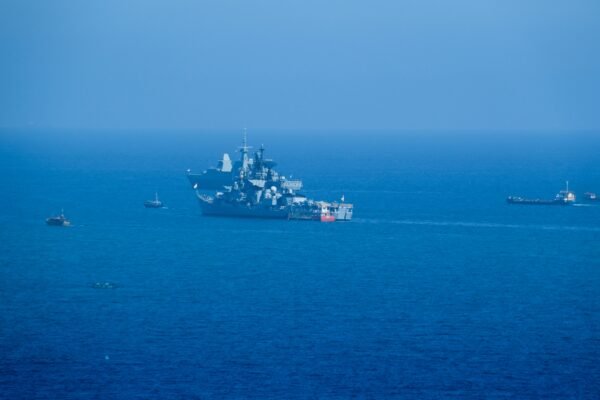
When warships from the United States, Russia, Japan, Iran, the Philippines, South Africa, and more begin to converge off Visakhapatnam, India, for the Milan-26 naval exercises, to be held from February 18-25, their choreography may look pretty familiar: flags, formations, maneuvers, photo-ops and deliberations. But this 13th edition of India’s Milan exercise is different. It culminates India’s sustained 32-year journey from a regional maritime participant to a pivotal master builder in the Indo-Pacific maritime security architecture.
Conducted under the aegis of the Indian Navy’s Eastern Naval Command, Milan-26 will occur alongside two other hallmark events – the International Fleet Review (IFR) 2026 and the Indian Ocean Naval Symposium (IONS) Ninth Conclave of Chiefs – together called the Vizag (a common name for Visakhapatnam) trifecta. And if that wasn’t enough, during February 24-25, the New Delhi-based MP-IDSA will host the 16th South Asia Conference on the theme of “Sagar to Mahasagar: Strategic & Development Partnerships,” bringing academics, analysts, practitioners, and policymakers together.
This confluence of ideas, institutions, and naval operations alludes to how India today is contributing to the building of norms, practices and cooperative partnerships. The surge in activity promises to make Milan-26 a global node of naval diplomacy, operational engagement, and strategic signaling all at once.
From a Modest Beginning to Multilateral Maritime Hub
Milan – the Hindi word for “confluence” – began in 1995 with only four foreign navies: Indonesia, Singapore, Sri Lanka, and Thailand. This modest initiative of then Fortress Andaman & Nicobar (FORTAN) was aimed at enhancing mutual understanding and trust through professional interactions among regional maritime forces.
In more than three decades, this biennial exercise has steadily expanded, mirroring the transition in India’s maritime interests. By 2014, participation had grown to 17 nations; by 2022 this naval exercise was drawing 42 foreign countries – involving 13 warships, 21 aircraft and a submarine plus observer delegations – marking a quantum leap in the complexity and scope of their exercises and interactions. So far, Milan-26 has confirmed participation from 70 countries.
This rapid transformation reveals India’s expanding convening power as well as its shifting strategic doctrines: from a regional focus under the early Look East and Act East policies to a more inclusive maritime design aligned with the SAGAR (Security and Growth for All in the Region) and MAHASAGAR (Mutual and Holistic Advancement for Security and Growth Across Regions) visions as enunciated by Prime Minister Narendra Modi in 2015 and 2025, respectively.
Scale, Significance, and Strategic Signals
The 2026 edition of the Milan naval exercises is projected to be the largest in its history. Invitations are extended to over 135 countries, with 70 having already confirmed their attendance. At least 23 foreign warships are slated to participate, including significant contributions from major navies such as that of the United States and Russia. Participation spans navies from the Indian Ocean Region, Southeast Asia, the Western Pacific, and beyond — showcasing Milan-26 as a genuine Indo-Pacific maritime platform, rather than a narrow regional exercise.
The expanded scale is accompanied by a growing complexity in logistics and deliberations. Milan-26 features both harbor and high sea phases involving maritime domain awareness, air defense, anti-submarine warfare (ASW), search-and-rescue, and humanitarian operations, testing interoperability across varied platforms and doctrines.
Meanwhile, hosting Milan-26 alongside the IFR 2026 and the IONS Conclave magnifies India’s soft and hard power. The strategic convergence of major naval powers at this Visakhapatnam “trifecta” positions India as a trusted interlocutor.
At the International Fleet Review on February 18, the ceremonial assembly of global navies will see President Droupadi Murmu review the assembled fleet of over 70 ships including India’s two aircraft carriers. Over 60 nations are confirmed to be participating, representing India’s standing as a maritime convenor.
On February 20, the IONS Ninth Conclave of Chiefs brings together naval leadership from 25 member states and nine observers, facilitating strategic dialogue on maritime security, piracy, humanitarian assistance and disaster relief (HADR), and information sharing with lasting bonds.
Both events will be bridged by Milan-26, a familiar biannual naval exercises of the last 31 years. Together, these events allow India to anchor operational trust and interoperability with strategic dialogues and maritime diplomacy.
India’s Maritime Choreography in Action
During Milan-26, the results of India’s naval modernization, especially its indigenization drive, will be showcased in platforms like the INS Vikrant aircraft carrier, the Visakhapatnam-class destroyer, Nilgiri-, Shivalik-, and Kolkata-class frigates and other fleet capabilities. These will be the hallmark of Milan-26, signaling India’s arrival as both a builder and conductor of modern maritime power.
But also on show will be manifestations of India’s yearning for camaraderie, command, and collective action through widespread and diverse naval partnerships for the long run.
To understand Milan-26’s deeper strategic resonance, one must situate it within the broader metamorphosis in India’s maritime profile and vision. Modi’s March 2015 speech in Mauritius launched the “SAGAR vision,” which posited the Indian Ocean as a shared space for collective security and growth. SAGAR sought to prioritize cooperative frameworks, capacity building, and humanitarian collaboration, making HADR a major component of naval fleets.
However, over the past decade, India’s maritime posture has shifted beyond a purely regional lens to a global maritime focus. This is what Modi outlined as his 2025 “MAHASAGAR vision,” which integrates economic diplomacy, technological connectivity, environmental sustainability, and professional interoperability. Importantly MAHASAGAR envisions global partnerships beyond the Indian Ocean, reflecting India’s ambition as a Global South leader and net security provider.
In turn, MAHASAGAR’s expanded focus is reflected in the guest list for Milan-26. Attending navies include not only Indian Ocean Region states but those from Australia, Southeast Asia (Indonesia, Thailand, the Philippines, and Vietnam), the Middle East (Iran), Africa (South Africa), and even Europe (France and Germany). The warships of major naval powers like the United States and Russia at Milan-26 may become the focus of media headlines, yet India’s bonding with neighbors, middle powers, and the Global South will be equally critical for its future.
In the midst of fractured global order, India’s unique salience is reflected in its ability to bring opposing navies and leaderships together. The confirmed participation of United States and Russian naval assets underscores India’s ability to engage with opposing geopolitical poles through cooperative security frameworks.
Meanwhile, countries from diverse theaters of Southeast Asia, Africa, the Middle East, and the Indo-Pacific have also responded positively, indicating India’s role as a bridge between regional and extra-regional maritime actors.
Hosting such diverse and large-scale maritime events is bound to reinforce India’s transition from a regional participant to an Indo-Pacific node of maritime cooperation. When paired with the intellectual framings offered by India’s SAGAR and MAHASAGAR visions, growing convergence at such maritime interactions reflect a holistic maritime diplomacy where India’s doctrine, operations and multilateral cooperation intersect to maximize outcomes.
It is in this context that Visakhapatnam’s naval “trifecta” should be understood. India is asserting a logic where security is collective and oceans underline interdependence – and where India presents itself as convenor and perhaps a shaper of the 21st-century maritime order.



