
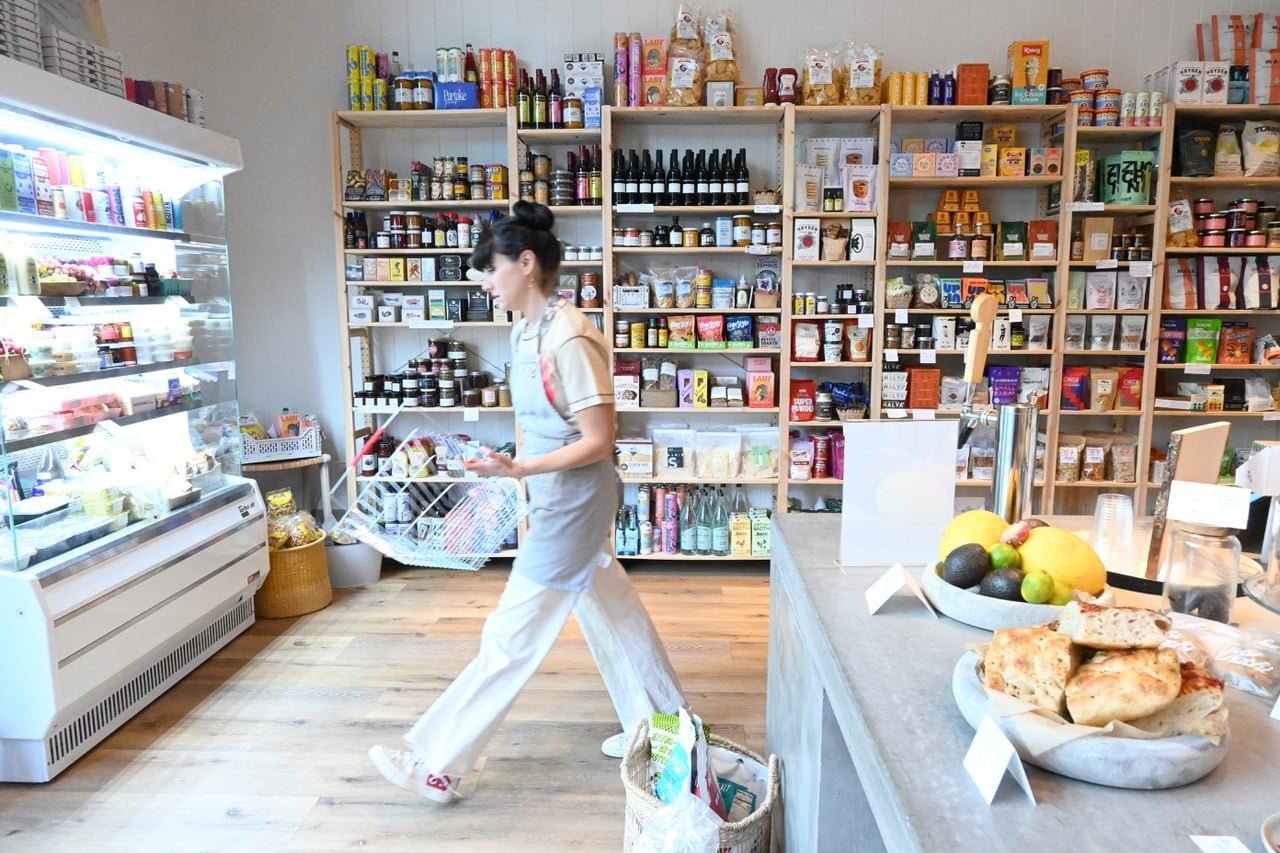
SAN DIEGO – For independent grocery store operators like Barons Market, connection to community is one of the key ingredients to successfully competing with the national chains.
According to Barons Senior Vice President Rachel Shemirani, the local grocer’s community outreach includes regular store tours that have attracted thousands of San Diego families and connected them to the hyperlocal, organic grocer her father founded in 1993.
That kind of neighbor-first approach is one hallmark of San Diego’s independent grocer scene. The business of running an independent grocery store is not easy, local leaders said, but it is important work.
Independent grocers are often family run and succeed because of their community ties, ability to adapt to trends and role as an incubator for small local businesses.
“The biggest difference is that [big box grocers] do not have the buying power, do not have the centralization and do not have the customer service,” Cardiff Seaside Market General Manager Austin Davis said when discussing what differentiates independent grocers from their corporate-led counterparts.
“From the business side, [independent grocers] don’t have the same adherence to a board of strangers that are working in a completely different state or sometimes in a completely different country,” he continued.
Leaders from Barons, Seaside, Windmill Farms, Always Hungry Grocery & Goods and SunCoast Market Co-op discussed the growing market for independent grocers in San Diego, foreseeing a promising future despite rising costs.
Consumer demand for clean, better-for-you (BFY) products is one driver that has allowed newer stores like Always Hungry and SunCoast to open and enabled local staples like Barons to expand.
“Independent grocery retailers are such a heartbeat in neighborhoods, especially as corporations keep getting bigger,” Shemirani said. “Independent retailers, especially in the grocery industry — there’s so many of us. In San Diego, there are so many good independent retailers that are not the big guys.”
Deep-Rooted Local Business Scene
Barons’ first location was established in Point Loma by Shemirani’s father Joe Shemirani and his brothers, who observed a market gap for affordable, organic food. In the 90s, organic products were regarded as a fad, Shemirani said.
“The way this industry has grown and changed has been unlike anything that we could have really even imagined,” Shemirani said.
Today Barons operates nine stores throughout Southern California, with a tenth location opening in Carlsbad Village this spring. The retailer carries about 9,000 products, Shemirani said, compared to the approximately 60,000 products carried at big box grocers like Vons or Albertsons and approximately 40,000 products carried at Whole Foods.
Shemirani said that Barons’ inventory is more on par with retailers like Costco or Trader Joe’s, which carry around 4,500 to 6,000 products, she said. An average Barons customer visits the store about three times a week.
“The reason why we carry that kind of limited amount is to create a 10-minute shopping experience,” Shemirani said. “The less choice a customer has, the more satisfied an experience they have. If you pull back and look at who in this industry is really doing the best, you’ve got Trader Joe’s and Costco — they’re the ones that are really killing it.”
Barons has a weekly food panel meeting where 50 to 60 individuals sample 80 to 120 items in order to hone the store’s selection and provide a fresh mix of products for consumers to browse.
Shemirani said that sourcing local products is a priority for the store, with much of its produce coming from farms within an 80- to 100-mile radius. Barons, among independent grocers, is on the larger side. This means that smaller local brands need to have developed infrastructure to be ready for placement in the store and distribute to its nine locations.
Founded in 1985 by brothers John and Pete Najjar, Seaside was a product of “blood, sweat and tears,” Davis said. The brothers grew up in Detroit, Michigan, where their family ran a small grocery store. Upon moving to San Diego, the pair worked at a grocer in El Cajon before deciding to take the jump and open Seaside in the neighborhood of Cardiff-by-the-Sea.
Today, the store serves at least 2,000 customers a day, Davis said, and is known, among many things, for its signature Burgundy Pepper Tri-Tip, dubbed “Cardiff Crack.”
Over the years, community involvement has been a top priority. Seaside donated new steps to make local beach walkways safer, sponsors many school events and hires neighborhood students in its store.
While on solid footing today, the store spent its first 15 years reinvesting into the company. In the last 15 years, Seaside expanded into the former neighboring Gold’s Gym. Part of the company’s success, Pete Najjar said, is its ability to adapt to community needs quickly and steadfastly.
“People ask us for an item, we find it for them,” Najjar said. “Products from back east, different sauces, different seasonings, we would go out of our way to get it. We go out of our way for all of our guests that come into the store… Everybody’s our neighbor when they walk in.”
Windmill Farms is a local independent grocer with deep history in the region. The stores lineage traces back to the 1930s, when Henry Boney borrowed a $600 from his in-laws to launch a fruit stand venture that would eventually turn into a network of local grocery stores.
National grocery chain Sprouts Farmers Market was founded in 2002 by Boney family members out of Gilbert, Arizona, and ownership and branding of the family’s stores evolved many times over the years.
Windmill Farms, initially established in 1975 by Steve Boney, was reestablished in its Del Cerro location in 2003 by Scott Boney, and today is run independently.
Grocery Buyer Rob Heinz, who has worked at the store for over two decades, said that the store’s community ties and expansive nutrition section make it a staple in the neighborhood.
“There’s a lot to say about the independent market having the idea for community wants compared to the corporate structure of data,” Heinz said.
Heinz mentioned that when Sprouts operated three independent stores, they were the chain’s busiest locations.

Incubating Other Small Businesses
Beloved San Diego-founded brands like Bitchin’ Sauce and Perfect Snacks may have originated at farmer’s markets, but they got their first shelf space at independent grocers.
Davis recalled that Seaside was one of the first grocers to carry the aforementioned brands, which are both nationally distributed products today.
Acting as an incubator for small local brands is more that a business move for stores like Seaside — it’s a calling.
“I’m willing to run it at a lower price and make less money off of it,” Davis said. “I’m willing to bring it in and just try it, even if I’m going to lose money on it, just to give them an opportunity to grow… It’s an opportunity to show something unique to our customers.”
The same sentiment is shared by Katie Jayne Sprenkle, founder of Always Hungry. Products sold in her independent, bodega-inspired market have ended up on the shelves of stores like Target and Erewhon.
Sprenkle initially launched Always Hungry as an online business offering discovery boxes featuring local products. In 2024, the store got the opportunity to host a pop-up at SpringHill Suites in Oceanside, while constructing its first location at 505 Oak Avenue.
When the Oak Avenue location opened, it was a shared space with Little Victory Wine Bar.
As both Little Victory and Always Hungry outgrew the shared space, Sprenkle invested in a new home for the market at 325 Carlsbad Village Drive. The $200,000 buildout began in 2025, funded primarily by an angel investor during an initial fundraising round.
The new location will be opening in phases starting this month. The store launched a second round of fundraising withing the last month to fund additional equipment purchases. Through the second round, Sprenkle hopes to find two or three solid investors that share the store’s hyperlocal values.
“People get upset, sometimes when they come in the store, [for instance if] I don’t have bananas,” Sprenkle said. “Until I find a banana farm in San Diego, it’s not happening.”
Uplifting local farmers and businesses is at the heart of Sprenkle’s mission, especially since she herself grew up on a farm.
“I do not ever nickel and dime with farmers,” she said. “Whatever they want, that’s what they get… I think it’s my upbringing — seeing my parents work so hard and struggle. I am trying to support all of these people, these dreamers, and get them on a shelf.”
Adapting to Market Trends
Local leaders agree that independent grocers have the upper hand when it comes to staying on trend. Smaller organizational structure and close community ties allow the stores to make inventory changes quickly and keep their fingers on the pulse of consumer behavior.
Overall, consumers have been shifting towards BFY products, making organic and local grocers more appealing.
“People will pay $14 for a loaf of bread because they know that that is the cleanest they are going to get, and it is worth that price tag,” Sprenkle said.
The organizational structure of independent grocers also allows for quick adaptation when the market takes unexpected turns. During the pandemic, when supply chains were in disarray, Davis said that Seaside was able to nimbly meet consumers’ needs.
“We didn’t have to wait for someone out of the state to tell us, ‘Hey, you have to wait for us to partner with someone that’s out of the country and wait for shipments to come over,’” Davis said. “We went down to where the cruise ships were coming in and said, ‘Hey, you guys aren’t able to take your product out anymore. Can we buy your product so we can sell to our customers?’”
During the pandemic, Seaside also collaborated with a local distillery to produce hand sanitizer and repackaged flour from companies that sold to baking businesses.
“You are very, very mobile when you are only responsible to yourself and your customers,” Davis said.
Navigating a Challenging, Changing Market
Ten years after its efforts began, SunCoast opened its co-op market in Imperial Beach on Jan. 31, bringing healthy food options to a market of about 100,000 people in South County. The 6,200 square foot space cost $4.1 million to open, funded through public agency and foundation grants with additional funding from a CDFI loan, community and philanthropic donations, sponsorships and owner equity raised through the $200 per owner share purchases.
“It was incredibly challenging to raise the funds needed and to do all of the planning and development work as a resident-led, volunteer effort,” SunCoast Board President Kim Rivero Frink said. “It took 10 years and an incredible amount of perseverance, time and work to get to the point of opening. Fortunately, there is a robust network of food co-op consultants, technical assistance and peer support.”
While rising costs make it difficult for independent grocers like SunCoast to open, Frink said that the demand is there.
SunCoast will create 25 new jobs and generate an annual economic impact of $6.5 million.
At the well-established Barons Market, Shemirani said that the store has experienced double-digit growth and will increase its employee count from 450 to 500 within the next year. Two years ago, the organization was also able to increase its employee benefit package.
Shemirani agreed that cost of goods is a major challenge for grocers.
“There’s a lot of chatter saying that cost of goods was coming down,” Shemirani said.
“We’re not seeing it.”
While stores may have to make tough decisions, Shemirani said that independent grocers always try to be fair and negotiate the best deals they can.
Shemirani and Davis both said that, to maintain a competitive edge, independent grocers’ best ammunition is their community orientation and grit.
“They’re going to be friendly,” Davis said, referring to big box competitors. “We’re going to be friendlier.”
Unwavering commitment to community and relentless perseverance define the businesspeople behind the region’s beloved and burgeoning independent grocers, leaders said.
“Independent retailers are the lifeblood of the grocery industry,” Shemirani said. “There are so many families that are doing what we do, have the same challenges, have the same passions, and I think right now, we are all looking for more community instead of less community.”

Born and raised in San Diego, Madison takes great pride in local storytelling. Her coverage at the San Diego Business Journal includes tourism, hospitality, nonprofits, education and retail. An alumna of San Diego State University’s journalism program, she has written for publications including The San Diego Union-Tribune and The San Diego Sun. At the 2024 San Diego Press Club awards, Madison was recognized for her exemplary profile writing. She was also a speaker for the 2023 TEDx Conference at Bonita Vista High School. When she’s not working on her next story, Madison can be found performing music at a local restaurant or on one of San Diego’s many hiking trails.



