
Last fall, a man who calls himself Chemical Analyst allowed the two of us – New York Times reporters writing about the illegal drug trade – to watch on a secure video call as he packaged ultrapotent synthetic drugs for distribution.
These chemicals now flood the modern drug market. Many have psychoactive effects that are much more intense than those of traditional drugs. One newly emerging drug, cychlorphine, can be 250 to 500 times as strong as heroin and 10 times as strong as fentanyl.
Chemical Analyst is a small-time, independent dealer who supplies powerful drugs without a cartel or gang for support. From an apartment in the northeastern United States, he places online orders for drugs made in a lab in China, repackages them and sells them domestically.
Operations like this represent the frontier of a drug market that is increasingly democratized. Compounds can be made in labs all over the world, ordered online and shipped anywhere. And because these drugs are often entirely new chemical compounds, they are difficult for law enforcement officials to detect.
We interviewed Chemical Analyst over the course of a year, after meeting him through others who use and sell these new, potent drugs.
He allowed The Times to observe his operation on the condition that his identity would remain confidential. He is a felon on probation who fears further prosecution. He is also a functional addict who regularly buys, sells and ingests some of the most potent drugs in the world.
The Times decided to describe parts of his process because they are vital to understanding both the origins of ultrapotent drugs and the difficulties faced by law enforcement in tracking and interdicting these new compounds.
In 2022 and 2023, Chemical Analyst was a street dealer of fentanyl and crack. His setup at an apartment “is so much safer,” he said. “I don’t have to worry about running if a cop rolls up through the alley,” he added. As his own use gravitated to more potent drugs, he developed the connections and expertise to sell them, too.
His latest drugs arrived in mid-October from China in a silver Mylar bag. He paid $4,370 in cryptocurrency for the shipment, which contained several powerful and potentially deadly synthetic compounds.
One bag held a 100-gram slab of MD-PiHP. The drug is a cathinone, a class of stimulants often sold as “bath salts” that can induce psychosis. In markets where these stimulants are particularly popular, like Miami, they are increasingly showing up in toxicology reports from people who suffer fatal overdoses.
On the secure video call, Chemical Analyst measured 100-milligram crystals of the drug into small bags. He sprayed the bags with bleach to remove his DNA, applied labels from an untraceable thermal printer and wore textured latex gloves to keep the bags clean of fingerprints. Because Chemical Analyst is a convicted felon, his prints are already in state databases.
He moved the drugs into smaller baggies and weighed them. He then sealed them into packages for shipment. He wrote a false return address so he could not be traced and drove far from his residence to drop them in the mail.
Chemical Analyst said that people might assume he sold on the “darknet,” a restricted network that requires special software to access. But he has a website on the regular internet, and he takes steps to conceal his whereabouts and identity. He accepts cryptocurrency payments, but he avoids Bitcoin because he worries that it might be trackable.
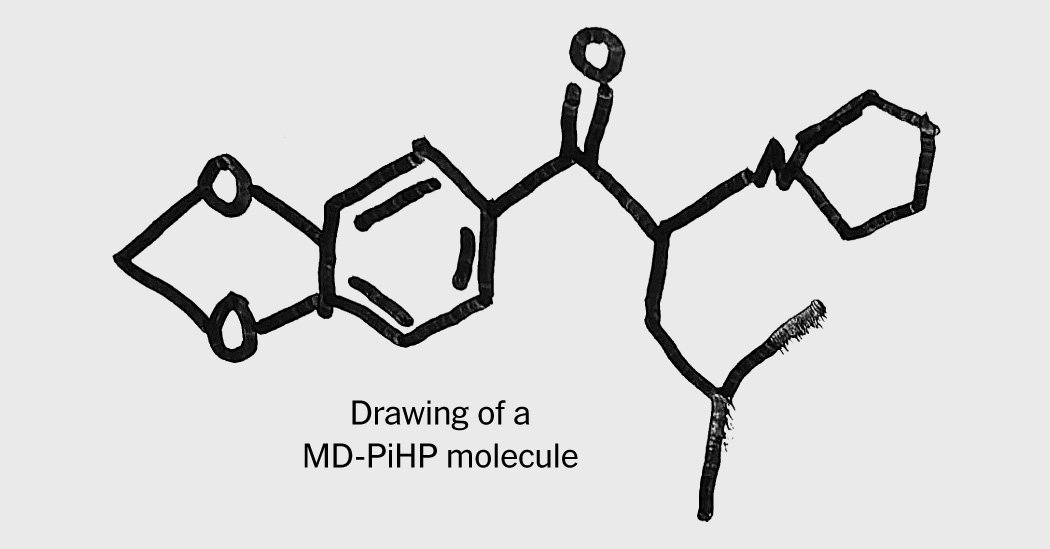
Drugs like this are hard to police in part because their composition changes all the time. The molecular structure of MD-PiHP is nearly identical to that of MDPV, a potent cathinone that appeared in 2010 and can cause extreme psychosis and death.
Chemical Analyst spoke in detail about the chemistry of these novel drugs. He offered to draw MD-PiHP to show important facets of its structure; shortly after the video call, he texted his illustration.
Chemical Analyst first spotted an online listing for the drug in early 2025. He is familiar enough with drug molecules that the structure alone made him want to try it. He was surprised by its potency and effects. “This is not something humans should be getting high on,” he said, adding an expletive.
He worried that the drug’s potency could produce a high so intense that it “could easily cause anhedonia,” an inability to experience joy when sober. He said that, unlike other suppliers, he did not adulterate his products, so they were predictable and therefore safer. “It’s how I pay the bills,” he said.
His operation also shows just how inexpensive illicit drugs have become in the age of synthetics. In his recent shipment from China, he ordered half a dozen different substances, paying between $6 and $28 for a pure gram, depending on the drug. A standard dose is 50 to 100 milligrams, meaning that the cost of getting high is often less than $1.
He keeps a collection of novel drug samples, as well as a separate stash for his own consumption.
Chemical Analyst plays another important role in the emergence of ultrapotent synthetic drugs. He is part of a small but influential circle of armchair chemists and theorists who discuss ideas for new drugs and scour medical literature for forgotten molecules.
He said that some members of these groups interacted with Chinese manufacturers to discuss new drug ideas. “They get ideas from us,” he said. “We have direct contact with them.”
A source at a Chinese drug manufacturer confirmed to The Times that new drug ideas were introduced first to small dealers and users like Chemical Analyst to test their popularity. If a drug catches on, it might be introduced to the mass market, which continues to rapidly transform.
Source: www.nytimes.com



