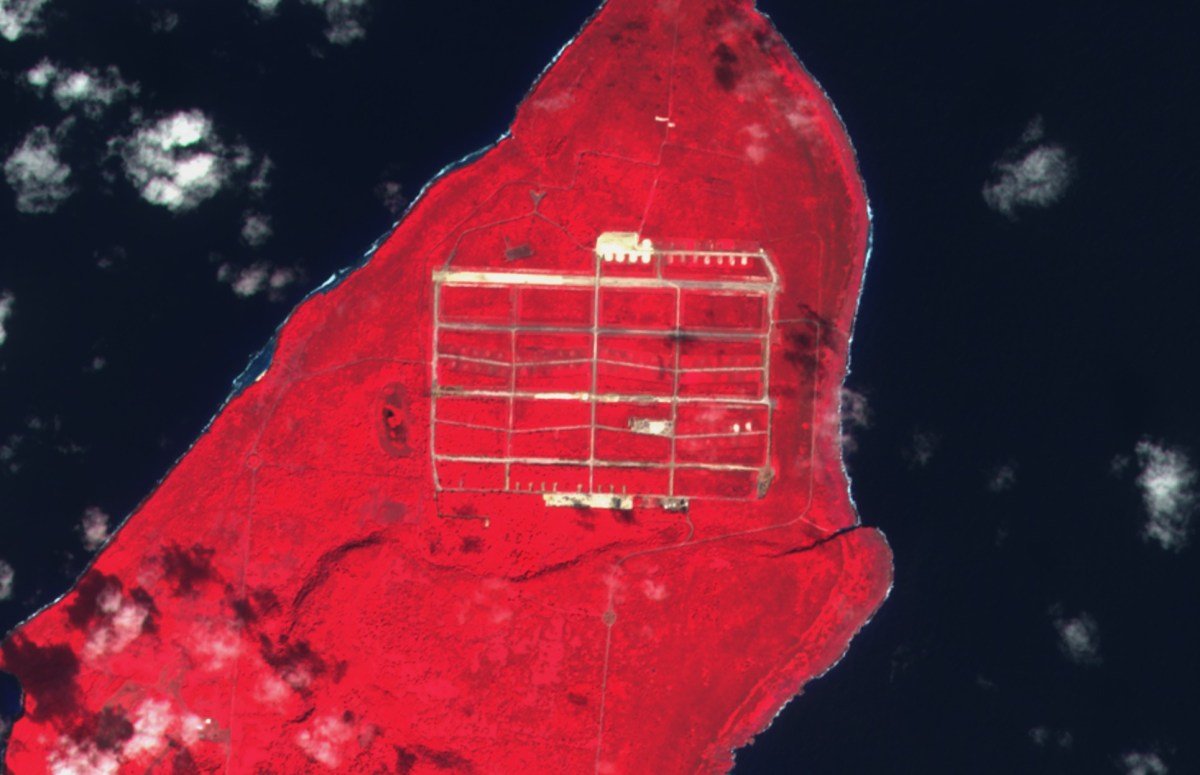
Across sleepy and remote islands in the Pacific, U.S. military engineers are working around the clock to revive strategically important airstrips that American troops first built under fire over 70 years ago during World War II.
The reconstruction effort is being led by a designated office within the U.S. Air Force, whose Agile Combat Employment, or ACE, doctrine has identified dozens of airfields that will be used to house and launch fighter jets, aerial refuelling tankers and weapons during a war with China. A trilateral force of the Navy, Marine Corps and Air Force is now converging with a single goal in mind: re-establish a presence on the airfields once used to deliver decisive combat power for the United States during the last great power war.
“I like to say we’re going back to the future,” Lt. Col Frank Blaz, a senior engineer and site lead for the Pacific Air Forces, said back in 2024. “As part of our Agile Combat Employment, we’ve taken a look at all of the historic airfields within the Pacific that helped us launch and execute successful campaigns. Building new is not the way to go. It’s expensive. Repairing and rehabilitating what exists is a much better economic solution.”
Newsweek’s investigation into U.S. planning has outlined new major hubs coming online under ACE as the military rivalry with China intensifies.
Why ACE Matters
The Air Force’s long-established central air corridor moves fighter aircraft into the West Pacific via large hubs in Hawaii, Guam and Japan’s Okinawa island. But in wartime, access to those hubs may no longer be guaranteed.
China’s long-range strike capability has grown at an unprecedented pace, threatening to overwhelm Guam and Okinawa’s limited missile defense systems and putting Hawaii at risk of strikes from China’s mainland. The Pentagon’s latest China military power report, released in December, revealed the Chinese Rocket Force’s growing ballistic missile inventory—the primary threat to U.S. airfields in the Pacific.
Increasing the number of hubs and spokes in the Indo-Pacific multiplies the Chinese military’s targets, requiring more decision making in where and when to strike and how many munitions to expend. It also allows U.S. forces to absorb missile strikes with more confidence by giving engineering crews time to repair damaged airfields while fighters and tankers rotate to another point to continue combat operations.
Long-standing Chinese plans envision opening strikes that cripple U.S. bases and cut off air support to America’s front lines. The U.S. is countering the strategy by “setting the theater” for conflict before it begins, by prepositioning wartime material that can be slung under fighters and bombers at short notice, and have runways and hardstands ready to accept inbound tankers and commandeered airliners, and additive manufacturing equipment ready to repair battle-damaged aircraft—all building deterrence that can prevent a future war, or fight one if deterrence fails.
The whole-of-military effort to prepare the Pacific theater across 12 time zones, dozens of countries, and millions of square miles all serves to prepare U.S. forces for what could be, Capt. Thomas H. Healy, commanding officer of Navy Reserve Center Great Lakes, said at a Pearl Harbor anniversary luncheon in December, reflecting on the impact of the attack on U.S. naval power during World War II.
Leaders of the Navy Reserve anticipate 50,000 call-ups within 30 days of a war with China over Taiwan. Command Master Chief Petty Officer Robert W. Lyons of the Navy Reserve Forces Command emphasized the need to avoid another Pearl Harbor-style attack, and said the revitalization of critical airfields across the Pacific would serve the role of avoiding one.
“Agile Combat Employment enables U.S. air power to operate from multiple, dispersed locations in a crisis or contingency situation. The strategy provides operational flexibility and makes our forces more resilient throughout the Indo-Pacific,” a Pacific Air Forces spokesperson told Newsweek.
To make ACE work, the U.S. is bringing World War II airfields back to operational status, opening the door for hundreds of aircraft and thousands of personnel to flow through the central air corridor in wartime. The U.S. preparations have drawn Beijing’s ire.
“Some people in the United States habitually exaggerate the so-called ‘China threat,'” a spokesperson for China’s Washington embassy told Newsweek. “Cold War thinking, bloc confrontation, and zero-sum games are unpopular and lead nowhere. China will firmly safeguard its sovereignty, security, and development interests, and earnestly maintain regional peace, stability, and prosperity.”
North Field: A New Air Power Hub
North Field, an abandoned airfield on Tinian Island in the Northern Marianas, will serve as one of the new hubs complementing Andersen Air Force Base in Guam, where Northwest Field has also been rebuilt for the Marine Corps. Both locations will serve alongside dozens of additional spoke airfields in the second island chain and wider Pacific region as major sources of combat power generation that once delivered war materials during last century’s fight against Japan.
At its height in World War II, North Field was home to over 230 B-29 Superfortress bombers across four active runways, operating as the largest airfield in the world at the time. Eighty years later, engineering units from the Navy, Air Force and Marine Corps are working to restore North Field’s runways, taxiways, and parking areas to its 1945-era specifications while modernizing the airfield’s facilities for state-of-the-art aircraft including large cargo planes, advanced fifth-generation jets and unmanned wingman fighters.
Design documents viewed by Newsweek showcase the broad scope of the full-scale reconstruction of North Field that began in 2021.
The revitalization is led by specialized Air Force units known as Rapid Engineer Deployable Heavy Operations Repair Squadron Engineers, or RED HORSE. The rapid response civil engineer units have rotated every six months for two years to uncover, clean and rebuild North Field. Guam-based counterparts of the U.S. Naval Construction Battalions, better known as the Seabees, have also been deployed to Tinian in recent months to build housing and warehouses.
Phase one of the project cleared and disposed of vegetation from the airfield’s north apron. Phase two cleared Able, Baker, Charlie and Dog runways, taxiways, and hardstands ahead of repaving. Phase three, currently in progress, will mill and repave the runways to achieve full operational capability.
“The revitalization of Tinian’s historic North Field is advancing on schedule. With jungle clearing now complete, runway milling operations are underway, paving the way for the next major phase: laying asphalt, which is set to begin in the first quarter of 2026,” the Pacific Air Forces spokesperson said.
The airfield is expected to come back online by 2027, when U.S. officials say the potential for Chinese military action against Taiwan is highest. Meanwhile, the Marine Corps also has its sights set on a joint training facility that will span the northern end of Tinian by the 2030s, incorporating 13 helicopter landing zones, two live-fire ranges, radar towers and an expeditionary base camp.
The North Field complex, when complete, will be the among the largest airfields in the Indo-Pacific, matching major U.S. air hubs in Hawaii, Guam and Japan, according to Air Force and Marine Corps documents reviewed by Newsweek. It could serve hundreds of tankers and fighters as well as unmanned fighter wings that can link up with aircraft launching from Andersen Air Force Base 115 miles to the south.
By 2027, the Air Force will have three major hubs serving as stepping stones into the West Pacific, all operating across the Northern Mariana Islands in the central air corridor. Accompanying them will be dozens of spoke airfields that will together restore the U.S.’s ability to island-hop across the Pacific Ocean.
“North Field is not planned to be a permanent U.S. base. It is being developed as a contingency and training location for rotational, expeditionary forces. While there are many benefits to [the Pacific Air Forces’] capabilities, operations, and exercises, protecting the United States Homeland is the most vital, and above all, the [Commonwealth of the Northern Mariana Islands] is a U.S. Territory.” — a spokesperson for the Pacific Air Forces.
Central Air Corridor
Expansion projects underway on several islands across the Pacific have the explicit goal of establishing additional spokes for the second island chain hubs in Guam and Tinian. The Air Force plans to return the islands to their World War II-era function, serving as the depth and breadth of a key network of airfields delivering warfighting supplies to troops engaged in the Pacific War.
Newsweek‘s investigation compiles ongoing and future efforts to expand U.S. capabilities in the region as tensions with China continue to rise.
Northwest Field, 5 miles from Andersen Air Force Base—the Pacific Air Forces’ main air hub—has been rebuilt with two 8,000-foot runways capable of operating strategic airlift aircraft and Marine Corps tactical aircraft. Since 2024, construction efforts at the airfield have cleared and repaved taxiways and open-air parking areas for dozens of aircraft, including 27 keyholes for large support planes. Additional hardened bunkers between Northwest Field and Andersen Air Force Base, used to store munitions, have also been constructed since 2024. A large part of the reconstruction supports the ongoing relocation of Marine Corps units from Okinawa. Last summer, Northwest Field was used as a staging point for aircraft participating in Resolute Force Pacific 2025, an Air Force-wide exercise simulating a war with China.

Tinian International Airport, a few miles south of North Field, is expanding to operate as a diversionary airfield if Andersen Air Force Base, North Field, or Northwest Field are damaged in missile strikes. Contractors are modifying the flight line for aircraft parking, adding new underground fuel storage and distribution systems that can pull fuel directly from a ship in port, and constructing maintenance hangars for KC-135 tanker aircraft. The project’s first phase of establishing parking for U.S. aircraft is already complete. The second phase is in progress with completion slated for 2027.
Yap International Airport, on Yap Island in Micronesia, is slated to receive upgrades to its runway, parking areas, taxiways and ports to support U.S. military operations in wartime. The expansion will provide new parking areas for U.S. aircraft that use the airport as a hot refueling point and divert airfield. The Pentagon announced its intention to prepare an environmental impact statement for the project in August.
Peleliu Airstrip, in Palau, is a historic World War II airfield seized by the Marines in 1944 during the Battle of Peleliu. The airfield is being refurbished and permanent housing for Marine units is also being explored. Additionally, the Marine Corps is considering a prepositioning site in Palau to support its Force Design 2030 effort, mirroring its growing presence in the Philippines. Other Palau-based work includes construction of the Tactical Mobile Over-the-Horizon Radar that will be used to supplement existing sensors designed to detect Chinese ballistic missiles approaching the second island chain.
Mactan-Benito Ebuen Air Base, Clark Air Base, Subic Bay International Airport and Basa Air Base, in the Philippines, are all being expanded to accommodate additional aircraft and associated logistics to operate tankers and fighters in the first island chain. The Air Force Sustainment Center’s Global Enterprise Network for Universal Sustainment, or GENUS, program identified the four Philippine airfields as candidates for sustainment and logistics units that would be deployed across the Pacific during a war with China to return battle-damaged aircraft back to a combat-ready state. GENUS is also in negotiation with the governments of India, Singapore and Japan to establish additional repair spokes.
Wake Island Airfield, a stopover for tactical aircraft, was used as an advanced base by Marines in December when they deployed an air defense radar and communications equipment to the island in a test of deployment capabilities. It also played a heavy role in Resolute Force Pacific 2025 as a stopover point for fighters queued into arrival at Andersen Air Force Base. In November, the island hosted Army forces testing rapid insertion of HIMARS launchers. Wake Island has also been surveyed for Palmetto Challenge 2026, an upcoming large force employment exercise from Joint Base Charleston that will feature eight C-17 military transport aircraft deploying simultaneously for wartime contingency training.
Republican Sen. Roger Wicker of Mississippi, chair of the Senate Armed Services Committee, visited multiple sites in August as part of an Indo-Pacific tour of military construction projects and official visits to Guam, Tinian, Palau, the Philippines and Taiwan.
“We live in the most dangerous national security moment since World War II,” Wicker said in a statement on his trip. “Congress plays a vitally important role in reassuring U.S. allies and partners of our commitment to maintaining a favorable regional order in the Indo-Pacific.”


“The Asia-Pacific region is a haven for peace and development, not a chessboard for geopolitical games. China has consistently maintained that defense and security cooperation between countries must not target or harm the interests of any third party. Showing off military might and inciting confrontation are detrimental to regional peace and stability.” — spokesperson for the Chinese Embassy in Washington, D.C.
Alaska: Northern Air Corridor
Work is underway at several northern corridor airfields in Alaska to prepare them for operational use as ACE bases.
Joint Base Elmendorf-Richardson, a major Pacific Air Forces hub, is expanding its second runway from 2,900 feet to 10,000 feet, allowing it to accommodate any operational aircraft regardless of weather conditions. The $309 million project will also build out the parallel taxiways and add an arm and disarm pad to the base.
Eielson Air Force Base, the Pacific Air Force’ critical mission profile base in Alaska, wrapped up a $600 million F-35 expansion in 2024, enabling operations for 54 fifth-generation fighters that serve in a rapid response role. The base now serves as a premier air power generation hub for tactical aircraft that would stream into the Pacific in wartime scenarios
King Salmon Airport, used as a divert airfield for Pacific-bound flights from Alaska, began a master plan review last May under the advisement of Alaska’s Department of Transportation and Public Facilities. It began operations in 1943 as a World War II satellite field for the then-Army Air Forces. Construction to rehabilitate the airport’s taxiways, aprons and lighting is planned for 2028. The airport’s main runway is also scheduled for resurfacing in 2028 to facilitate its role as a divert airfield and ACE site into the 2030s. Both the U.S. and Japanese air forces have deployed F-22, F-16, C-17 and C-130 aircraft to King Salmon Airport.

Cold Bay Airport, in the central Aleutian Islands, operates with 10,179-foot and 4,900-foot runways. Historically, it served as an Army Air Forces base during World War II and now operates as a civilian airport and divert airfield for commercial flights crossing the Pacific. Cold Bay hosted Marine F-35B jets last August during Exercise Arctic Edge 2025, serving as a refueling point and regional hub for Marine forces.
Eareckson Air Station, in the far reaches of the Aleutian Islands, officially closed as an air base in 1994 after 51 years of operations, having begun as a World War II airfield. Joint Base Elmendorf-Richardson maintains the facilities at Eareckson as an ACE base and divert airfield for transpacific military flights. Air Force engineers visited the island in 2024 to evaluate the airfield’s existing pavement as part of a routine inspection. Eareckson completes the northern air corridor.
Naval Air Facility Atsugi and Yokota Air Base, in Japan, will receive the transports and fighters flowing through Alaska’s various airfields, and expansions are underway at both to store prepositioned wartime material. Expansions at Atsugi will provide support to carrier air wings flying into theater, and expansions at Yokota have been delivered incrementally for over five years as the U.S. readies the base for a future fight against China. Both expansion efforts are being led by RED HORSE and Seabee units.

Australia: Southern Air Corridor
In a conflict between the United States and China over Taiwan, Australia will play an indispensable role as a large hub for combat aircraft flowing into the first island chain. It already hosts a detachment of Marine Corps aviation and ground units as a rotating forward-deployed rapid response force, and is currently participating in advanced U.S. missile programs as a key partner, including for hypersonic weapon flight tests. Australia also hosts Talisman Sabre, a multinational exercise that frequently tests U.S. training and technology dedicated to the Pacific theater.
Aircraft flying to Australia from the contiguous United States will have the option to stop over in Honolulu before continuing west to Kwajalein Atoll, a series of islands in the Marshall Islands used for U.S. missile testing. Kwajalein has been used as a refueling point during Marine and Army exercises and can facilitate additional follow-on forces after units deploy logistical elements there. In 2023, Kwajalein supported the longest-ever MV-22B flight from Honolulu to Subic Bay as part of the annual Balikatan exercise with the Philippines.
U.S. units could also opt to stop in American Samoa before continuing on to Australia. Pago Pago International Airport was also among the airfields surveyed for Joint Base Charleston’s Palmetto Challenge 2026, which is scheduled to begin this month.
In a conflict, U.S. aircraft can reach Australia from one of dozens of airfields in the central air corridor and continue on for forward basing in the Philippines, Southeast Asia or the Indian Ocean.
“The difference between survival and catastrophe often hinges on the quiet, unglamorous work of preparation.” — Capt. Thomas H. Healy, Navy Reserve Center Great Lakes commanding officer.