
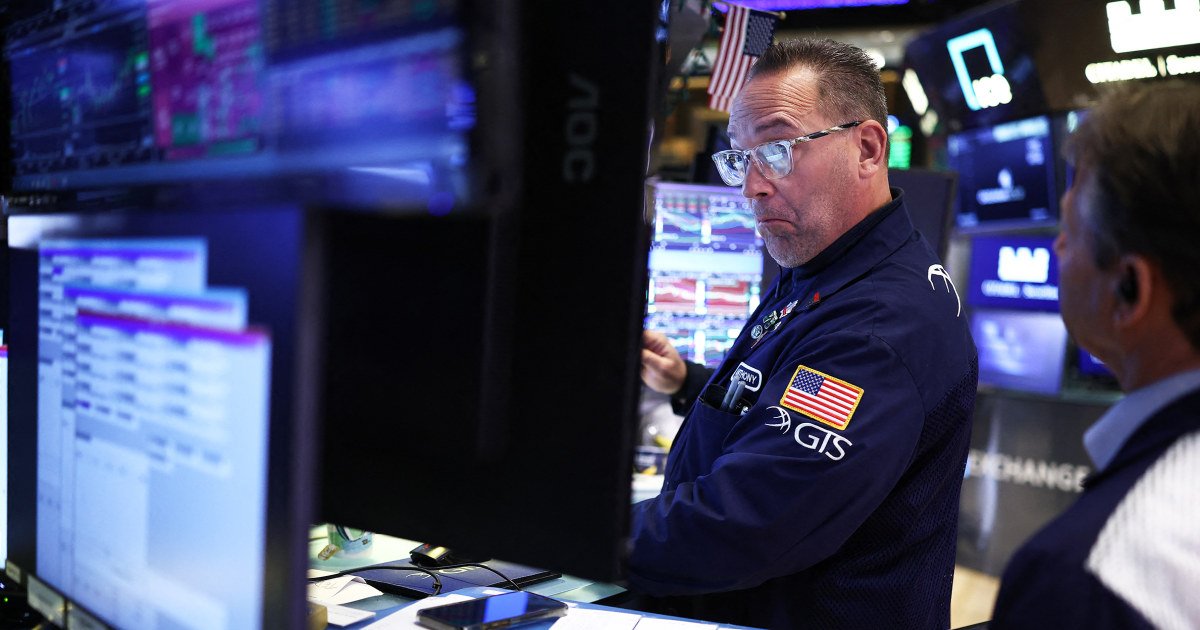
Stocks roared higher at the opening bell Wednesday, after President Donald Trump announced a two-week ceasefire between the United States and Iran, bringing a pause to the war that started more than a month ago.
Subscribe to read this story ad-free
Get unlimited access to ad-free articles and exclusive content.
Official statements from Washington and Tehran, however, did not offer a clear picture of what the future of shipping traffic in the Strait of Hormuz would look like. Before the U.S. and Israel attacked Iran, more than 20% of the world’s oil supply, plus other energy products, transited the waterway off Iran’s southern coast every day on their way to global markets.
Despite the unanswered questions, markets had an overwhelmingly positive response to the news.
The S&P 500 surged 2.5% when the opening bell rang in New York at 9:30 a.m. ET. The Nasdaq Composite soared 3.1%, the Dow spiked 1,400 points and the Russell 2000 rose 3.4%.
Strategists on JPMorgan Chase’s trading desk said that it “feels likely” that the S&P 500 could rise even further “as euphoria returns to markets.”
“Assuming that this is not a feint from any of the parties, the market is likely to treat this as a de facto end of the conflict despite the economic damage that is still coming across all regions,” they wrote.
Other experts cautioned that the market could be getting ahead of itself.
“We are not out of the woods yet,” Krishna Guha, Evercore vice chairman and head of economics, wrote in a memo Wednesday morning. “The ceasefire could fall apart. There will still be an initial inflation shock.”
U.S. crude oil prices plunged 18% in morning trading Wednesday to around $92 per barrel. International Brent crude oil also tumbled 16% to around $90. If the move in U.S. crude oil holds through the afternoon, it would mark its biggest one-day percentage drop since 2020.
“Further price direction will hinge on whether talks translate into a durable agreement and a sustained normalisation of flows through the strait, with volatility likely to persist during negotiations later this week,” ING analysts wrote Wednesday morning.

But while oil prices may be falling, gas prices will take longer to reflect the moves. In some regions of the U.S., “these big drops today don’t get locked in until this evening,” GasBuddy analyst Patrick De Haan wrote on X.
Still, he said, the falling prices in energy futures are “good news for drivers.” He predicted that “prices may begin to ease” in the next 36 hours, and the cost of a gallon of gas could fall 1 to 3 cents per day by the weekend.
Since the war started, unleaded gas prices have risen more than $1.20 per gallon, from $2.94 to $4.16 as of Wednesday morning, according to GasBuddy data.
Jet fuel prices have also been soaring. Since the U.S. and Israel launched strikes on Iran on Feb. 28, the costs have nearly doubled, according to data from industry monitor Argus.
Delta Air Lines said Wednesday that it expected to spend an additional $2 billion more on jet fuel in the current quarter than it had previously planned. It also said it would cut its growth plans to stem rising costs.
ExxonMobil also said Wednesday that about 6% of its global output had been lost as a result of the war. It said two liquefied natural gas facilities in which the company holds an interest were impacted by “attacks.”
“Public reports indicate the damage will take a prolonged period to repair,” Exxon said in a statement. “Pending an on-site evaluation, we are unable to comment on the length of time before the two trains return to normal operations.” A train is a processing unit for liquefied natural gas.
Meanwhile, U.S. Treasury yields of all maturities traded steeply lower on the news of a short-term ceasefire. The 10-year yield, which influences consumer mortgage rates, dropped sharply to 4.23%. Just weeks ago, it was trading at nearly 4.4%.
Stocks around the world also rallied. Japan’s Nikkei 225 soared more than 5%, Korea’s Kospi index surged 7% and the Hang Seng index in Hong Kong was up 3%.
Europe’s Stoxx 600 surged 4.5%. Flagship indexes in France, Italy and the United Kingdom jumped more than 3%. Germany’s DAX stock index jumped more than 5%.



