
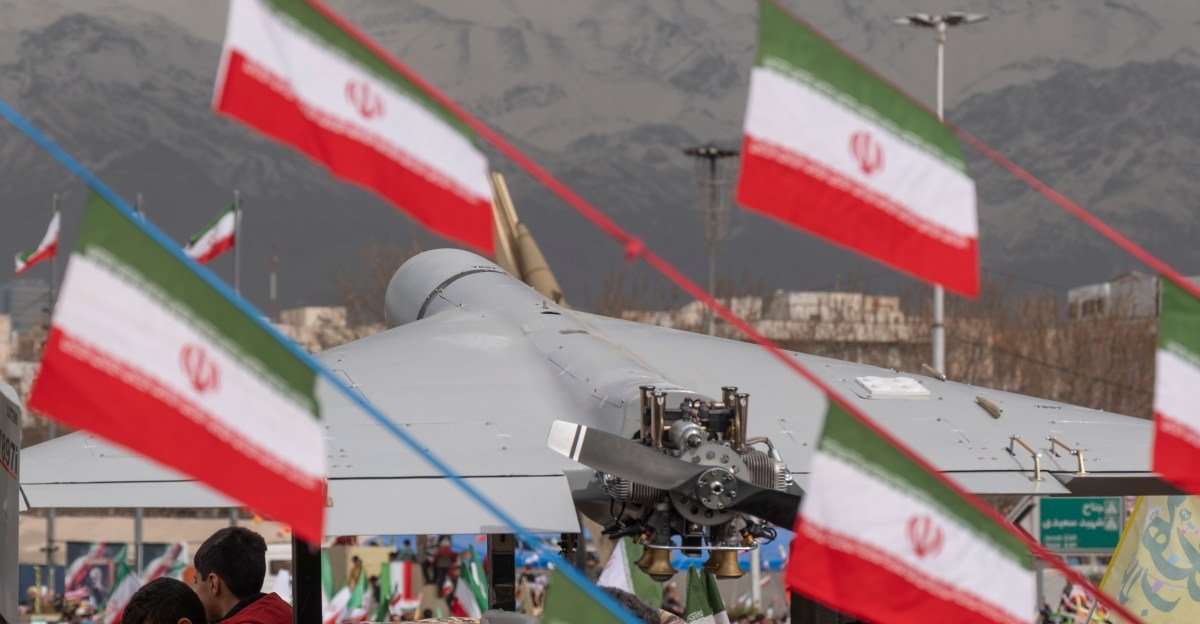
After more than three weeks of war in Iran, the US has destroyed major components of Iran’s military, including ballistic missile sites and much of the country’s navy.
One advantage Iran retains, though, is the Shahed-136. The Shahed, a one-way, single-use attack drone, is small, inexpensive, and highly accurate. Iranian drone attacks have led to the death of six US service members, damaged oil and natural gas facilities in the United Arab Emirates, Qatar, and Saudi Arabia, and are quickly depleting America’s interceptor stockpiles.
Michael C. Horowitz is a senior fellow for technology and innovation at the Council on Foreign Relations and a professor at the University of Pennsylvania. He says these drones have ushered in a new era of warfare: “The way that I would think about this is just like the introduction of the machine gun at scale in World War I,” he told Today, Explained co-host Noel King.
Noel talks with Horowitz about what the drones can do, how the US can counter them, and what they mean for the future of warfare.
Below is an excerpt of their conversation, edited for length and clarity. There’s much more in the full podcast, so listen to Today, Explained wherever you get podcasts, including Apple Podcasts, Pandora, and Spotify.
The US has done damage to Iran’s missile sites and military bases. But Iran still has cheap, easy-to-assemble drones that pose a real threat on the battlefield. Michael Horowitz, senior fellow at the Council on Foreign Relations, tell us about them drones!
These one-way attack drones, like the Shahed-136, are used essentially as a substitute for a cruise missile. Iran is using them to do things like target American air defense radars, which are necessary to find other drones and shoot them down. Iran is using them to target government buildings like embassies. Iran is using them to target critical infrastructure that countries in the Middle East use for oil and gas.
The thing that somebody like me worries about is that American aircraft carriers in general are extremely well protected. A drone in and of itself would never take out an American aircraft carrier. They’re just too small. But a lot of them could. And the real risk here is that suppose you fired not one, not a hundred, but 500 at an American aircraft carrier at once. Even if the US could shoot down 450 of them, that’s still a lot that are getting through it.
The scale of these one-way attack drones that you can launch generates the potential ability to not just target the kinds of infrastructure and things that we’re seeing Iran doing, but really important military targets as well, including our ships.
Iran presumably does not have an infinite number of these drones. How many do they actually have on hand?
We don’t actually know exactly how many Iran has on hand, but we know that they have thousands. We also know, for example, that Russia has the ability to produce a thousand or more every couple of weeks of their knockoff of the Shahed-136.
Iran likely has the ability to do something in that range as well. The US and Israel are obviously targeting their manufacturing capabilities, but Iran has a lot of manufacturing that’s more underground, and because you can use commercial manufacturing to build these systems, you can do that almost anywhere.
That’s one of the reasons why I have been very vocal that the United States needs to invest more in these capabilities. And why I was thrilled, frankly, in the context of this conflict, regardless of what one thinks of the conflict itself, to see the US use its first precise mass system, the LUCAS drone, against Iran.
The American military arsenal is based on quality over quantity. It’s based on having small numbers of exquisite, expensive, hard-to-produce systems that are the best in the world, but they were designed to be essentially bespoke products. They were not designed for mass production. The issue is that that’s not enough anymore.
In a world that required having those expensive, exquisite systems to do things like accurately fire weapons at your adversaries, then that was a unique advantage for the United States military. But because everybody — both smaller states and militant groups — can launch more accurate precision strikes at lots of different targets, it means that just having those kinds of systems is not enough for the United States.
If Iran is firing a $35,000 Shahed-136 at the United States, and the United States is shooting it down with a weapon that costs anywhere between $1 million per shot and $4 million per shot, you do not need to be a defense planner to understand that that cost curve is in the wrong direction.
How did Iran get so well-armed?
Necessity is the mother of invention. A country like Iran has felt intense security threats in the region. In part that’s because of Iran’s own ideology: If you’re going to roll around chanting “death to America,” then you need to be prepared for the United States and the region to have some questions.
Iran fought a war against Iraq in the 1980s. Iran has been in continual tussles with various neighbors over the years. And so Iran built up a pretty extensive military arsenal. Not anywhere near as good as the United States or Israel, but Iran, in some ways because they had to, was a pioneer in developing these low-cost, long-range precise mass weapons that they then shared with Russia. And Russia’s used hundreds of thousands against the Ukrainians.
Is there a way for the US to defend against these Iranian drones without spending so much money?
The US has options. It’s just going to take some time to get there.
Another country where necessity has been the mother of invention has been Ukraine, facing down the Russian invaders now for four years. And because Ukraine is the victim of dozens to hundreds of launches of these Shaheds almost every day, Ukraine has pioneered lower-cost air defense systems using even less expensive drones, for example, to take out those $35,000 drones, or even in some cases using old World War II-style anti-aircraft guns.
If a fairly cheap unmanned drone can overwhelm a billion-dollar aircraft carrier, does the US need to start rethinking the way it fights wars?
One hundred percent. The plan to rely only on these exquisite, expensive, hard-to-produce weapons is no longer going to be enough for the United States. That would especially be true in a war against the most sophisticated potential adversaries the United States could face like China or Russia.
What the United States needs to pursue is what’s called a high/low mix of forces. Some of those high-end systems like Tomahawk missiles and F-35s, things that the United States has worked on for a generation, but then also a new wave of these lower-cost systems that need to be treated not as the kind of thing you might hold onto for 50 years, but as cheaper, more disposable, and upgraded on a regular basis.
What do you think war looks like a generation from now?
The character of warfare is always in flux. The way that I would think about this is just like the introduction of the machine gun at scale in World War I. It fundamentally changed the character of warfare.
The machine gun then just became a ubiquitous weapon. Everybody had machine guns. And then in World War II it was the tank. And everywhere since then, there have been tanks.
What we are now seeing between the Russia-Ukraine War and this war with Iran is these one-way attack drones. It’s not that they’re the only things that militaries need, but these are now going to be part of the arsenal moving forward. And if you don’t have them, and if you can’t defend against them, you’re going to be in trouble.



