
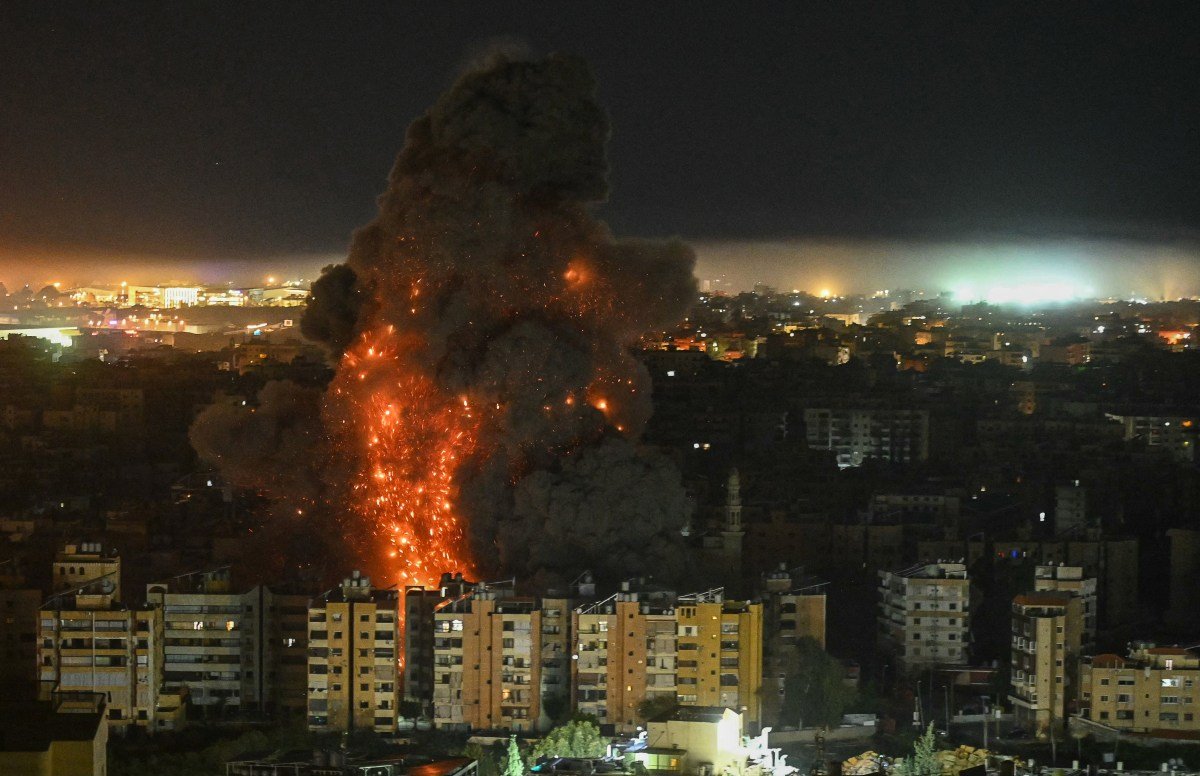
Within hours of the U.S. and Israel bombing Tehran in early March, Iranian missiles began flying in all directions, striking U.S. bases in Kuwait, Oman, Qatar, Saudi Arabia, Turkey and elsewhere.
Was that the threshold—the moment a conflict shifted from regional to global? Or are we still edging toward some undefined tipping point when everyone agrees that this is a world war?
Experts disagree sharply. Some say no, not even close. Others argue we are already there. As the Iran conflict deepens alongside NATO’s involvement in Ukraine, China’s threats toward Taiwan and Russia’s expanding posture across multiple regions, many believe the conditions for a broader global conflict are already in place.
Michael O’Hanlon, who has spent decades studying defense policy at the Brookings Institution, told Newsweek that this is not a world war.
“It is not a world war. It is a regional war with one additional outside actor and worldwide consequences. That is different,” O’Hanlon said.
His point is simple: Right now, the U.S. is fighting Iran directly. Russia is fighting Ukraine but only indirectly supports Iran. China is watching but not supplying weapons. The conflicts are separate. The combatants do not overlap. The strategy is not shared.
That distinction is what matters, O’Hanlon argues. A regional war with global spillover is not the same as a world war.
Paul Poast, an associate professor at the University of Chicago who researches international relations, sees it differently. Looking at the web of indirect fighting across two continents, he offers a more troubling assessment.
“The U.S., China and Russia will be engaged in indirect fighting in two theaters on two continents, Ukraine and Iran. I know people don’t like using the phrase ‘world war,’ but that is awfully close to any definition I would use,” Poast said in an analysis published by the university on March 12.
The Pearl Harbor Test
Retired United States Marine Corps Colonel Mark Cancian turns to history for a clearer benchmark. In 1941, Japan attacked Pearl Harbor. Suddenly, the countries fighting Germany in Europe were also fighting Japan in the Pacific. The conflicts merged. The same actors fought in both theaters. The grand strategy unified across oceans.
“Looking back on World War II, I think there was agreement at the time that it became a global war, not just a European war, when Japan attacked the United States and European colonies in the Pacific,” Cancian, now a senior adviser in the Defense and Security Department at the Center for Strategic and International Studies, told Newsweek.
“Germany and Japan had only a weak alliance, but the Allied countries fighting in Europe were, for the most part, the same ones fighting in the Pacific. For us, then, it was a global war,” he added.

Today looks different. The U.S. is fighting Iran directly, but Russia is not—it is watching. China is not fighting Iran either. There is no formal alliance connecting Ukraine and Iran. There is no shared plan.
“There is a weak alliance between Russia, Iran, and China,” Cancian said. “In the western Pacific, relations are sometimes tense, but it’s not a shooting war. The United States and Iran are not directly involved in the Ukraine war. For this reason, I don’t see this as a global war.”
Yet Poast raises a darker question: What happens if Russia starts sending weapons to Iran instead of just intelligence? What if China supplies components while simultaneously threatening Taiwan? At what point does a web of indirect involvement become indistinguishable from a world war?
What Is a World War?
For Cancian, following the World War II benchmark, the trigger comes when the same major powers fight in multiple theaters—when conflicts merge, and when the countries fighting in one war are the same ones fighting in another. At that point, there is no longer a distinction between separate wars but a single, unified global conflict.
This definition echoes what Kristian Gleditsch, the regius professor of political science at the University of Essex in England, argued in Newsweek‘s December 2024 analysis on the question. A world war requires “very severe warfare [and] some kind of connection among different armed conflicts around the world that warrant seeing them as part of a larger overarching conflict—for example, involvement of the same actors or close alliances.”
Gleditsch’s framework for what is not a world war requires three conditions: geographic separation, no coordination between combatants and the absence of direct great-power conflict. Today, those conditions largely hold. Ukraine and Iran remain separate wars. Russia and Iran are not coordinating strategy in a unified campaign. The U.S. is not fighting China or Russia directly.

By most expert definitions, the fighting in Iran is not a world war. It is a regional war with global consequences. But the risk of these separate theaters merging into a single worldwide conflict remains.
In a nightmare scenario, Russia escalates weapons transfers to Iran. China supplies components while threatening Taiwan. The U.S. finds itself engaged in indirect wars across multiple regions simultaneously. That is when the definition changes—when a world war begins.
How long the window remains open to keep these conflicts separate depends on decisions being made now in Washington, Moscow, Beijing and Tehran. None of those capitals appears to be treating this as an urgent containment problem.
In a polarized era, the center is dismissed as bland. At Newsweek, ours is different: The Courageous Center—it’s not “both sides,” it’s sharp, challenging and alive with ideas. We follow facts, not factions. If that sounds like the kind of journalism you want to see thrive, we need you.
When you become a Newsweek Member, you support a mission to keep the center strong and vibrant. Members enjoy: Ad-free browsing, exclusive content and editor conversations. Help keep the center courageous. Join today.




