
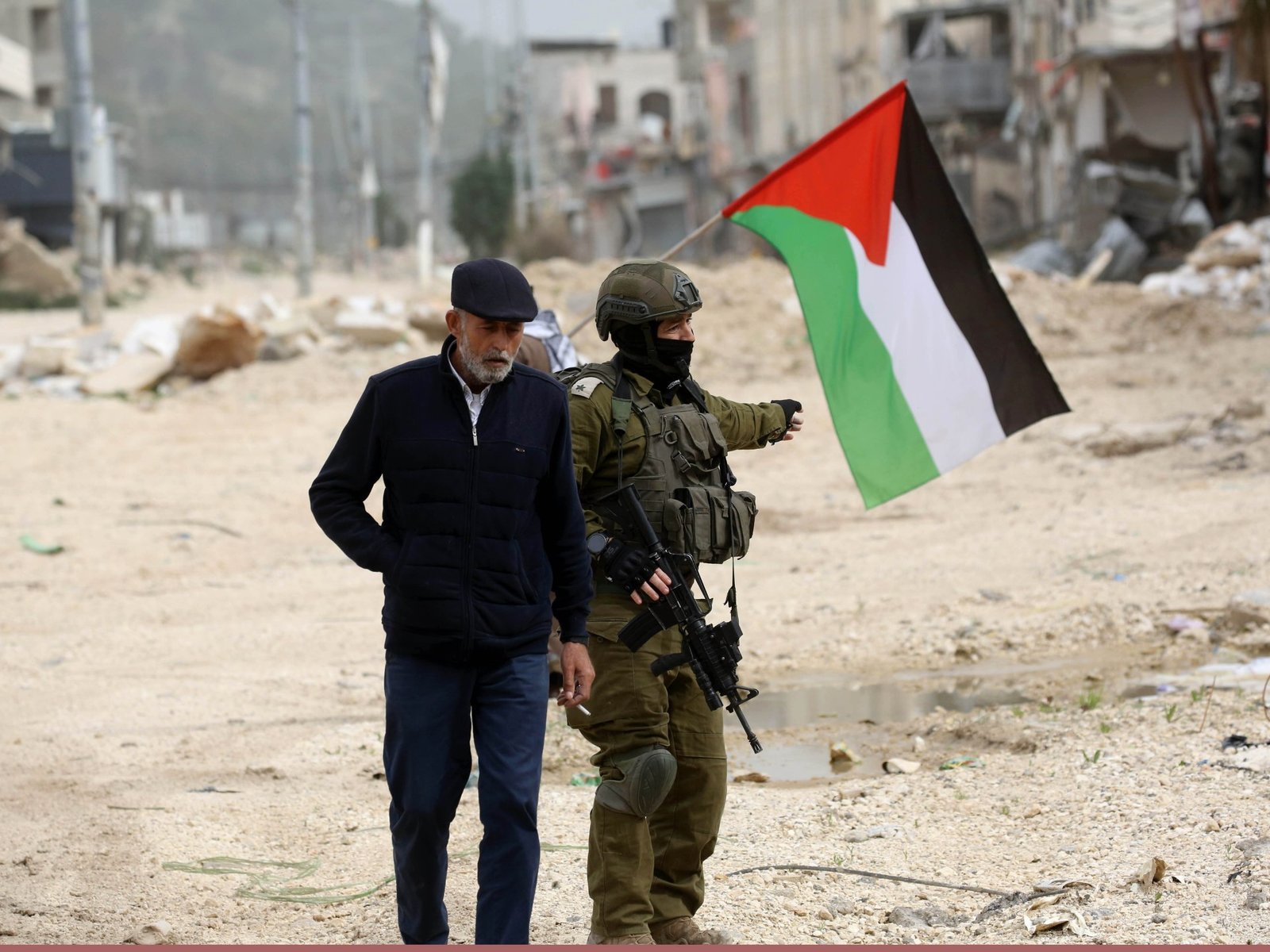
The Israeli government has approved a plan to begin land registration in the occupied West Bank, meaning it will be able to seize land from Palestinians who cannot prove ownership.
For the first time since Israel’s occupation of the West Bank in 1967, it will register such land as property of the state – also known as settlement of land title – in Area C of the occupied West Bank.
Recommended Stories
list of 3 itemsend of list
Area C is the part of the West Bank that remains under direct Israeli control. It covers about 60 percent of the West Bank.
According to Israeli media, Israeli Minister of Finance Bezalel Smotrich, who submitted the proposal to restart land registration with Minister of Justice Yariv Levin and Minister of Defence Israel Katz, said the move was a continuation of “the settlement revolution to control all our lands”.
The Palestinian Authority presidency said the decision amounts to “de facto annexation” of the West Bank. It is the formalisation of the ongoing process of building settlements in the West Bank in violation of international law over the past several decades.
Here’s what we know about how this could be implemented:
What does the land registration process mean?
During Jordanian control of the West Bank from 1949 to 1967, the administration primarily followed the British Mandate of land ownership, under which land was registered as state or private property.
But only about one-third of the land in the West Bank was formally registered under this process. Large numbers of Palestinians living in the region had no documentation or other means of proving they owned their own land. Many of them had also lost documents or they had been destroyed during the 1967 six-day Arab-Israeli war, which resulted in the Israeli occupation of the West Bank.
When Israel took control of the West Bank, it discontinued the process of land registration.
Now, the government has decided to restart the land registration, a move that many Israeli human rights groups and political analysts have condemned.
Xavier Abu Eid, a political analyst based in the West Bank, described the Israeli government’s move as a “de facto annexation of Palestinian territory”.
“What they are doing is the implementation of annexation, packaging it as a mere bureaucratic process,” he told Al Jazeera.
He added that it reaffirms the idea that “there is a colonial power that sets two different sets of legislation depending on ethnic and religious identity, defined also as apartheid.”
Where will land registration be implemented?
In 1993 and 1995, the Oslo Accords were signed between Israel and the Palestine Liberation Organization. They laid out administrative control of the West Bank and Gaza and divided the occupied West Bank into three areas – Area A, Area B and Area C.
The new Palestinian Authority (PA) was granted full administrative control of 18 percent of the land – Area A – and joint control with Israel over 22 percent – Area B. Area C remained under complete Israeli military control. These areas were meant to be in place for five years, after which full administrative control would be handed to the PA. However, this transfer never took place.
The land registration that will now be restarted will apply to Area C, which is home to more than 300,000 Palestinian people.
According to the Israeli anti-settlement group Peace Now, in Area C, about 58 percent of the land remains unregistered. In a statement on Sunday, the group warned that the Israeli government’s land settlement process will now facilitate full Israeli control of this unregistered land.
How will land registration work?
Israeli authorities have provided few details about how the process will unfold, but essentially, it will likely involve transferring legal ownership of land to the Israeli state and issuing evictions to Palestinian communities, as has been happening in East Jerusalem in recent years, experts told Al Jazeera.
Michal Braier, an architect and the head of research at Bimkom, an Israeli human rights organisation that focuses on land and housing rights, said it is likely Israeli authorities will take the same approach in the West Bank as they have taken in East Jerusalem since 2018. In East Jerusalem, only 1 percent of settled land has been registered to Palestinians from 2018 to 2024, according to Bimkom.
Braier said Israel will begin by selecting the areas of land it wants to register. The government has set a goal of registering about 15 percent of the unregistered land within the next four years, she added.
“Now we can pretty clearly guess that this 15 percent will be lands where they assume that they can prove the state ownership easily or they can easily reject Palestinian ownership claims because a lot of these unregistered lands don’t have clear records and the records go a very, very long time back. So it will be very hard to prove Palestinian ownership,” she told Al Jazeera.
In theory, she said, Palestinians will be able to file land claims as part of the new process, but in practice, it is likely that they will be prevented from successfully doing so.
“Even if they do file claims, the legal bars they need to meet are very difficult to obtain. On top of this, there is the problem of Absentee Property Law, which moves land into the state’s hands and is yet unclear how exactly it will be practised in the occupied West Bank. So Palestinians are highly likely to lose their individual property rights,” she said.
The Absentee Property Law is an Israeli law enacted in 1950 that states that Israel has the right to seize property of “absentees” – people who were expelled, fled or who left the country after November 29, 1947, the day the United Nations General Assembly passed a resolution to end the British Mandate and recommend the creation of a Palestinian and a Jewish state. Israel was founded less than six months later.
Braier said land registration “will be used as another mechanism to grab land that they could not grab until now for different reasons and to build more settlements and push out Palestinians from Area C”.
According to a Times of Israel report, an Israeli government resolution linked to the land registration bill has allowed for an initial budget of $79m for the land registration process in Area C from 2026 to 2030. The report added that during this process, Israel, which already has civilian and military control of the area, will establish 35 ministerial positions and set up state agencies to begin the process of registering land.
What does this mean for Palestinian communities?
Peace Now described the Israeli government’s decision to restart land registration in the West Bank as “a mega land grab of Palestinian property”.
“Land registration will result in the transfer of ownership of the vast majority of Area C to the state, leaving Palestinians with no practical ability to realise their ownership rights,” the group said in a statement on Sunday.
Abu Eid said the land registration process the government intends to undertake amounts to a “full-fledged ethnic cleansing policy” and added that it is a moment that will be “remembered as a turning point in Israeli attempts at erasing the Palestinian cause”.
But he noted that the Israeli government’s decision has not arisen in a vacuum as Israel has “allowed for a wave of terror attacks by Israeli settlers and the expansion of colonial settlements all over the West Bank” for years.
“Palestinians in general are not just dispossessed of their land and natural resources but come under attacks that are dealt with utter impunity both by the Israeli regime and by the international community,” he said.
“In al-Auja, for example, near Jericho, from 100 Palestinian families that used to live in the place a few months ago, now there is not a single family left,” he added.
He said it is likely that Israel will expect thousands of displaced people from the West Bank to go to Jordan.
“You should not forget the incitement coming out from members of the Israeli government claiming that Jordan should be turned into Palestine while Palestine should be left for the Zionist project,” Abu Eid said.

How have Palestinian land rights been eroded before this?
The West Bank is home to about 3.3 million Palestinians. It is divided into 11 governorates with Hebron being the most populous at 842,000 residents. Jerusalem follows with 500,000, Nablus with 440,000, Ramallah and el-Bireh with 377,000 and Jenin with 360,000.
Since the Israeli occupation in 1967, the Palestinian people have been subject to land seizures and illegal settlement expansion.
Today, about 700,000 Israelis live in the West Bank and East Jerusalem in settlements and outposts that are Jewish-only communities built on Palestinian land. These range in size from a single dwelling to a collection of high rises. Last year, the Israeli government approved the construction of new settlements in the region, seeking to advance “de facto sovereignty” in the region.
In all, the number of settlements and outposts in the West Bank and East Jerusalem has risen by nearly 50 percent since 2022 – from 141 to 210 now.
Besides eroding Palestinian people’s land rights, Israel has also carried out frequent raids in the West Bank, where Palestinians are also subject to checkpoints, arbitrary arrests, home demolitions and settler attacks.
The Israeli human rights organisation B’Tselem estimated that settler attacks against Palestinians have forcibly displaced 44 communities across the West Bank in recent years. These attacks have also resulted in the deaths of Palestinian people. Since Israel’s genocidal war on Gaza began on October 7, 2023, settler attacks have also intensified.
At least 1,054 Palestinians were killed in the West Bank by Israeli soldiers and settlers from October 7, 2023, to February 5 of this year, according to the latest United Nations figures.
Braier said Sunday’s approval of Israel’s land registration in the West Bank will result in a rise in violence in the region.
“Area C is being cleared out by what is usually regarded as settler violence, but this violence is actually state violence, backed by state mechanisms, so this is all working together to expand Israeli control over Area C and expand settlement in Area C,” she said.
Is Israel’s land registration process legal?
In 2024, the International Court of Justice (ICJ) ruled that Israel’s “expropriation of land and properties, transfer of populations, and legislation aimed at the incorporation of the occupied section are totally invalid and cannot change that status”.
The ICJ has also ruled that Israel’s long-term occupation of Palestinian territory is illegal and must be terminated “as rapidly as possible”.
Braier said the Israeli government’s latest decision on land registration also contravenes international law.
“International law is clear: As an occupying power, Israel cannot exercise sovereign powers, including final determination of land ownership, in an occupied territory,” she told Al Jazeera.
“This position was reinforced by the International Court of Justice’s 2024 advisory opinion, which found that similar settlement of land title proceedings in East Jerusalem violate the laws of occupation,” she said.
“Furthermore, the decision to authorise Israeli civilian authorities to manage the land registration procedures likewise constitutes a clear indication of the annexation of the area,” she added.
What does this mean for Israel’s peace treaty with Jordan?
On October 26, 1994, Israel and Jordan signed the Wadi Araba Treaty, which formally ended the state of war between the two nations that had existed since the creation of Israel in 1948.
Under the agreement, Israel and Jordan established diplomatic ties, agreed to exchange territory and opened the way for cooperation in trade, tourism, transport links, water resources and environmental protection. Jordan also signed the agreement seeking to ensure a two-state solution between Israel and Palestine would be established.
But the public in Jordan, opposition groups and human rights groups have repeatedly called on the government to sever relations with Israel due to its continuing aggression in Palestine.
In 2014, many Jordanians took to the streets, calling on the government to scrap its peace treaty with Israel after clashes between Israeli police and Palestinians at Al-Aqsa Mosque in Jerusalem.
In 2024, a similar call was issued by Jordanian activists as Israel conducted its genocidal war in Gaza, which has killed more than 70,000 Palestinians.
On Sunday, Jordan, which shares a 482km (300-mile) border with Israel and the West Bank, condemned Israel’s decision to reinstate land registration in the West Bank. Jordan’s Ministry of Foreign Affairs described Israel’s move as a “flagrant violation of international law”.
While Jordan’s peace treaty with Israel still holds, Abu Eid said Sunday’s decision by the Israeli cabinet is a serious and sensitive matter for Jordan, particularly if thousands of people are forcibly displaced from the West Bank.
Furthermore, he said, Israel has been acting against the principles of the Jordan-Israel peace agreement for years.
“If peace agreements are aimed at creating the conditions to enhance cooperation and establish a two-state solution, Israel goes against all of such principles, seeking the expansionist ‘Greater Israel’ agenda,” he said.
“Jordan takes such matters seriously and will certainly seek to have collective action with other regional and international allies,” he added.



