
There have been reports in the media that some other ethnic sects in southern Lebanon have been allowed to stay despite evacuation orders. Is that something you’ve heard as well?
We know that is true. It is mostly the predominantly Christian areas or Christian villages that have been allowed to stay. And they wanted to stay, and said so loud and clear: We’re not leaving because we’re terrified we may not be able to come back. The I.D.F. later said, “Well, if you don’t have Hezbollah fighters, fine. We’ll allow you to stay.”
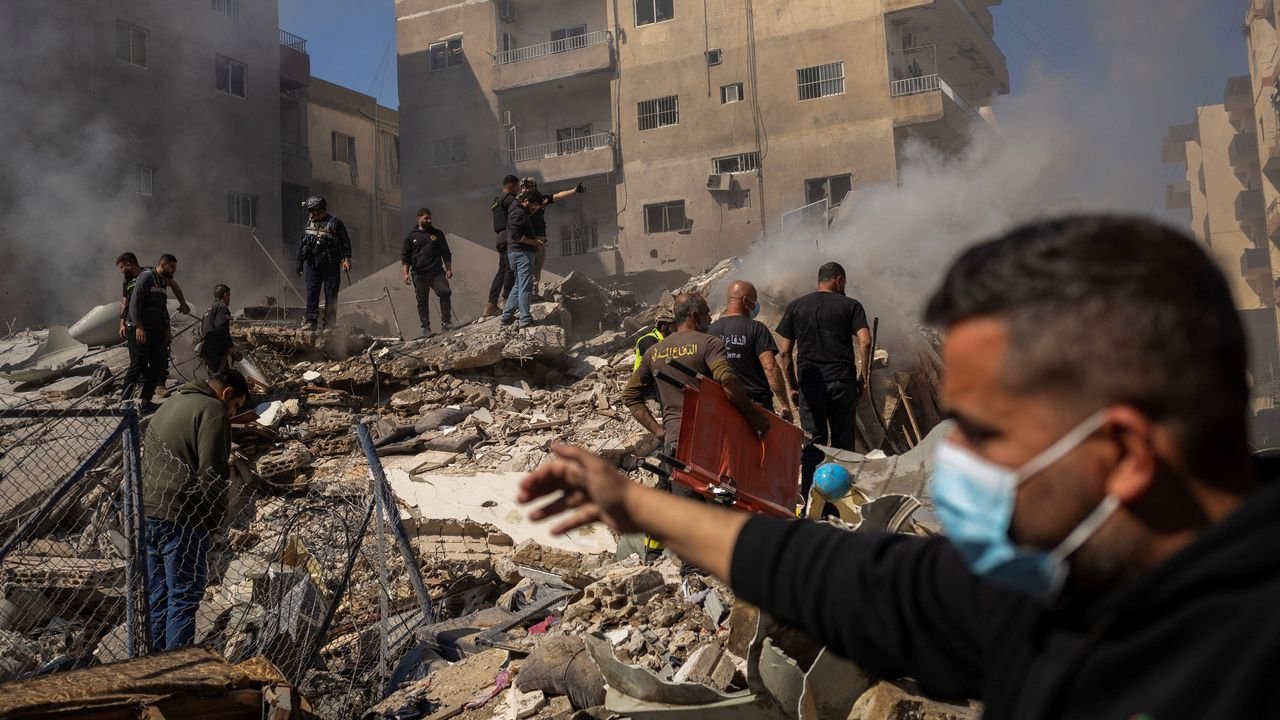
What is happening today in the south is triggering a lot of anxiety for southerners because they saw what happened in Gaza. People’s homes are completely destroyed. People in Gaza were not allowed to go home. The memory of the Palestinian Nakba is also there. People left thinking they’d go back to their homes, but were never allowed to go back. We still have Palestinian refugees in Lebanon from that period. So, for the Lebanese, they’re terrified that once they leave, they may not be allowed to go back.
Is the stated Israeli reason for this that Shia communities in southern Lebanon are actually housing Hezbollah fighters and weapons, or is the idea that the Shia community more broadly gives political support to Hezbollah and therefore is a threat?
I think it’s a mix of both. There is a sense of collective punishment. You have two political parties that predominantly represent the Shia community, Amal Movement and Hezbollah. Not all the Shiites in Lebanon are supporters of Hezbollah. So there is a sense of collective punishment when you’re kicking a religious sect and saying, “No, you’ve probably supported Hezbollah, therefore you’re not allowed to come back. You’re guilty by default somehow.” As to the idea that many of these villages harbor Hezbollah, many of the Hezbollah fighters come from these villages. And, for them, they’re defending their land. They’re there to defend their land. I’m talking about the ones who are fighting now.
But this does not in any shape or form justify Hezbollah dragging Lebanon into this conflict, which was a conflict that everyone here was desperate to stay out of. That decision was made by Tehran in an attempt to turn Lebanon into another battlefront.
How much resistance is Hezbollah putting up on the ground? And, secondly, it seemed like the central government, before the war, had finally gotten more serious about disarming Hezbollah than it ever had before, but how has that gone in the last month or so? Is there an effort by the Lebanese state to disarm Hezbollah? As you say, a lot of Lebanese people are upset that they were dragged into this war.
Hezbollah has put up a lot of resistance fighting on the ground. It’s not about the rockets. It’s the actual resistance on the ground. This is their terrain. These are their homes. They know these areas very intimately. So they have put up resistance, and we see it. And they’re doing this while much of the setup they had in place prior to 2024, a lot of the military infrastructure, was destroyed by the Lebanese Armed Forces. Much of this, south of the Litani, had been cleared out.
But in terms of disarming Hezbollah more now, you cannot disarm them in the middle of a war. There were more than a hundred strikes in the space of ten minutes on Wednesday. So it’s very difficult to say you are going to be disarming this group in the midst of a conflict. But what the government has done is declare Beirut a city free of arms. This effectively means going into areas, setting up checkpoints, and making sure that there are no armed non-state actors in administrative Beirut. I think it’s an important move in a very big way. We have to wait and see how they’re going to implement this because it may put the Army at odds with local populations. Tensions are already very high. People are very polarized, and the I.D.F. just issued a new evacuation order, and not only for the suburbs. They’ve really expanded the area to the Palestinian camps and elsewhere.
I don’t know where these people are going to go. We don’t have enough shelters. This is a country that has no air defenses, it has no sirens, and it has no bomb shelters.
But the Lebanese President reached out again and said they need to be negotiating directly with the Israelis. So Prime Minister Netanyahu announced that he’s authorized direct negotiations with Lebanon. Meanwhile, there’s no ceasefire. Frankly, I’m not holding my breath over these negotiations, but at least it opens a window, a diplomatic window to spare Lebanon more destruction.
Lebanon is a country that has had to deal with many refugees, including Palestinian refugees and Syrian refugees, at different times. You said that over a million people in the south had to leave their homes. Where are they going and what sort of strain might that put on the rest of Lebanon, in addition to the obvious horror for the people who have to leave?
The government has, I think, done a really good job in its very rapid response. This is the most responsive government we’ve seen to crises. They have established shelters in public schools and used the sports stadium in Beirut. Still, while some people displaced by the war are staying with their families, some are staying with friends, and some are renting places and staying there, it has created a lot of tension on the ground for a number of reasons. I think, as time passes and resources dwindle, it’s going to be a race to the bottom. Two, there is the sense that the targeting we saw by Israel has placed a bull’s-eye on the displaced. Nobody wants to have a displaced person in their vicinity because everyone’s worried that they might be targeted by Israel. And it’s created a lot of tensions on the ground, a lot of accusations. We’ve seen some neighborhoods that have absolutely refused to even open the public schools for refugees.
In addition to being concerned about targeting, is there a sense from other people in the country that some Shias had brought this on themselves by supporting Hezbollah, and that Hezbollah dragged this country into the war?
It is an issue, but it’s a minority issue. Like all countries, you have different perspectives and points of view. So it is an issue, but I really would say it’s a minority issue. People are trying to help in any way they can. Even those who don’t want to host are trying to help in other ways, but there’s also a lot of anger. There’s a lot of anger at Hezbollah for having dragged Lebanon into this, and an understanding that the displaced are the ones, frankly, who are paying the price for Hezbollah’s military adventurism. So, yes, there are people who think that way.



