
Indonesia’s ascent up the ranks of the top genre is marked by contributions from many great filmmakers, from Joko Anwar, Timo Tjahjanto, and Hadrah Daeng Ratu to Bobby Prasetyo, Awi Suryadi, and more, including Kimo Stamboel. The veteran director decides to offer up a follow-up to his celebrated feature “Sewu Dion” with this prequel offering, even taking the same writing team with Khalid Koshogi taking a story from SimpleMan, to create “Janur Ireng,” now available from EST N8.
After their father dies and their house burns down, Sabdo (Marthino Lio) and Intan (Ratu Rafa) are two people who can never be united. Their family holds a deep-rooted belief that if the two were ever to come together, they would unleash an unstoppable power. Driven by greed, their uncle Arjo Kuncoro (Tora Sudiro) and his wife Lasmini (Masayu Anastasia) lure them into the family’s lavish mansion with promises of wealth, only to trap them in a nightmare. Their only hope for survival lies in Janur Ireng, the deadliest black magic ever known in Java.
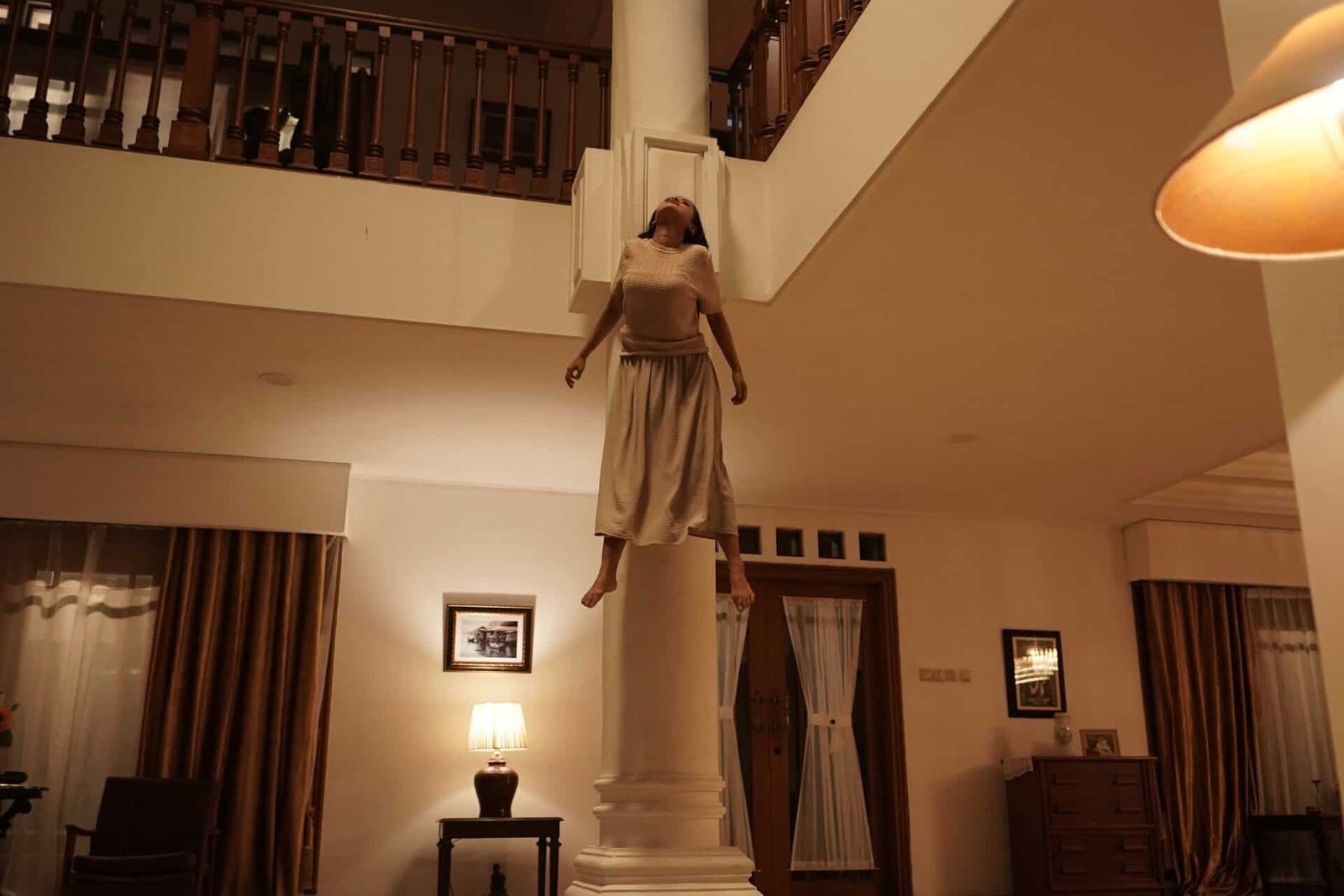
Kimo Stamboel’s “Janur Ireng” is a formidable entry in modern Indonesian horror, successfully bridging the gap between traditional Gothic atmosphere and the visceral intensity of contemporary folk horror. Much like his work on “The Queen of Black Magic,” Stamboel proves he is a master of the “slow-burn-to-total-chaos” style. Based on the viral SimpleMan universe, the film effectively utilizes a simple family tragedy to drop Sabdo and Intan into a house defined by its shadows and secrets. The initial arrival and the subsequent struggle to acclimate to life with the menacing Arjo and Lasmini provide a slew of fantastic haunting scenes, offering up atmospheric bits that feel both classic and fresh.
The film’s greatest asset is its visual language. Stamboel and writer Khalid Koshogi craft a world where Arjo’s plantation isn’t just a setting, but a manifestation of his occult dealings. There is a palpable sense of menace in the way Arjo and Lasmini operate; they possess a theatrical air that feels delightfully over-the-top, perfectly complementing a film that plays with light and shadow in every setpiece. This “old-school” touch, involving spectral beings and long-forgotten rites, is balanced by a modern sensibility regarding its subject matter and brutality. Fans of Stamboel’s previous collaborations with the Mo Brothers will recognize that signature flair for making the supernatural feel physically dangerous.
That touch of brutality is where the film truly finds its stride, leaning into the “body horror” territory Stamboel explored so effectively in “The Queen of Black Magic.” While the initial implication is a standard haunting—highlighted by an invisible force tossing Sabdo across a room—the horror quickly escalates into something far more macabre. The sequence following a failed ritual, where a demonic spirit races through the house as payback, is a masterclass in tension. This leads into a terrifying dream sequence where Intan is trapped in a cornfield and attacked by a floating, severed torso. By the time the finale arrives, featuring a spectacular conclusion involving ripped entrails, gouged eyes, and a chase by a headless body, the film cements itself as an immensely gruesome and bloody triumph.
However, “Janur Ireng” is not without its slight issues. The main drawback lies in the narrative clarity; while the story provides ample opportunity for Gothic ambiance, it offers very little in the way of general understanding. There is a lack of information regarding the specific black magic rites Arjo is practicing or why he is so committed to them. This ambiguity undoubtedly stems from the film’s existence as a prequel to “Sewu Dino,” meaning the internal logic feels inconsistent when viewed as a standalone experience. This is a common pitfall in “shared universe” horror, where the lore can sometimes feel like it’s being saved for a later entry. Additionally, some glaringly obvious CGI and jarring insert shots of a goat-headed demon crop up periodically, though they aren’t enough to derail the overall experience.
Ultimately, with plenty of quality factors on display, “Janur Ireng” proves that Kimo Stamboel remains one of the undisputed masters of modern genre cinema. While the flaws may nag at those who haven’t seen the preceding film, it remains a standout effort that sits comfortably alongside his best work. Fans of Asian folk horror or those who appreciated the relentless pacing of “The Queen of Black Magic” will find a lot to like in this bloody, atmospheric descent into the occult.



