
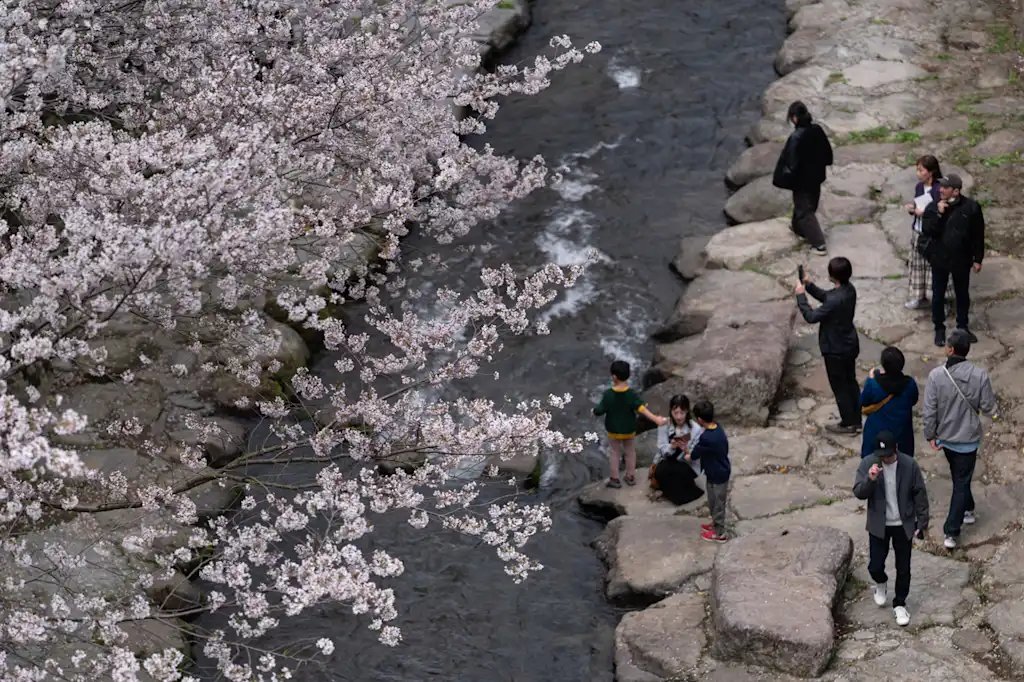
The spring bloom of cherry blossoms is a stunning sight. Across Japan, Korea, and places like Washington, D.C., the trees burst with dense, pink flowers for just one or two weeks, bringing millions of tourists.
But climate change is threatening these blooms.
As the planet warms, our winters are getting milder. And those mild winters can delay the flowering of cherry blossom trees by up to 32 days, according to a new study by researchers at the Forestry and Forest Products Research Institute in Kyushu, Japan, in collaboration with Boston University.
Without enough cold weather, the trees don’t know that winter has passed, and so they don’t know to come out of their winter dormancy state.
But more than just delaying the onset of flowers, mild winters are also making cherry blossoms less dramatic, affecting how many buds bloom and causing the trees to look less flush with flowers—which could have huge implications for tourism.
A less dramatic display
The study, published in the International Journal of Biometeorology, specifically looked at Yoshino cherry trees, a hybrid species developed in 19th-century Japan and the most popular varietal.
“What’s really unique about these cherry trees is they flower in a huge burst, like all the flowers open just at once, within a day or so,” says Richard Primack, a Boston University biology professor and coauthor of the study. “It’s an absolutely unbelievable flower display.”
But if there’s a very mild winter, the buds aren’t ready to respond to warmer temperatures. Instead of the flowers opening over a few days, they open up over the course of a couple of weeks.
A longer flowering period sounds good in theory, but it’s less dramatic. Because the flowers don’t last long, they die off as new ones bloom. That change leaves cherry trees looking “kind of bedraggled,” Primack says, with just a “scattering” of flowers.
So, cherry trees never reach “peak bloom,” meaning 80% of their flowers open at once. Flower buds will even fall off the trees without ever opening.
Impacts on cherry blossom tourism
The southern boundaries of these trees are already being affected, with a less reliable display of blooms. As the planet continues to warm, there will be years in which cherry blossoms don’t give off dramatic displays of their pink flowers at all.
That could affect all sorts of tourism and disrupt cultural practices. Across Japan, some 37 million tourists travel to see the cherry blossoms bloom, and residents even take off from work to have cherry blossom parties or to gather with friends and family to picnic under the flowering trees.
There are also multiple cherry blossom festivals, with food, drinks, and performances. In 2025, Japan’s cherry blossom season had an economic impact of $9 billion.
In the United States, Washington, D.C’s cherry blossoms alone bring about 1.5 million visitors—which translates to more than $200 million in visitor spending.
“If the cherry blossoms aren’t as dramatic, then it means that the hotels aren’t filled, the restaurants aren’t filled with people, the merchants aren’t selling as much stuff, and so it has a big drag on the economy,” Primack says.
“People have to be prepared for this,” he adds. “It either means that you don’t have these flower displays every year and people just accept that. Or it means that in these places, people have to start planting other species that are more tolerant of mild winters.”
An example of climate change disruption
The study was able to understand what’s happening with Yoshino cherry trees because Japanese meteorologists have been closely monitoring when these trees bloom for decades. Researchers analyzed nearly 60 years of Japanese meteorological data. (Lead study author Toshio Katsuki, from Japan’s Forestry and Forest Products Research Institute, is a noted expert on cherry trees.)
“You have more information about the Yoshino cherry flowering than really almost any plant species in the world,” Primack says.
But they’re not the only trees affected by climate change. All sorts of species are seeing effects from our warming world, particularly along the southern edge of their ranges.
The study suggests that a warming climate is disrupting the trees’ reproduction. If trees don’t flower as well after warm winters, they might not be pollinated effectively either.
Ultimately, what’s happening with cherry blossoms illustrates the reality of climate change, and the way it impacts all sorts of species and industries.
“It’s an indicator,” Primack says, “that climate change has the potential to disrupt natural systems in unexpected ways.”



