
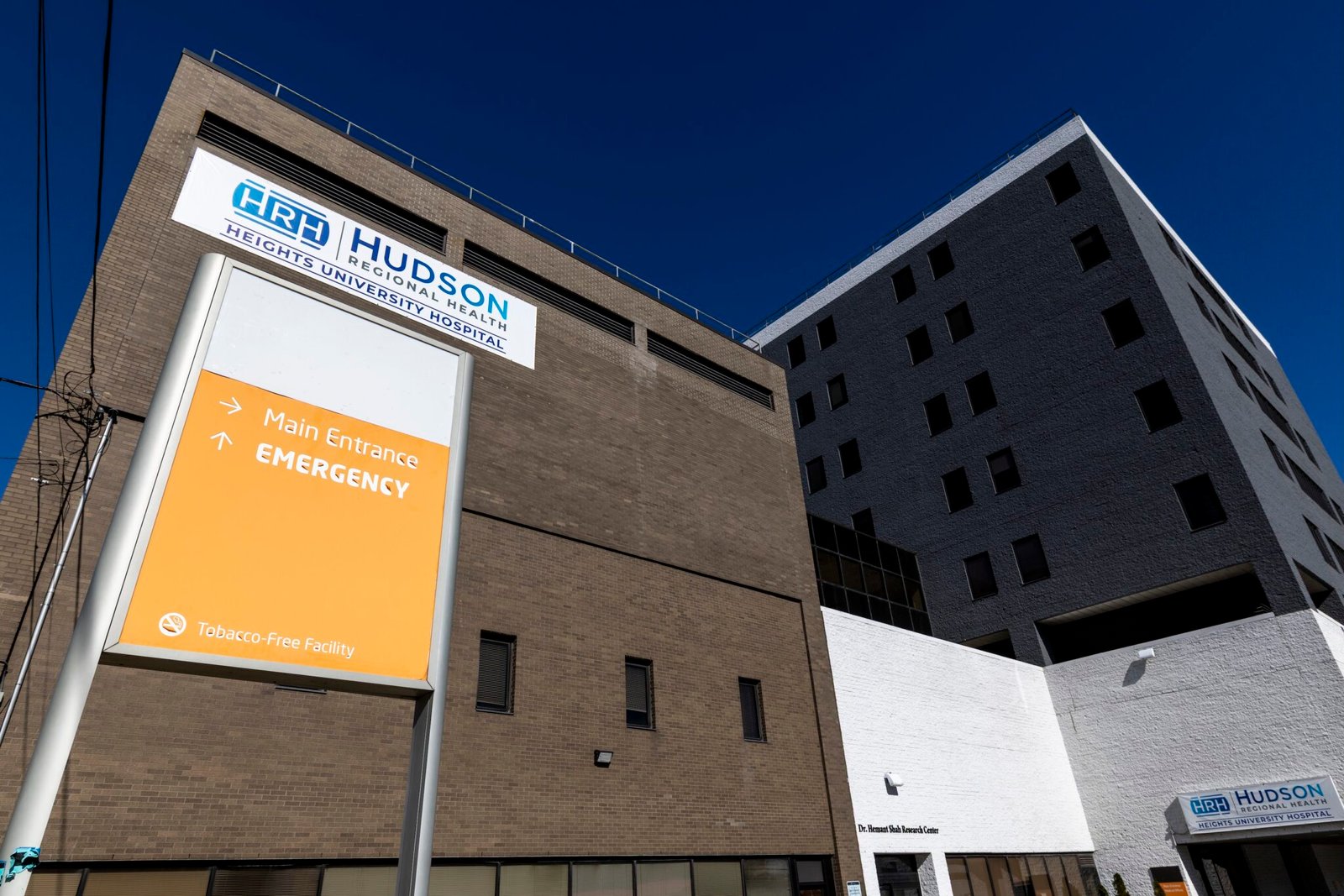
Heights University Hospital in Jersey City closed its doors over the weekend, alarming local officials who say the state should intervene to prevent New Jersey’s second-largest city from losing critical health care infrastructure.
The closure came after a failed, last-minute push by Jersey City officials to get a judge to force the hospital’s owners, Hudson Regional Health, to keep the facility open. The news means Jersey City, home to nearly 300,000 residents, is home to just one hospital emergency room.
Hudson Regional Health spokesman Vijay Chaudhuri called the closure “extremely disappointing,” but said it was made to “preserve the stability of the hospitals in the system” and ensure the continued delivery of care within the company’s network.
Gov. Sherrill plan seeks to fine big companies with workers on Medicaid
Chaudhuri said Hudson Regional Health, which also runs hospitals in Bayonne, Hoboken, and Secaucus, will continue to look for ways to work with government or private partners to create a health care system “that provides quality care the community deserves, in a way that is financially sustainable.”
Long known as Christ Hospital, Heights University eliminated inpatient care and other services in November before closing its emergency room on Saturday.
“What is the next step? Because the community suffers with this closure,” state Sen. Brian Stack (D-Hudson) asked the acting state health commissioner Thursday at an unrelated hearing.
State Sen. Raj Mukherji (D-Hudson) urged the state to declare the long-struggling hospital a public acute care facility, like University Hospital in Newark, and invest additional state funding to keep it open. While there are two other acute care hospitals within a few miles of Heights University, the area is often choked with traffic, Mukherji noted.
“This could be the difference between life or death for a patient,” Mukherji told the New Jersey Monitor.
Debbie White, president of the Health Professionals and Allied Employees union, which represented most of the roughly 50 workers still at the hospital right before its closure, noted that Newark has three hospitals for a population only slightly larger than Jersey City’s.
“Jersey City needs these hospital beds,” White said at a rally outside the hospital Thursday.
Maggie Garbarino, a spokeswoman for Gov. Mikie Sherrill, said the hospital’s operators have “routinely circumvented statutory and regulatory requirements” during the closure process and the state plans to collect the fines it is owed.
“New Jersey Department of Health staff are actively engaged to ensure patient safety and access to care, and ambulances will be on site to redirect any patients as needed. The Sherrill Administration is committed to ensuring this does not happen again, and the Governor will be pursuing legislation to give the State more tools to hold health care facilities accountable to the patients and communities they serve,” Garbarino told the New Jersey Monitor in an email.
Heights University owes the state more than $128,000 for closing down services without proper state approval, according to state regulators.
State officials said the Health Department gave the hospital an extra $10 million in 2024 to keep it open during the bankruptcy of its former, for-profit owners, CarePoint Health, and $2 million last fall to help it make payroll.
“We certainly do have enforcement tools within the state and we are prepared to use them if any further actions are taken by the operators of the hospital,” acting Health Commissioner Raynard Washington told Senate lawmakers last week. “We remain committed at the department to ensuring our residents have access to care.”
Hudson Regional officials want to knock down the 150-year-old hospital and redevelop the Palisades Avenue site — which has stunning views of the Manhattan skyline — with a housing component that could help fund health care services on site.
“A new, state-of-the-art facility, financed through the redevelopment process, will enable the recruitment of top physicians, the expansion of specialty services, and the ability to attract a higher payer mix and patients who currently leave Jersey City to seek care elsewhere. These capabilities are critical to generating the revenue necessary to sustain the hospital while continuing to serve a large, underinsured population,” Chaudhuri told the New Jersey Monitor by email.
Until then, Hudson Regional Health officials said in a statement, they will refer patients to other providers in the area and said it is working with a local federally funded clinic, Alliance Community Healthcare, to open an additional practice at a medical building just down the street from the now-shuttered hospital.
Chaudhuri said whether public or private, any facility operating in Jersey City will face the same “monumental challenges” that Hudson Regional Health faced, including the need to spend millions on infrastructure upgrades and operations.
A public-private partnership between Hudson Regional Health and the City of Jersey City, Chaudhuri said via email, “would be a far more practical solution that would not require the state to invest tens or hundreds of millions of dollars on an annual basis, given the state’s budget challenges.”
State and local elected officials said they are skeptical about partnering with Hudson Regional Health, saying the hospital’s operators have reneged on multiple promises they made in recent years to continue to provide acute care, or just emergency services, at the location.
“I would be very concerned about that,” Mukherji said. “What kind of guardrails could you put on something like that to actually assure we would see an acute care hospital on that site?”
Jersey City Mayor James Solomon raised the idea of a city takeover of the property through eminent domain during Thursday’s rally at the hospital.
“This is people’s lives being less important than corporate profits,” he said. “We are taking zero tools off the table.”
GET THE MORNING HEADLINES.



