
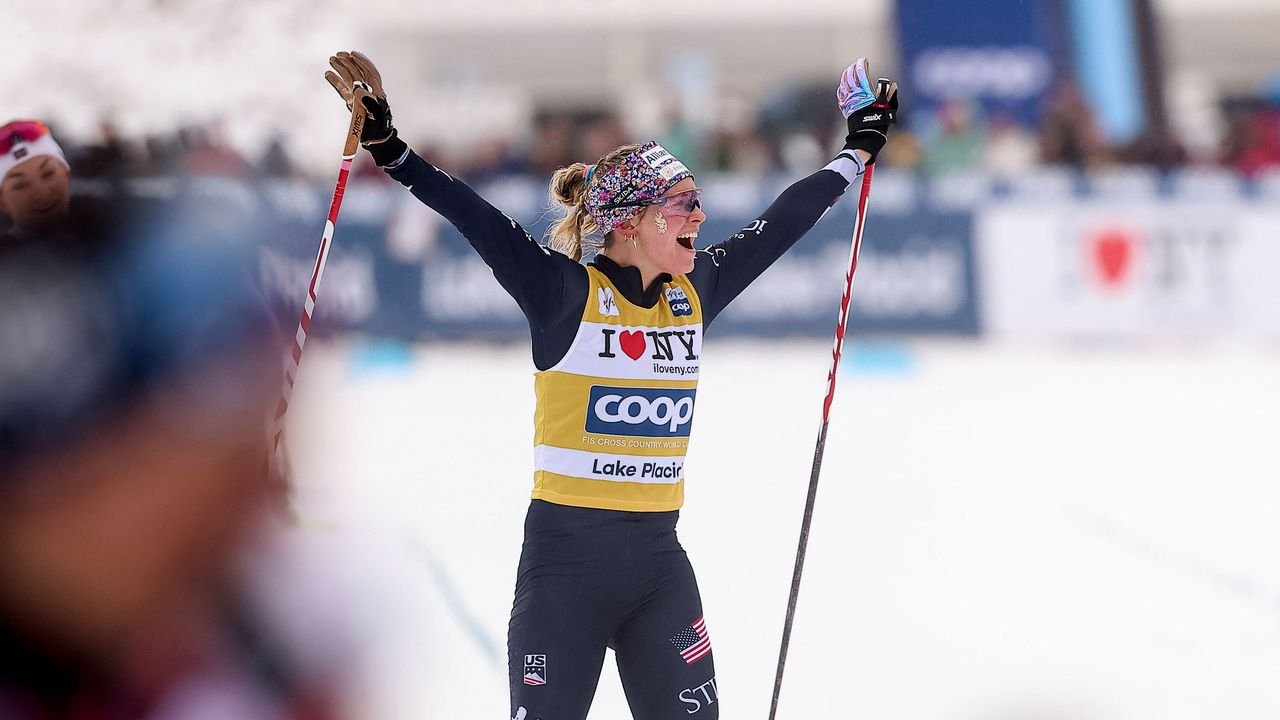
But it was a daughter of the Midwestern branch of this Nordic family who drew the crowds to northern New York this weekend—Jessie Diggins, who grew up near the Twin Cities, and who went on (with some coaching and training from Caldwell’s son Sverre) to become the greatest American ever to put on a pair of skinny skis, and arguably the greatest winter endurance athlete this country has ever produced. Diggins used her star power to persuade the Europeans who run the World Cup to turn their attention to the U.S. for the first time in decades, holding a pair of races in her native Minnesota two years ago (after a COVID delay). That event was such a triumph, with some twenty thousand spectators enthusiastically crowding onto a Minneapolis golf course, that she was able to lure the Europeans back for what she had announced would be her retirement races, following her last Olympics in Milan, where she took home a bronze. (She has won four Olympic medals, including a gold, and seven World Championships medals.)
Diggins has captured the soul of this Nordic nation not only because she’s been so successful—as the races ended Sunday, she was awarded her fourth “crystal globe” marking her as over-all World Cup champion for the entire season—but because of the way she races. Unlike her Scandinavian competitors, who tend toward both elegant technique and northern reserve, she has earned her victories by descending dramatically into what she calls the “pain cave.” She powers up hills, sometimes wasting energy as her bobbing head flings her ponytail side to side; she skis the downhills with unmatched speed and abandon; she crosses the finish line utterly spent, often collapsing into a heap of heaving breath and cramping muscle. (There’s even a “Diggins Collapse Index” online, ranking her post-race sprawls on the snow.) It’s the same off the course: she’s told, with rare candor, the story of her battles with an eating disorder; Peacock is currently streaming a documentary on her career called “Threshold.”
In Lake Placid, the Minnesota state flag was prominent around the course, and American flags flew, too, if not a sea of them. In fact, many of the Minnesotans in attendance wore buttons that expressed their opinions of Immigration and Customs Enforcement officers; many of those who cheered Diggins on two years ago spent this winter blowing whistles to protect their neighbors. (The sport definitely skews liberal. When Ogden won his first silver medal—something no American man had done since Koch, fifty years ago—he was asked how it might change his life. Perhaps, he said, he could leverage it to meet one of his heroes, Bernie Sanders.) But for every shirt bearing a slogan, there were ten cheeks covered in (biodegradable) glitter like the kind that Diggins sprinkles on her face before every race. Diggins, for all her grit, has also brought a sparkle to the sport. The love for her was palpable; you could follow her progress around the course just by listening for the cheers that would arise as she turned each corner. She perhaps arrived too worn from the Olympics to dominate the proceedings; she mustered a fifth-place and a ninth-place finish in the first two races, but it didn’t matter. Handmade “Thank You, Jessie” signs waved around the track.
The American crowd—perhaps, in part, because so few of their countrymen and women have risen to the very top of the sport—are also renowned as knowledgeable fans of skiers from other nations. They cheered long and hard for Klæbo on Friday, as he plowed through a dumping snowfall with his usual grace, winning easily. Klæbo—injured earlier this month after a collision with Ogden that left him concussed—decided to skip Saturday’s sprint races, where he otherwise would have been the prohibitive favorite. That left the door open for a beloved Italian star, Federico Pellegrino, who, like Diggins, is retiring after this competition. Pellegrino soaked in the crowd’s affection during his warmup laps, as they chanted his nickname, Chicco Pelle. “I got this feeling of power coming from the public,” he said after the race. “Cheering for me,” he added, and when he won he donned a cowboy hat, to the throng’s delight. Klæbo returned to the course on Sunday for the last race of the season, a gruelling twenty-kilometre odyssey through the steep climbs and drops of the wooded track, and won with his usual aplomb. At times, as the other racers sweated and strained in a pack behind him, he would swivel his head to survey their progress, looking for all the world like a fourth-grade teacher taking his somewhat unruly charges on a field trip.



