
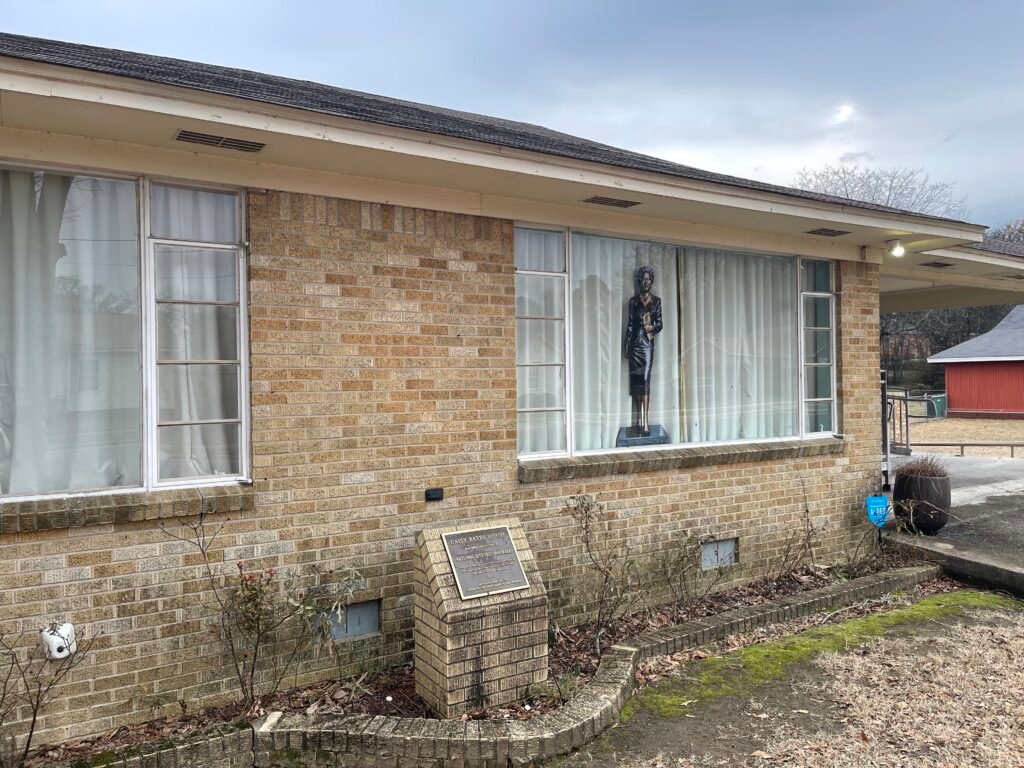
There are many striking features of the 10 ½-foot-tall statue of civil rights leader Daisy Bates that now stands in the U.S. Capitol. The statue’s details each tell an important part of Bates’ life story, down to the NAACP button on her lapel.
But there were two things that struck me most the first time I saw the bronze statue on a tour of the Capitol. One was the rolled up newspaper she held in her left hand. The other was the reporter’s notebook she held in her right hand.
Both are reminders of the far-reaching legacy of Bates, the civil rights leader and mentor to the nine Black students who desegregated Little Rock Central High School in 1957.
She was also a trailblazer in journalism whose courage in the face of threats is something that more news outlet owners, publishers and journalism leaders should consider emulating.
In Arkansas, Monday isn’t just Presidents’ Day but also Daisy Gatson Bates Day. Setting aside a state holiday to honor Bates in 2001 was one of the best ways to honor a civil rights icon well known within the state but probably not as known nationally as she should be. The 2019 law that replaced one of the state’s two statues at the U.S. Capitol with one depicting Bates will hopefully go a long way toward remedying that.
“The Long Shadow of Little Rock,” Bates’ memoir, is a book that should be required reading not just for students in Arkansas but for adults as well. It’s a book I read shortly after moving to Arkansas. Its pages are earmarked and passages highlighted with pieces of Arkansas history I wanted to learn more about.
The sections that stand out particularly to me recently are the history of the Arkansas State Press, the newspaper Bates and her husband L.C. Bates founded that chronicled the Civil Rights Movement.
Bates writes about the gamble they took on starting the paper, deciding that a newspaper was needed to carry on the fight for civil rights.
“If we could get advertisers to support a crusading paper, all well and good,” she wrote. “If not – well, that was part of the gamble.”
Arkansans honor Daisy Bates as statue unveiled at U.S. Capitol
It was a costly gamble, with advertiser boycotts and the Bateses working 12- to 18-hour days to keep their paper alive.
The gamble that Bates was willing to take stands in stark contrast to decisions made by some newspaper owners in recent years, especially Jeff Bezos’ cutbacks that have decimated the ranks of The Washington Post.
The cuts have been disheartening for reporters and editors like me who got into journalism idolizing the Post and can quote every line of “All the President’s Men” by heart. It’s even more dispiriting to realize that the layoffs include one of its last ties to the Watergate era.
Bezos is free to do with his money as pleases but the newspaper in the nation’s capital is a special institution. That’s why Katharine Graham invested in the Post and was willing to take risks, both legal and financial, for its future.
Daisy Bates also saw the value of a newspaper, especially at a critical moment like the Civil Rights Movement. It was indeed a crusading paper, one that fought to free Black people “from muddy, filthy streets, slum housing, menial jobs and injustice in the courtroom,” she wrote.
Bates saw the value of a newspaper for a community, especially at a pivotal moment in history. Other newspaper owners can today show the same courage Bates did in the face of financial and political pressures.
If Daisy Bates could afford to take that gamble, someone like Jeff Bezos certainly could.
This story was originally produced by Arkansas Advocate, which is part of States Newsroom, a nonprofit news network which includes Florida Phoenix, and is supported by grants and a coalition of donors as a 501c(3) public charity.



