
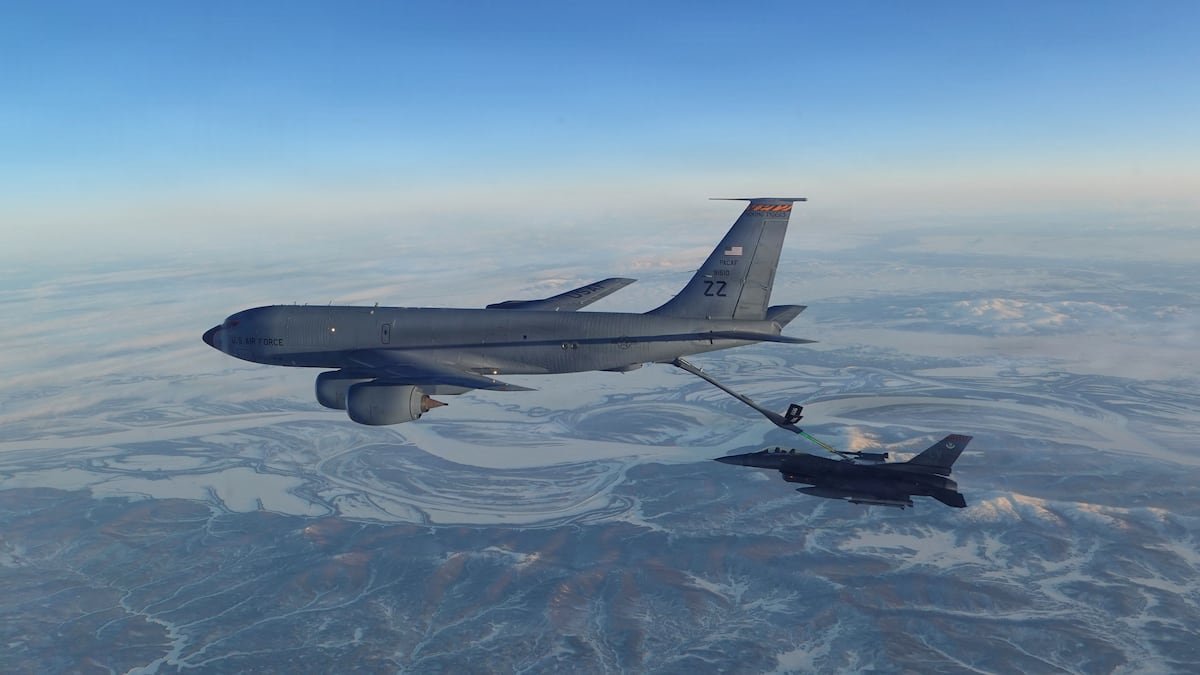
It first flew in 1956, when Dwight D. Eisenhower was president. It carries 200,000 pounds of fuel, siphoned away mid-air through a metal tube. And it doesn’t have parachutes, trapping crews during a crash.
The KC-135 Stratotanker plane, effectively a flying gas tank, is at the core of the U.S. military’s ability to fight wars around the world.
Earlier this week, a KC-135 crashed while flying over Iraq during Operation Epic Fury, killing six crew members aboard. Another KC-135 was involved but landed safely in Israel, according to the Israeli Ambassador to the U.S.
U.S. Central Command said the crash was not due to hostile or friendly fire and said it would investigate the cause. On Friday, the command said it would release the names of those killed and the units they were from after their families were notified, as is standard practice.
The KC- 135 is part of the 6th Air Refueling Wing and 927th Air Refueling Wing, a Reserve unit, at MacDill Air Force Base, along with at least 15 other Reserve and Guard units nationwide.
Despite being more than 60 years old, introduced about 10 years after the U.S. Air Force was founded in 1947, KC-135s are still widely used in military operations to refuel other aircraft. Built by Boeing, its frames are similar to the 707 commercial passenger plane.
According to its tail number, the plane that crashed in Iraq had previously been assigned to the 459th Air Refueling Reserve Wing at Joint Base Andrews near Washington, D.C., in Maryland. Photos circulating online of the other plane that landed in Israel show that a clipped tail was assigned to Beale Air Force Base in California.
Many things could have caused the crash, said Cedric Leighton, a retired Air Force Colonel and intelligence officer, who was based at MacDill in the 1990s.
The planes could have crashed mid-air, veering off their flight paths, or had a mishap while one was refueling the other, he said.
Mid-air refueling is a very difficult and precise maneuver.
The planes must travel together at the same speed through the air and be a specific distance apart. A telescoping metal tube called a boom connects the planes while fuel is transferred through the tube.
In the crash last week, damage to the surviving plane gives some clues as to what could have happened, Leighton said.
“The fin being broken off suggests there was contact and seems to be consistent with a refueling operation gone wrong, but are there other possibilities,” he said.
Though KC-135s have generally been safe, given the duration of their time in flight, the planes’ age could have been a factor in the crash and is increasingly a concern, Leighton said.
“Airframes get old just like anything else, and because they’re built from metal, there is a thing such as metal fatigue, and that can absolutely be a factor in the airworthiness of an airplane like this,” he said. “It is certainly something that has to be looked at.”
Unlike fighter jets, like the F-16, where pilots can eject themselves from the cockpit and are equipped with parachutes, KC-135s have no parachutes because it is “basically impossible” to eject from the aircraft given its configuration, Leighton said. The planes are not designed for emergency bailouts.
“They don’t have those parachutes on there because there just isn’t any utility,” he said.
A refueling plane has a minimum of three crew members, two pilots, and a boom operator who works in the back belly of the plane called the “boom pod,” a difficult spot to quickly get out of in the event of a crash.
The newer Boeing KC-46 Pegasus refueling plane, which works much the same way and is slowly replacing the KC-135s, also does not carry parachutes for its crew.
The Air Force removed parachutes from the KC-135 in 2008, saying that they just slowed things down on the plane.
“They seldom have mishaps, and the likelihood a KC-135 crew member would ever need to use a parachute is extremely low,” according to an Air Force article at the time.



