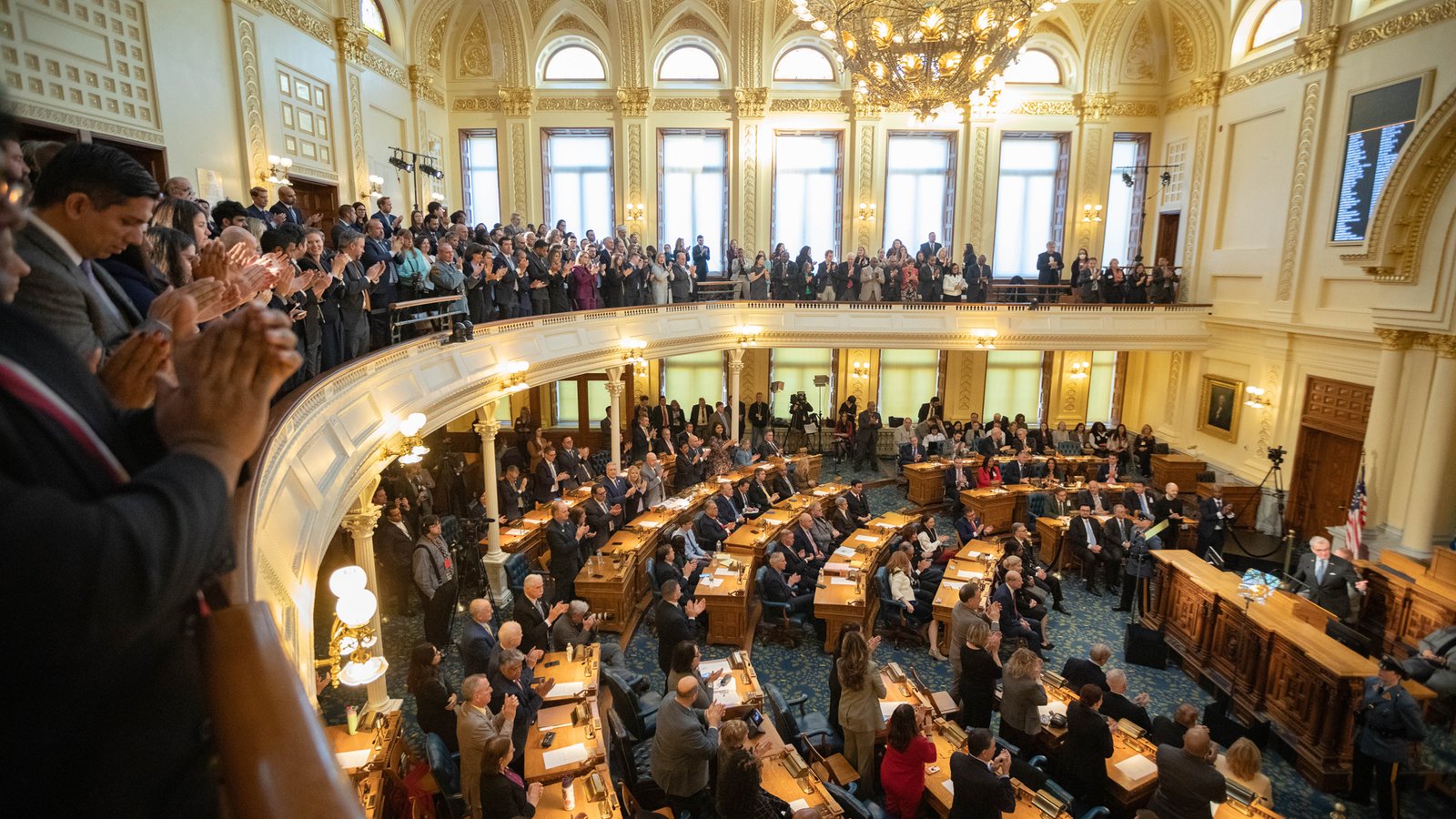
 On the last day of its two-year term, the New Jersey Legislature acted on more than 150 bills, including proposals to increase tax credits by billions of dollars and another adding $120 million in spending to a state budget with a structural deficit of at least $1 billion.
The Assembly met for close to 7 ½ hours on that day, Jan. 12, and the Senate for three hours, with multiple breaks, all to get their bills to the governor’s desk before noon the next day.
That last day was, as is usually the case, the most productive of the two-year legislative session. It ended a lame duck session that saw the introduction of more than 630 new bills. Dozens of these late bills, and others that had been pending since the start of the two-year session, were rushed through committee hearings around the holiday season.
“We all have the habit of waiting to the last minute,” Sen. Paul Sarlo (D-Bergen) said during a Senate Judiciary Committee hearing to confirm two gubernatorial nominees earlier this month. “Sometimes difficult discussions are best, too, when you have them at the last minute.”
An NJ Spotlight News analysis found that lawmakers took at least some action on more than 1,100 bills between Nov. 6 and Jan. 12, the last voting session of the Legislature’s two-year term. They introduced and amended bills, moved some through one or more committees and passed hundreds through the Assembly, Senate or both.
This frenzied practice is a New Jersey standard. In eight of the past 10 legislative terms, NJ Spotlight found, lawmakers voted on more than 100 bills on the final day.
“It’s not the perfect way — or not even a legitimate or reasonable way — to do thoughtful legislation,” said Michael Egenton, chief lobbyist for the New Jersey State Chamber of Commerce. He described working during lame duck as “being hit with all different issues and at a high velocity rate.” The only way to keep up with the action, he said, would be to “clone myself.”
So many bills
The 2025-26 lame duck session was more chaotic than the previous term. This past lame duck saw lawmakers introduce 482 bill, and 26 became law. Then-Gov. Phil Murphy signed into law 47 bills introduced during the most recent lame duck session — which commenced after the Legislature returned from a 19-week break for summer and the election season.
Bills originating in lame duck had a better chance of enactment than those introduced in the first 22 months of the session, the NJ Spotlight News analysis found.
Murphy signed 123 bills on Jan. 20, his last day in office, and 225 in January — more than 40% of the laws Murphy enacted during the entire session.
Advocates, analysts and even lawmakers themselves say last-minute legislating runs counter to good government. Bills are introduced during holidays or right before a committee hearing. Committees in both houses hear the same bill at the same time. Committee chairs hold the most contentious bills that draw the most speakers until last. Lawmakers vote on bills without getting cost estimates. Voting agendas are packed.
The approach is opaque, not transparent.
“Many major decisions were strategically pushed to lame duck by lawmakers, and then, obviously they moved really quickly,” said Nicole Rodriguez, president of New Jersey Policy Perspective, a Trenton-based nonpartisan research group. “Hundreds of bills were introduced, amended, passed within hours. And what’s most disturbing, it gives little opportunity for public engagement, for press scrutiny, for full legislative debate, and even when those policies themselves have merit, the process is not sound.”
Saladin Ambar, a political science professor and senior scholar at the Eagleton Center on the American Governor at Rutgers University, said the rush “lets our elected officials off the hook.”
“It delays what voters want, need, or have pushed for — for want of courage, more than skill,” he said.
Dull weeks
New Jersey lawmakers are part time and most hold other jobs. Still, the state is one of just seven whose Legislature meets through the year. Little tends to happen, though, from the end of June, when the budget is finalized, to November elections.
“How many ‘lame duck issues’ are being pushed at the end of the year that they could actually hear earlier, and it would allow for better and clearer fiscal and implementation analysis to ensure that these policies can be fulfilled and funded,” Rodriguez said. “What it really comes down to is a legislative culture that perhaps values speed over deliberation.”
Senate rules generally limit to 30 the number of bills considered during a day’s voting session. A majority vote can waive that, and it happens frequently. More than triple the limit were on the Senate agenda for its last voting session Jan. 12.

Four days earlier, the appropriations committees in both houses held their last hearings, each with 80 bills to consider. Agendas were revised multiple times, including on the hearing day. Three bills heard by the Assembly Appropriations Committee were pending introduction — meaning the public had no ability to see them before the hearing’s start.
At the start of the meeting, a traffic light sat on the desk next to Assembly Appropriations Chair Lisa Swain (D-Bergen) to alert people testifying when their time was up. Bills were taken out of order. Some bills were amended, though the amendments were not read aloud.
Confused lawmakers
“It can take advocates and people who do this full time, sometimes people with advanced degrees, awhile to figure out amendments and figure out the full picture of a bill,” said James Sullivan, interim policy director of ACLU-NJ. “Oftentimes we’re showing up to a committee with testimony prepared, thinking that we have a position on the bill, only to find out the last minute there’s amendments put on the bill. And these amendments aren’t online.”
He added: “I can only imagine what it’s like for someone in the general public that wants to take part in the process.”
At times, even the legislators didn’t know what they were voting on.
Amid the Assembly committee’s eight-hour hearing, the next-to-last bill was A-5160, which sought to transfer some school employees from one pension system to another. There was confusion over the cost of the bill, with estimates at more than $500 million. Deborah Cornavaca, director of government relations at the New Jersey Education Association, said an earlier version of the bill would have been more expensive, but the one up for a vote had a onetime cost of $3 million to $8 million.
“Miss Cornavaca has better information than we do,” said Assemblyman Jay Webber (R-Morris). “That’s part of this process. It’s dismal. It’s 9:30 at night. … You can understand our being frustrated.”
While that bill cleared the committee and Assembly, it did not pass the Senate.
Both appropriations committees approved more than a dozen bills that could cost the state $3 billion, some in supplemental spending and others via tax credits. Most were certified as needing cost estimates — none of them done prior to voting by the panels and one or both houses.
One bill was a supplemental appropriation of about $120 million. The largest expenditures were $25 million for a supercomputer initiative involving several universities, and $20 million for events and marketing for FIFA World Cup matches at MetLife Stadium in East Rutherford. Also included: $9 million for capital improvements in Union County, home of Democratic Sen. President Nicholas Scutari, and $4 million for a network operations center in Middlesex County, home of Assembly Speaker Craig Coughlin, also a Democrat.
Good government advocates complained that the bill was introduced in both houses on the same day as the hearings, and no text was available on the Office of Legislative Services’ website until the following day. It was the last bill called during the six-hour Senate Budget and Appropriations Committee meeting.
Sarlo, who chairs that committee and cosponsored the bill with Scutari, did not seek public comment before calling for a vote. It passed along party lines and Murphy signed it.
Dead bill
Another bill increased the maximum amount of tax credits the state can issue by $2.5 billion, including as much as $300 million to renovate the privately operated, 18-year old Prudential Center in Newark. The bill was introduced in the Senate three days before Christmas and in the Assembly on Jan. 2. Its sponsors represent Newark. A number of people testified against what they called generous tax breaks and Republicans complained that the majority Democrats were rushing a high-cost bill.
The bill’s passage was dizzying. The Senate passed its version before the Assembly voted, and then had to take back that vote. The Assembly approved its version and sent it to the Senate, which gave its approval. Murphy signed it on his last day in office.
Sometimes waiting until the last minute can prove deadly for a bill.
One of three immigrant protection measures, introduced just days before the session was to end, sought to limit the collection and sharing of individuals’ immigration status by governmental and health care facilities. It passed both houses on Jan. 12 — only to be quickly conditionally vetoed by Murphy and sent back to the Legislature.
Hours later, both the Senate and Assembly voted to agree with the veto. But Murphy still didn’t sign it. The bill died.
“Unfortunately, upon further review of the legislation, we discovered a drafting oversight that could create significant complications when it comes to advancing our shared goal of protecting New Jersey’s immigrant communities,” Murphy said in a statement. “I deeply wish there was sufficient time left to correct this issue.”
In an unusual document that would have served as a veto message, Murphy said the only change needed would have been the insertion of six words.
“When we’re talking about criminal legal issues and when we’re talking about democracy in general, when we only have a week to debate these complex bills and the amendments and get them through committee, I don’t think that’s enough time,” Sullivan said. “We owe the state, and we owe the people in New Jersey the time to get it right. And it’s just not possible to get complex issues like that right in such a short timeframe.”
‘Sometimes a sewer’
Perhaps the most controversial meeting of lame duck was the contentious Dec. 1 hearing by the Senate State Government, Wagering, Tourism and Historic Preservation Committee. Its last bill was S-4924, introduced by Scutari just days before Thanksgiving, which sought to rewrite powers held by the state Comptroller’s Office. Kevin Walsh, comptroller at the time, had angered some legislators and local officials with his its aggressive pursuit of local corruption.
The hearing drew dozens of good government advocates in opposition.
U.S. Sen. Andy Kim (D-NJ) signed up to speak early in the hearing so he could return to Washington for a voting session. Instead, he was the last witness called. When Kim went beyond the allotted three minutes, Sen. James Beach (D-Camden), the committee chair, cut him off. A shouting match ensued.
Beach told Kim he wasn’t special. And Beach said that yes, he had allowed a bill proponent to testify for longer — because Beach had invited the man. Beach then railed against Kim for voting to approve some of President Donald Trump’s nominees, and told Kim he could leave.
The bill cleared the committee, though it received criticism even from Democrats and it made national news. When Kim counted the incident on CNN, anchor Jake Tapper commented, “Trenton sometimes is a sewer.”
Scutari decided not to pursue the bill further.
This story is made possible in part by the Corporation for Public Broadcasting, a private corporation funded by the American people.
Editor’s note: This story has been corrected to reflect that Prudential Center is privately operated.