
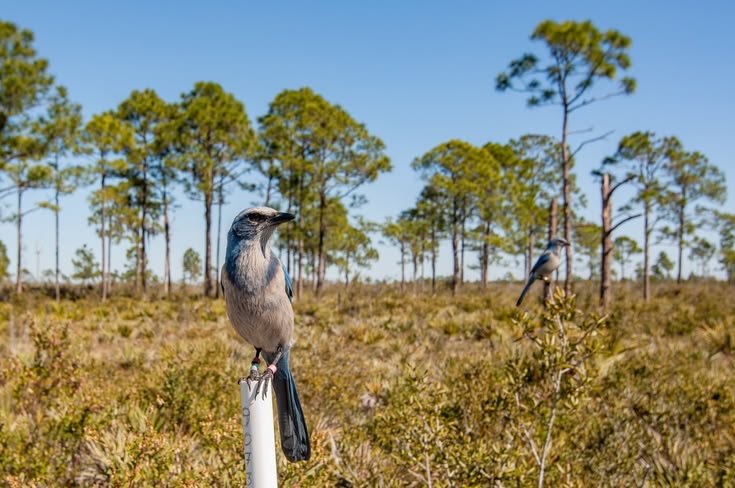
There’s no “Cutest Critter in Florida” contest but, if there were, I can name a few contestants. The diminutive Key deer, for one. The seagrass-munching manatee for another. And, of course, the friendly Florida scrub jay.
You may not be familiar with the scrub jay. Contrary to what The Trashmen used to sing, not everybody’s heard about the bird. They’re classified as threatened under the Endangered Species Act, which means they’re not fluttering all over the state.
If you’re lucky enough to spot one, though, you’ll find it quite charming. I once visited Oscar Scherer State Park in Osprey accompanied by a ranger who knew how to summon scrub jays. One swooped in and landed right on my photographer’s head. It stood there as the photographer handed me her camera and I took the bird’s picture.
Not everyone is a fan of these little birds, though. While I was in Charlotte County recently, I heard about a lawsuit aimed at robbing scrub jays of their federal protection.
Michael Colosi is an Ave Maria resident who’s been described as “a young tech entrepreneur.” He recently moved to Florida from New Jersey. In 2024, he bought a 5-acre parcel in Punta Gorda and planned to build a house there. But because the parcel is in scrub jay habitat, he’s required to pay Charlotte County a hefty fee.

Instead, with the pro bono help of the Pacific Legal Foundation, he’s now suing the county and the U.S. Fish and Wildlife Service. His attorneys say scrub jays do not deserve protection under the Endangered Species Act.
Scrub jays are the only Florida bird species that live nowhere but Florida. Therefore, Colosi’s attorneys argue that the birds cannot be protected by federal law. By its very nature, they say, federal law must involve more than one state.
If Colosi wins, this could disrupt endangered species protection all over the nation, according to Aaron Bloom of Earthjustice, which has intervened in the case on behalf of several environmental groups.
“This is a dangerous argument they are making,” Bloom told me. “Dangerous not just to the Florida scrub jay, but to a lot of endangered species.”
Shot down by Hammer
Enough Floridians have fallen in love with the scrub jay that, over the years, they have repeatedly been proposed as our state bird, replacing the rather blah mockingbird.

Unfortunately, longtime National Rifle Association lobbyist Marion Hammer has repeatedly shot down the idea.
When supporters boasted about how gentle the scrub jays are, pointing out that they will eat peanuts right out of your hand, Hammer scoffed.
“Begging for food isn’t sweet,” Hammer sneered. “It’s lazy and it’s a welfare mentality.”
Most of what we know about scrub jays comes from Archbold Biological Station. Scientists at the station near the Central Florida town of Venus have been studying the scrub jay for more than 50 years. It’s one of the longest running studies of any bird in the world.
“We might be in the middle of nowhere in Florida, but we’re well known in the world of biological science,” said Sahas Barve, Archbold’s director of avian ecology.
Thanks to Archbold, scientists have learned that scrub jays are family-oriented creatures, Barve said. Chicks that mature will stick around the nest to help the parents raise their younger siblings.
These bird brains are also pretty smart. Like your mom putting leftovers in Tupperware, scrub jays know how to save food for later. They plant some 6,000 to 8,000 acorns in the ground for future consumption and remember where to find each one, Barve told me.
“The ones they don’t need then sprout from the ground,” Barve said. That’s how they help spread oak trees in their habitat — what’s left of it, that is.
Habitat is where it’s at
Florida used to have a lot of habitat for Florida scrub jays. Now, not so much.
As it says right in their name, the places these little birds live are in the Florida scrub — sandy spots full of pines, oaks, and saw palmetto. Another species that’s strongly attracted to these dry spots: Developers.
Take a wild guess which one is dominating the Florida landscape now. It ain’t the scrub jays.
“Over the last 100 years, they’ve lost 90% of their habitat,” Barve said.
As more and more of the Florida scrub has been converted to sprawl, the number of scrub jays has fallen. The ones left are hanging on in the remaining islands of scrub such as the Ocala National Forest, said Mark J. Walters, a University of South Florida professor and author of “Florida Scrub Jay: Notes on a Vanishing Bird.”
“If they become isolated, their population numbers drop,” Walters told me. “There’s no mistake about it — they’re going extinct.”
Scrub jays were classified as a threatened species in 1987. That means they’re covered by the Endangered Species Act, which I like to think of as the greatest thing any Florida man ever did.
Florida man saves nature
Fifty years ago, a Florida man named Nathaniel Reed worked as assistant secretary of the U.S. Department of the Interior. Reed was the son of a New York theater producer but grew up far from Broadway. He spent his childhood in Jupiter collecting butterflies and jotting notes on all the birds he saw. His mother joked that he loved fishing so much, he was born with a rod in his hand.

The grown-up Reed had become alarmed by reports of wildlife disappearing around America. He gathered a group of like-minded federal officials at a Chinese restaurant in Washington. They jotted down the wording for what would become the Endangered Species Act.
The bill passed Congress by a nearly unanimous vote in 1973 and was signed into law by Reed’s Republican boss, Richard Nixon.
“We had the fervor of youth and a sense of high ethical standards for how man should treat his fellow creatures on spaceship Earth,” Reed told me years later.
The best thing about the Endangered Species Act, Barve said, is that it covers habitat as well as the animals and plants within the habitat.
“The most powerful aspect of the law is that the habitat itself is considered to be protected from an act of destruction,” he said.
That’s why Charlotte County established a habitat plan in 2014 that requires a lot of extra fees and other measures as conditions for building in scrub jay habitat. Then it uses that money to acquire and preserve more habitat.
That’s why the Pacific Legal Foundation wants a court to toss it out.
Enemies of cuteness
If you’ve never heard of the Pacific Legal Foundation, let me lay out for you three very informative facts about the organization:
- It was founded in 1973 in California. One of its prime founders was an aide to then-Gov. Ronald Reagan named Ed Meese III. Meese later became U.S. attorney general, then had to resign under a thick cloud of scandals.
- One of PLF’s early causes was helping the cigarette industry fend off attacks. According to Source Watch, the foundation was considered a “key third-party ally” by the Philip Morris Co., which used PLF “to undertake hidden media and political activities on its behalf.”
- The foundation has been particularly hostile to environmental causes, supporting, among other things, the continued use of DDT, the toxic pesticide that turned eagles into endangered species. One of its sources of funding has been ExxonMobil, which spends its oil profits to undermine efforts to reverse climate change.
So, it makes perfect sense that they’re opposed to protecting the cute little scrub jays, doesn’t it?
Their argument on Colosi’s case is two-pronged. PLF says the Endangered Species Act cannot cover scrub jays because they exist in only one state. That violates the provisions of the commerce clause, which underlies congressional authority for such regulations.
This argument, if the court agrees, would also dissolve legal protections for other critters in a similar position. That includes the Florida panther, our official state animal, which has been on the endangered list since the first list came out in 1967.
In fact, according to Bloom, the majority of imperiled species exist in a single state, so say goodbye to legal protection for them too. He sent me a list put together by Defenders of Wildlife of 1,229 such endangered species found in only one state. They range from the aboriginal prickly apple in Florida to the Zayante band-winged grasshopper in California.
The other thing the PLF wants a court to toss out is Charlotte County’s fees for building in scrub jay habitat. Although Charlotte County records show hundreds of other people have, in the past 11 years, paid the fees without complaining, PLF contends the fee schedule is completely out of whack.
“When Mike inquired about a construction permit, the county demanded an exorbitant development fee of nearly $120,000, simply because a scrub jay could nest on his land one day,” the foundation wrote in a press release about its case. Those fees “seem plucked out of thin air with steep, haphazard increases tied to total acreage.”
Colosi’s attorneys insist that his parcel is bad habitat for scrub jays, but Charlotte County records show at least 15 have been spotted in that neighborhood in the past year.
What seems to particularly offend the PLF lawyers is that — and this is a direct quote from the lawsuit — the scrub jay has “no commercial or economic value,”
But that’s where they’re wrong.
They’re nationwide
Scrub jays are, to put it in non-scientific terms, rock stars.
I don’t mean the kind of sad, has-been rock stars like Moby beefing with the Kinks. I mean vital, exciting rock stars like Bruno Mars in Vegas. They’re like money, baby! And they MAKE money, too.
Biologists from Yale, Harvard, Cornell, and Princeton have visited Archbold to see the scrub jays and draw on studies of the species, Baras told me.
They aren’t the only folks from other parts of the country who have traveled to Florida to view scrub jays. Audubon Florida brings birdwatchers through Archbold on tours, and those tourists come from more than just Florida, Bloom said.
Cornell University created an app for birders called “eBird.” That provided more evidence of the birds’ widespread appeal.
“We were able to use the eBird app to cite more than 1,000 people from outside Florida who saw Florida scrub jays in 2024 alone,” Bloom told me.
In other words, like the ZZ Top song, they’re nationwide!
I should add, by the way, that Bloom told me this issue of whether the Endangered Species Act can protect one-state wildlife has already been ruled on by other courts. The Pacific Legal Foundation agreed that it’s been ruled on, although not by the U.S. Supreme Court.
The way the Supremes are acting these days, though, legal precedents seem as malleable as a brand new jar of Play-Doh. That’s why Earthjustice and the other environmental groups are going all-out to mount a strong defense.
Caveat emptor
I tried several times to get Colosi to talk to me about all this, but with no luck.
The main thing I wanted to ask him was whether he was unaware when he bought his land that it was covered by the scrub jay habitat protection plan. After all, Charlotte County approved the plan 10 years before he became a landowner. The county property record for his parcel even says, “Land value may be adjusted due to scrub jay habitat.”
I sent that Watergate question — “What did he know and when did he know it?” — to the folks at the Pacific Legal Foundation. The response from Colosi’s primary counsel, Johanna Talcott, was to avoid answering the question.
“Mr. Colosi’s constitutional rights do not hinge on advanced notice of the infringement,” she replied via email. “Mr. Colosi is entitled to contest this unconstitutional intrusion on his property rights just as he would any unlawful restriction on speech or discrimination based on immutable characteristics.”
Her avoidance makes me suspect the answer is, “Yes, he knew.” I’m no lawyer, but I think the Latin phrase that applies here is “caveat emptor” — literally, “You got no one to blame but yourself, pal.”
This case is a long way from trial. But once they make it to the courtroom, I think the attorneys for the environmental groups should bring one of Archbold’s scrub jays with them. They should sprinkle a few peanuts on the bench next to the judge, then turn the bird loose.
That way, the judge can look the scrub jay right in the eye before making any decisions about the bird’s future — and ours, too.
Besides, think of the photos! Wouldn’t that be cute?
Independent Journalism for All
As a nonprofit newsroom, our articles are free for everyone to access. Readers like you make that possible. Can you help sustain our watchdog reporting today?



