
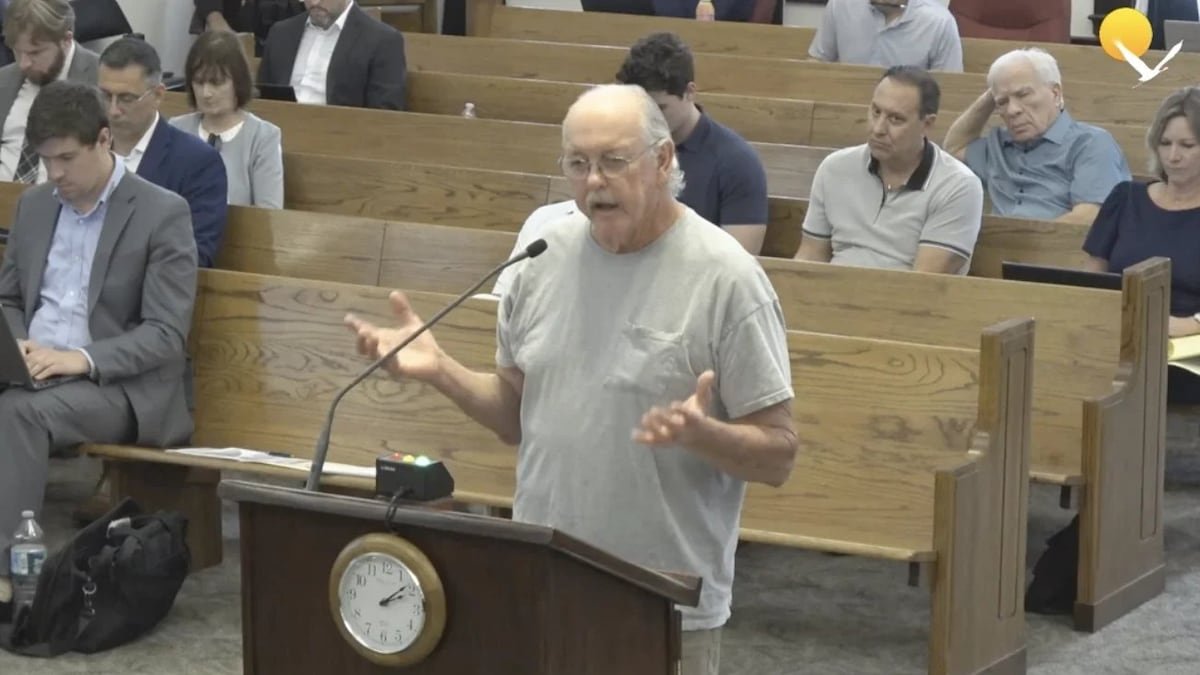
Pasco County’s Connected City once again took center stage at a recent Planning Commission meeting, as residents from the Kenton and Elam roads area voiced opposition to a proposed commercial development.
At the heart of the debate: the Kenton Road commercial master-planned unit development, a project seeking to transform 10 acres of agricultural land into a bustling community hub.
The proposal includes 110,000 square feet of nonresidential entitlements (90,000 square feet of storage, 20,000 for commercial/retail) and 120 hotel rooms. The project is located at the northwest corner of Kenton and Elam roads.
Under the county’s Connected City master plan, the site is designated as a community hub, intended for medium-density, mixed-use development that supports recreation, culture and social gathering.
The plan also includes fixing some of the area’s infrastructure. The developer has agreed to construct the “missing segment” of Kenton Road from Elam Road south to Overpass Road, including a new traffic signal at Elam. The county plans to reimburse the developer for the road construction, but the developer must pay a proportionate share for the signalization.
Many of the complaints from local residents are familiar, as the Connected City and the promise it once offered have been at the forefront of several debates the last two years. Those include missing parks, buffer and runoff issues and loss of privacy.
Phillip Singletary, who lives on a private stretch of Kenton Road, warned that the new development will lead to other problems.
“It’s at the very highest point of (Kenton), which is a dirt road,” Singletary said. “It washes out. The neighbors on the road, we all pitch in and we fix the road. It’s fine. But you put in 10 acres of concrete, asphalt, more cars, that means more runoff, more water. It’s just going to devastate everybody that lives down the road.”
Other residents worried that the existing dirt roads in the area are already failing under pressure from the nearby hockey school and Johns Hopkins All Children’s Hospital, and speeding cars are more of a hazard than ever.
Michelle Burkett, whose family owns 10 acres nearby, worried that the hotel would attract “transients” to the area, while Michael Pultorak, who has appeared before the Planning Commission and Board of County Commissioners numerous times concerning the Connected City, continued to argue that the proposed uses do not align with the vision of a family-centered hub.
“The community hub is not meant for people to move their sprinkler companies or move their businesses in,” he said, citing the comprehensive plan showing that storage units and hotels have their own defined areas in the innovation zone and business district.
“There’s a place for this and it’s on State Road 52,” he added. “If you’re going to say you’re going to put in crates or some restaurants, some cafes or some restaurants, that’s a social gathering place and that’s fantastic. A hotel is not supposed to go in the community hub.”
Barbara Wilhite, representing the developer, disagreed. She said the project was “thoughtful” and that the developer had agreed to a long list of prohibited uses, like stand-alone gas stations, pawn shops with outside junk displays and car washes.
She claimed the project would “activate the streets” rather than form a traditional strip mall, and that the bottom level of the storage unit would consist of retail and commercial offices.
There was a lengthy debate over the proposed social gathering area, and what that exactly meant. Planning Commission board member Jon Moody said it was a very “nebulous” term lacking specifics.
“I don’t know what that means,” he said. “Is it one table in the middle of a coffee shop and doughnut shop, or is there some big fountain?”
He pushed for a visual concept of the plans to give the public an idea of its intended size and features.
In past Connected City debates, residents have complained about how parks and other amenities never materialized, and sometimes when they did, they did not resemble what they felt had been promised.
Wilhite pushed back and said without identified tenants, it would be impossible to provide a conceptual plan. She did say the county staff could ensure the final site plan meets the “intent of the code,” however.
But Moody said that would be too late for residents.
“I don’t mean to be overargumentative, but at the time of the site plan the public has absolutely zero rights of redress,” he said. “The redress is here at the zoning.”
Moody eventually got a definition he found acceptable and ended up voting for the project.
The Planning Commission voted unanimously to pass the project onto the Board of County Commissioners for a final decision.



