
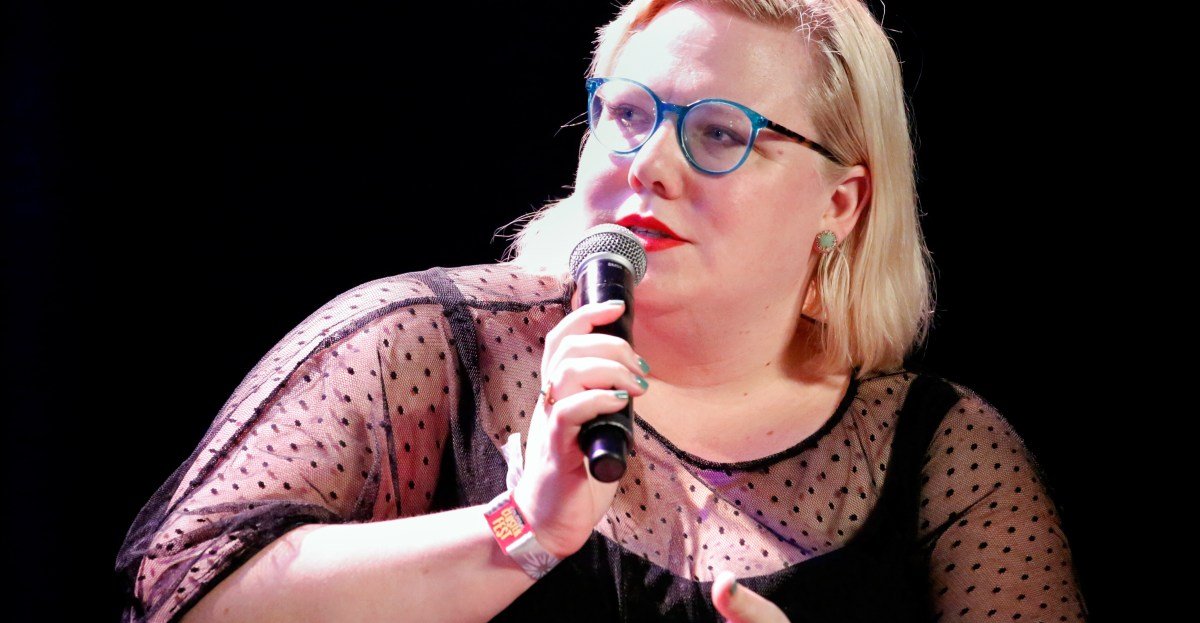
You might remember feminist writer Lindy West from her days on X (né Twitter) yelling at sexist, anti-fat trolls. Or from her book Shrill. Now, West is back with Adult Braces, a memoir detailing her journey, a literal road trip, to accepting her husband’s request to open up their marriage. Except it wasn’t really a request, as West tells it. And this time, people across social media had very strong opinions about it.
Slate senior writer Scaachi Koul joined Today, Explained co-host Noel King to talk through the internet’s reaction to West’s new book, and all that came after.
Below is an excerpt of Koul’s conversation with Today, Explained, edited for length and clarity. There’s much more in the full episode, so listen to Today, Explained wherever you get podcasts, including Apple Podcasts, Pandora, and Spotify.
Tell me about Adult Braces.
It’s a very digestible book. Adult Braces is Lindy’s memoir. This is her fourth book. She’s written a lot of political polemics, social polemics, a lot of personal writing, but this is some of her most personal. It’s a memoir about her taking a cross-country road trip, but also about her reformatting her marriage and turning towards polyamory with her husband.
Why do you think [the polyamory] has got people so upset here?
I think there’s a few trains of controversy here, and some is legitimate and some is really not. So the illegitimate complaints are kind of about this narrative having to do often with Lindy’s weight. She’s fat. She writes a lot about being fat. Or some people are saying that it has a lot to do with gender. Her partner, Aham, who is her husband — Aham goes by he/him and they/them — is nonbinary. So there’s been a lot of needless jabs at this particular facet of the story.
The other side of it is that the story that Lindy tells in this memoir — and all we really have to go on is what she tells us — is pretty brutal to her. Their entry into polyamory is not necessarily honest. A lot of people have been using the word “coercive polyamory.” It’s not a term I’ve ever heard before, but the idea that you kind of tell your partner, “it’s this or nothing.”
She’s clearly a reluctant participant for the first spell of their jaunt into polyamory. They meet someone, he falls in love with her first, and then she also falls in love with this person, Roya. And now the three of them are together.
When we frame this as it was coercive, as she was talked into it. There’s an opposite side of this that says: No, Aham, her husband, was honest with her right from the beginning, and she sort of hoped that it would never come to pass.
It’s clear that he told her, A condition of our marriage will be polyamory.
I think she understood some of the risks. She’s an adult. Lindy does not want to be infantilized. She said that several times — that she had and has autonomy, and these are her decisions. I believe that they are her decisions.
I want to bring the third into this, as the marriage did: Roya. Tell me about where Lindy starts with Roya, where Lindy ends with Roya, and why you think the ending has also made people uncomfortable.
When Roya is brought into the picture, it is true that Aham had more than one other girlfriend in addition to his wife. And so Lindy is a little…I would say she was reticent to kind of learn anything about this person and was sort of like, go do what you must. Aham starts to travel to Portland once a month to spend a weekend with Roya.
He has a big medical issue come up while she’s touring, and Roya is there to help. That starts to change the nature of their dynamic. Lindy talks a lot about — Wow, is this what it’s like to get a wife? Somebody who’s so organized, who takes care of the medical details and listens to me?
Over time, they start to develop a friendship, and then their relationship turns, and it becomes romantic. It fundamentally reshapes the entire nature of their polyamory and of their marriage and of their family. And then after that, Roya, she moves into the woods with them, and that’s where she is now.
You went out to the place where the family lives now. You wrote a profile of Lindy West. When you were there, did you push her at all on the question of coercion?
She preempts that question. I think it’s something that people have already said to her. She says that that’s just not true, and I kind of understand what she’s saying, which is, How can I prove it to you other than living in this life?
But if you try to write anything to convince other people, especially when it comes to memoir, it will feel dissatisfying. And I know that intimately. There’s only so much I can do. What I can offer is a perspective and a version of events. But as soon as I cross a threshold into feeling like I’m evangelizing for something, if you don’t believe me about my own experience, then it doesn’t mean anything.
I think people look at Lindy as a one-way mirror in a lot of ways. They see themselves in her. And when she makes decisions — when anybody in that position, [whether] a celebrity, influencer, writer, [or] creative, makes decisions that their audience doesn’t like, [that audience] takes it really personally.
Lindy is someone who I think a lot of people, especially her fan base, have viewed as bombastic and confident and bawdy and fun. And [then] compare that with the version that we read in Adult Braces — who is anxious and insecure, and being harmed by this person in her life.
As the audience, your proxy is her. You feel defensive of her.
What do you think about this argument that Lindy West’s memoir about coming to polyamory is like the death of millennial feminism?
We can have feelings about anybody’s relationship as it is displayed to us. We are entitled to that, especially when we’re being offered a commodity like a book which you purchase. But one person’s personal story, discomfort, misery, contentment, fulfillment, or lack of fulfillment does not speak to the end of a social movement that was knit together over several decades, and has more to do with Lindy West’s corner of the internet.
Social movements flex. They change. I don’t think it’s the death of anything. It is just where that version of it maybe ended up.



