
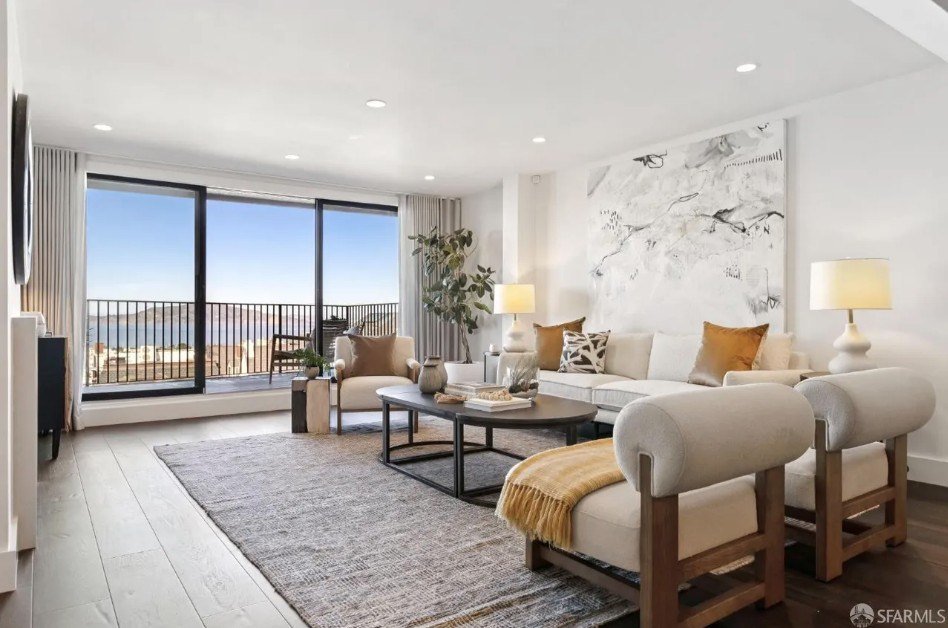
Newer doesn’t always mean better—and that’s exactly why buyers in pricey coastal markets are being drawn to legacy properties that offer character and charm. Even if the homes are smaller.
There is a distinct divide in the luxury real estate market: listings in mature coastal metros typically skew older and smaller, while growing inland communities offer newer, larger homes at lower prices, according to the latest Realtor.com® Luxury Housing Market report.
Some of America’s most celebrated cities, including New York City, Philadelphia, and San Francisco, are synonymous with well-established luxury rooted in history.
“In these metros, luxury housing is not defined by new construction or master-planned communities, but by mature neighborhoods, older architecture, and homes built decades ago that have retained value through location and scarcity rather than recency,” says Realtor.com senior economist Anthony Smith.
Simply put, some affluent home shoppers place a premium on living in prestigious cultural capitals like New York City and are willing to trade size and newness for location—often opting for older, smaller homes at prices comparable to mansions in the Southwest.
Nationally, entry-level luxury—defined as the top 10% of the market—begins at $1,193,000, with a median year built of 2003, according to the January 2026 luxury housing report from Realtor.com.
The typical home in the $1 million to $2 million price range measures 2,931 square feet and spends 92 days on the market.
In many of the priciest coastal markets, however, the median year built dates to the 1970s through the 1990s, and luxury homes average closer to 1,600 to 2,000 square feet.
“That size gap underscores a key difference in what buyers are paying for,” notes Smith. “In these metros, value is driven more by land, neighborhood prestige, and proximity to jobs or waterfronts than by square footage or new construction.”
West Coast leads in the oldest luxury housing stock
San Francisco stands out for having the nation’s oldest luxury housing inventory, with the median year built of 1974.
The typical entry-level high-end home in the Golden City in January came with an asking price of $2,499,000 and waited for a buyer 78 days, which was two weeks faster than the national median.
Located just 50 miles to the southeast in the heart of Silicon Valley and populated by a large contingent of tech workers and venture capitalists, San Jose, CA, where the top 10% of listings start at $3.15 million, has the second-oldest luxury inventory, with the typical home built in 1977.
Alexander Kalla, a San Francisco Bay Area–based real estate agent, tells Realtor.com that San Jose’s older luxury housing stock has a strong following among house hunters.
“A lot of my buyers in this category are established families and move‑up buyers who value larger lots, mature trees, and wider streets more than brand‑new construction, and they are comfortable doing selective remodeling to get the modern, open‑concept interiors they want,” says Kalla.
“We also see investors and international buyers targeting this legacy inventory because they can add value through renovations in locations that are already built out and close to major employers and top schools.”
San Jose’s breakneck selling pace
Perhaps unsurprisingly, the city’s 50- to 60-year-old luxury homes are flying off the market, selling in a median of just 19 days last month.
Kalla attributes this ultrafast market pace to a “perfect storm of undersupply and deep-pocketed buyers who are less sensitive to mortgage rates.”
Like other in-demand coastal legacy metros, San Jose has a very tight luxury inventory, so every well-priced listing that hits the market triggers a frenzy among buyers—even in winter, when most markets slow down, according to Smith.

“On top of that, you have high‑earning local tech and AI professionals whose stock and compensation have recovered last year, so they’re willing to compete aggressively for rare, move‑in‑ready homes in prime neighborhoods,” adds Kalla.
Kalla notes that while buyer demand is strong, San Jose’s bottleneck is luxury inventory supply.
“I currently have several fully pre‑approved clients I can’t get into contract because there just isn’t enough inventory coming to market,” he says. This environment leaves no space for shoppers to take their time to make a decision or try to negotiate a discount.
“The best homes often sell quickly and close to or above list price,” adds the agent. “If you wait for a ‘perfect’ deal, you often end up watching the right house go to a better prepared buyer.”
What distinguishes San Jose from some of the other top-tier markets, according to Smith, is that affluence is baked into the broader housing stock rather than concentrated just at the pinnacle. More than half of all the city’s listings are priced above $1 million, nearly five times the national share.
Unlike the Sun Belt markets gleaming with new subdivisions, San Jose’s luxury supply is the product of decades of development, with a large percentage of inventory dating to the 1950s and 1960s.
Many properties in the $1 million to $2 million range are relatively small by national standards, highlighting that value is driven less by size and more by location sought after by Silicon Valley’s high-earning households.
“High‑end buyers can live in neighborhoods with large backyards and top‑rated schools while being within a short commute of major campuses and downtown job centers, which is a rare combination even within California,” says Kalla.
Other standout legacy markets
On the East Coast, New York City ranked among the oldest luxury markets, with a starting price of $2.99 million and the third-oldest 90th-percentile housing stock, dating to 1990.
It was followed by Urban Honolulu, HI, where entry-level luxury homes are priced at $2,375,000 and the median year built is 1992. Key West, FL, rounded out the five oldest high-end markets, with a typical luxury home built in 1994 and priced at $5,295,000.
Other markets with notably aging luxury inventories include Los Angeles (1996), Oxnard, CA (1997), Philadelphia (1997), and San Diego, CA (1999). Washington, DC, and Riverside, CA, tied for 10th place with median build years of 2000.
“These older luxury markets highlight a common theme. At the top end, age is often secondary to location and scarcity,” says Smith. “Established neighborhoods, limited developable land, and consistent buyer pools help support pricing and turnover even when the underlying homes are decades old.”



