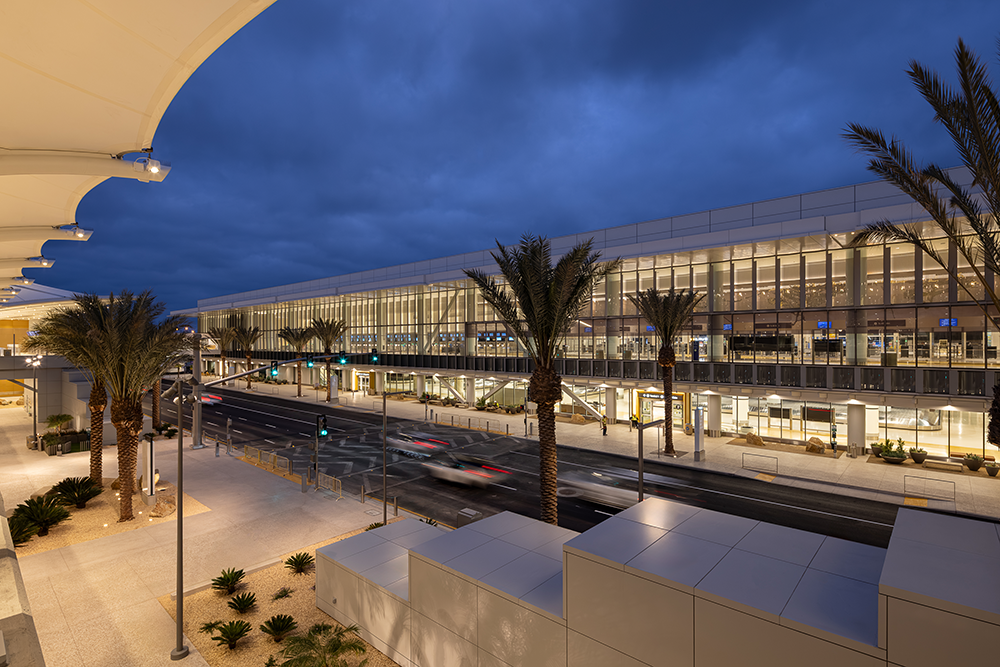
SAN DIEGO – Travelers who find it easier getting to and from San Diego International Airport have Latitude 33 to thank.
Based in Scripps Ranch, Latitude 33 was the lead civil engineer on the $4 billion airport project to build a new Termina 1, collaborating with Kleinfelder, based in downtown San Diego, to build the new Terminal 1 and the roadways around it.
“It was a massive project,” said Matt Semic, president of Latitude 33.
“The scale of the work is really unmatched with the roadway systems, the number of people that are going to be there.”
Latitude 33 was responsible for the civil engineering on “basically everything you see from the terminal, all the roadways, all the utility infrastructure,” Semic said.
“Kleinfelder was our partner in the effort. Kleinfelder’s structural engineering group designed all the bridges and all the elevated roadway system,” Semic said. “We designed all of the roads and the whole system, and they did the structural engineering for the bridge pieces. They were also the geotechnical engineer for the job.”
Semic said that Latitude 33’s share of the Terminal 1 project cost about $500 million and is the biggest project that the company has ever done.
The company has done some smaller airport work, “but not nearly to this scale.”

Challenges in ‘Roaring Success’ Project
Declaring the project “a roaring success,” Semic said that, “We were pretty well prepared.”
“It was a major effort, but honestly, we didn’t encounter too many things that were unexpected. It went and has been going very, very well. There’s a lot of challenges that we knew were going to come up,” Semic said.
Among them was designing a project that Semic described as “basically a bathtub.”
The airport is built on land that is barely above sea level, “so you dig a hole and all of a sudden, it fills up with water,” Semic said.
“It’s just like being at the beach, and you start digging a hole in the sand, it fills with water. That’s what the airport conditions are,” Semic said.
In the new terminal, baggage handling systems and utilities are all below ground level.
“You’re constantly pumping water and trying to be able to build,” Semic said, adding that the work required installing “very elaborate pumping systems.”
“It’s just a constant cycle of trying to be faster than the water coming in,” Semic said.
Yet, the biggest challenge, according to Semic, was doing the work while creating the least amount of disruption.
“It is an airport, so it needs to stay fully functional at all times, and that means operationally, we need to consider the passengers that are arriving on a regular basis.”
That entailed “making sure all the utilities still work “and that roads stayed open, Semic said.
New roadways designed by Latitude 33 as part of the project are meant to move all of the cars and much of the airport supporting traffic off North Harbor Drive,” Semic said.
“The hard part is, with the airport, you still have to go through local streets to get there,” Semic said. “Once you get to the airport, you no longer have to drive on North Harbor Drive, you no longer need to figure out what entrance you need to go into for what terminal. It’s one road, and you don’t have to deal with traffic signals and local streets and (traffic) weaving in and out.” Semic said.
As part of its task, Latitude 33 also managed 27 construction packages detailing the project.
“The construction packages are basically all of the permitting that we need to handle, it’s all of the design, it’s all of the approvals,” Semic said. “Basically, we’re writing the instruction manual for the contracts.”
That included construction drawings detailing the work.
“There were thousands and thousands of pages with engineering design and instructions on them,” Semic said. “We probably had 2,500 to 3,000 sheets on this. It’s crazy.”
To put that in perspective, Semic said that a typical construction project would have fewer than 100 pages detailing the civil engineering involved.
“We were writing the construction manuals for the contractors,” Semic said.“There were thousands of pages of design.”
The project also involved moving the historic United Airlines hangar to a new site.
Continued Work, Other Projects
Although Terminal 1 opened in September, Latitude 33’s work on the airport continues as the airport moves into its next phase of development, adding 11 new gates for the new terminal and a connector between Terminal 1 and Terminal 2.
In addition to the airport, Latitude 33’s other San Diego projects include the University of California San Diego Hillcrest Medical Campus redevelopment, the San Diego County Operations Center in Kearny Mesa that consolidated most county operations in 15 buildings on a 47-acre site, modernizing Johnson Magnet Elementary in Emerald Hills, The Havens master planned community in Bonsal, with 164 single-family homes, a vineyard and a winery, and Oceanside Fire Station 8.
Latitude 33 Planning & Engineering
FOUNDED: 1993
HEADQUARTERS: Scripps Ranch
PRESIDENT & PRINCIPAL: Matt Semic
BUSINESS: CRE planning, engineering and surveying
EMPLOYEES: 65
WEBSITE: www.latitude33.com
CONTACT: 858-751-0633
NOTABLE: Serving the region’s largest employers and civic institutions, Latitude 33 has worked on many of San Diego County’s highest profile projects, including planning and engineering of the new Terminal 1 at San Diego International Airport

A native of New England, Ray Huard has been a reporter at newspapers in California, Florida and New England, including The (Jacksonville) Florida Times-Union, the Miami Herald, the Palm Beach Post in West Palm Beach, the San Diego Union-Tribune, the North County Times, and the San Diego Business Journal. He has covered a wide variety of beats including real estate, politics, science, the environment, state and city government and courts.