
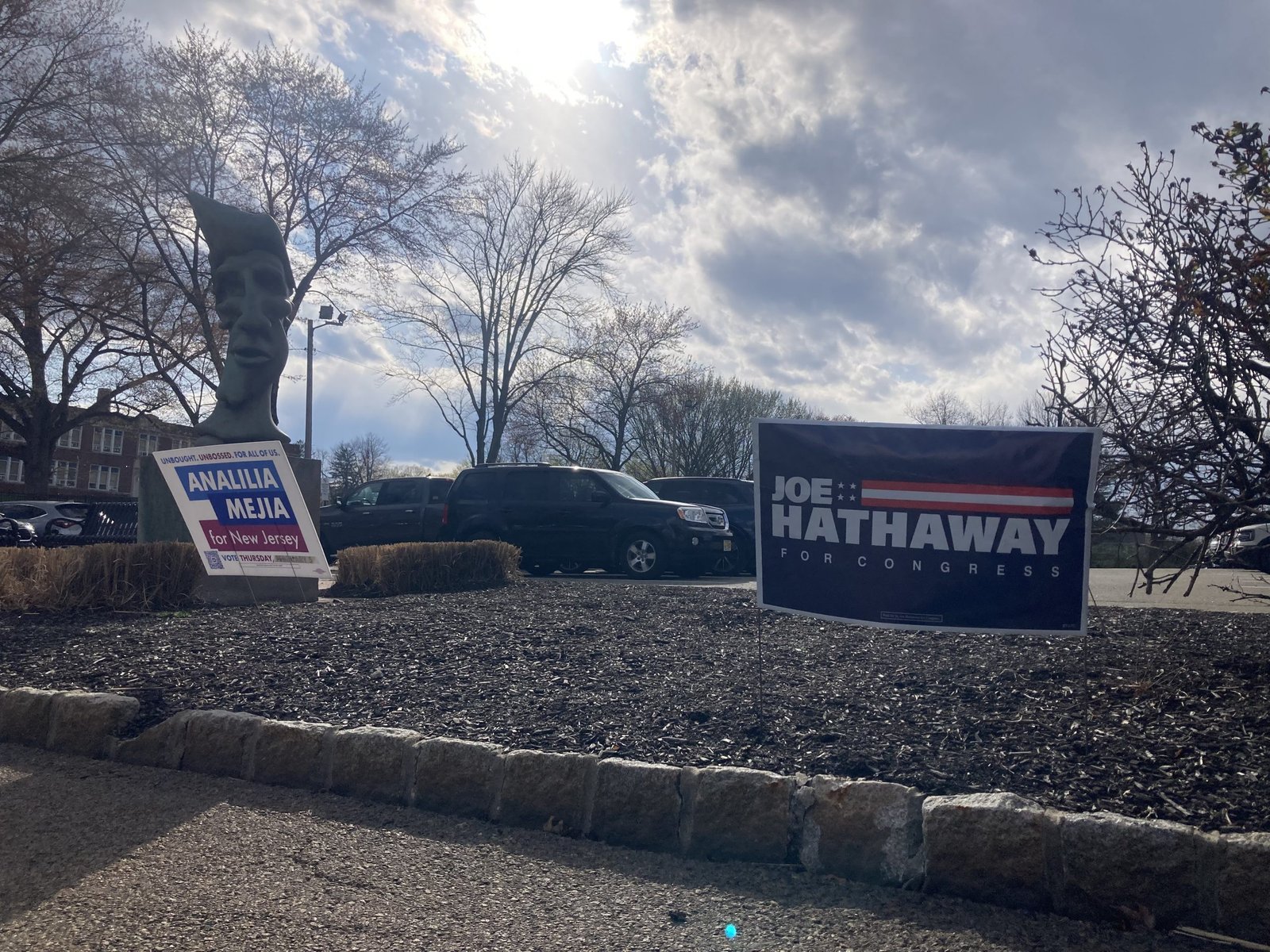
Regardless of who wins next week’s special election in New Jersey’s 11th congressional district, voters are in for a change.
11th district Democrats, though satisfied with their representation by now-Gov. Mikie Sherrill for seven years, have nominated a staunch progressive, Analilia Mejia, to succeed her. While the moderate Sherrill came from an apolitical military background, Mejia cut her teeth in the trenches of New Jersey progressive politics, and has promised to bring a new energy to what’s long been seen as more of a centrist district.
Hoping to halt Mejia’s rise is Joe Hathaway, a Republican councilman and former mayor in the Morris County suburb of Randolph. Hathaway has been more willing than many GOP politicians to break with President Donald Trump and promote a more bipartisan image, but he remains a loyal Republican who says Democrats have veered far off course.
By any measure, Mejia is the favorite to win. The 11th district includes a mix of left- and right-leaning North Jersey suburbs, but the left-leaning ones have a mathematical advantage; in the 2024 presidential race, Kamala Harris carried the district by a 53%-44% margin, and the political environment has only improved for Democrats since then.
Mejia has also raised and spent substantially more money – she’s raised $1.1 million overall to Hathaway’s $525,000 – in what has been a relatively below-the-radar contest. Neither national party has deigned to get financially involved, which should probably be seen as a sign of confidence from Democrats and of pessimism from Republicans.
In fact, the 11th district is something of a political microcosm of the state as a whole, voting within a few percentage points of the statewide result in all four recent gubernatorial and presidential elections. As the 11th district goes, perhaps so goes New Jersey, which Hathaway said is all the more reason to reject Mejia.
“What we are seeing now is the evolution of Democrat candidates who are now taking on this Zohran Mamdani, AOC, far-left flavor, and that is becoming the norm in their party,” Hathaway said at a meet-and-greet in Madison on Wednesday. “If Mejia can win here, if a candidate like that can win NJ-11, there’s going to be no stopping this kind of candidate. That is going to be where their party goes.”
Mejia counters that it’s Hathaway who’s deeply out of step with the 11th district, where the label of “socialist” might not be a winner (Mejia has sworn off the term for herself) but where the label “Republican” may be even more damaging.
“He’s a one-trick pony,” Mejia said of Hathaway after a town hall in Chatham on Monday. “He has nothing in his toolbox. My kids, when they don’t have an argument to make, when they’re losing because they don’t have a substantive thing to present, they fall to name-calling. That’s what Joe Hathaway is doing. I’m kind of used to it, I deal with teenage boys.”
Nearly 40,000 voters have already cast their ballots by mail or via early in-person voting, and almost two-thirds of them have been registered Democrats, who have built up a huge lead particularly among mail voters. But every other voter in the district is still theoretically up for grabs – and Mejia and Hathaway will be fighting for every one of them.
‘We are going into this election united as Democrats’
Back in the February primary, plenty of things differentiated the 11 Democrats running, but one thing united them: fierce, unwavering opposition to Donald Trump. That hasn’t changed.
At Monday’s town hall with former Rep. Tom Malinowski – Mejia’s closest rival in February – and Maryland Rep, Jamie Raskin, the very first topic was Trump. What can Congress do, Mejia asked, to stop an “unhinged president” from waging reckless war in Iran and unraveling American democracy?
For Mejia’s voters, too, Trump is top of mind. The New Jersey Globe spoke with eight Mejia voters at an early voting site in Madison, and nearly all of them referenced the need to take back control of Congress and rein in Trump as their primary motivation. Several couldn’t remember who they voted for in the primary, one supported Mejia rival Tahesha Way, and one said he didn’t vote in the primary at all because he was still a registered Republican at the time – but all were willing to support for just about any Democrat to halt Trump.
“Never again will I vote Republican,” one voter said. “And neither did my parents, and they were Republicans all their lives.”
Mejia, 48, has also laid out an ambitious policy agenda that includes goals like Medicare for All, a $25-an-hour minimum wage, and abolishing Immigration and Customs Enforcement. Those were the sorts of progressive ideas that helped her win the primary, and she hasn’t shied away from them even now that she’s facing a general electorate.
“She’s progressive, she’s for working people, and she’s unbought by big corporations and [American Israel Public Affairs Committee] money,” one voter who supported Mejia in both the primary and the general said.
But while Mejia’s positions haven’t changed since the primary – campaign literature passed out at Monday’s town hall still lists “abolish ICE” as a top priority – she has also shifted to speaking about unifying the Democratic Party and, when necessary, rejecting a left-wing fringe that seeks to divide people.
“We suffer from maximalism on both sides of the aisle, where we are trying to hold ourselves and our supporters to a level that actually leaves people behind,” Mejia said. “We have a duty to both represent and protect the rights of all our constituents.”
In particular, Mejia has worked to bat down the idea that her critical stance on Israel is akin to antisemitism, which Hathaway has made a focal point of his campaign. Earlier today, Mejia announced an endorsement from J Street PAC, a progressive-leaning Zionist group that aims to be a counterweight to more hardline groups like AIPAC.
AIPAC, for its part, directly and indirectly spent nearly $4 million to influence the February special primary – but that money was meant to sink Malinowski, not Mejia. The fact that Mejia, who is more of an Israel critic than Malinowski ever was, won instead was something of a freak accident for the pro-Israel group.
Malinowski said during the town hall that Democrats need to take a firmer stand against super PAC spending, and in a press gaggle afterwards, Mejia firmly agreed with him.
“As voters, we should only support people who are willing to reject that kind of money, because you can’t oversee it, you can’t challenge it, if you’re beholden to it,” she said. “Our party can do more. The Democratic Party can vote to say we’re going to reject or question these particular types of expenditures, fundings, organizations, and tactics.”
‘As Republicans, our mission took on a whole new meaning’
Hathaway, 38, has known for months that he would be facing voters on April 16; he was the only Republican who ever even expressed any public interest in what would always be a difficult battle for his party.
But he didn’t know who his opponent would be until February 5, when Mejia beat several better-funded, more moderate foes to win the Democratic nomination. Once Mejia was declared as the winner a few days after the election, Hathaway said, his own campaign took on a whole new focus.

“She is unquestionably the furthest left, radical progressive, socialist candidate that they could have put forward,” Hathaway said during his stump speech in Madison on Wednesday. “[When she won], our mission became a whole lot more important. As Republicans, our mission took on a whole new meaning.”
That’s a concern echoed by Hathaway’s voters, too. Three Hathaway supporters who spoke with the New Jersey Globe outside the Madison polling location cited Mejia’s left-wing stances as one of the core reasons they came out to vote Republican.
“She is so, so, so far to the left,” one said. “She’s a socialist, and I see the direction New York City is going,” another warned.
At Hathaway’s meet-and-greet, local loyal Republicans had plenty of other issues, too: what would Hathaway do to ensure illegal immigrants get deported? What about the SAVE America Act, a Republican-led voter ID bill that’s gotten bottled up in the U.S. Senate? Or affordable housing mandates, which red and blue suburbs alike have often chafed against at the state level?
But Hathaway has also emphasized – even to Republican crowds – that if voters send him to Washington, he doesn’t want to be a rubber stamp for his party or the president. On certain issues like the Gateway Tunnel project, he’s explicitly broken with Trump, and he’s heavily promoted a handful of endorsements from former local Democratic officials who have broken with their party to support him.
“In South Orange, Maplewood, Montclair, we are meeting with rooms full of Democrats – not a Republican in sight,” Hathaway said. “Democrats who are afraid of what her platform means for their party and for our safety in this district, and are opening the door to do something they’ve never done before, which is vote for a Republican.”
Even if some voters are amenable to that message, though, Hathaway is facing major headwinds. Recent polling has shown Trump deep underwater in New Jersey (and Sherrill well above water), and those polling numbers are probably matched in the 11th district. Other special elections around the country have featured double-digit Democratic overperformances – in Georgia earlier this week, a Democrat did a whopping 25 points better than Trump’s 2024 result – which may be a GOP death-knell in an already Democratic-leaning district.
Last month, Mejia released an internal poll putting her up by 17 points, a margin that would nearly match Sherrill’s 19-point landslide in 2022. Hathaway’s campaign said that the polling they’ve done hasn’t shown as lopsided of a result, but they haven’t released those numbers publicly.
But because he’s running in an April special election with a November general election just a few months away, Hathaway has a unique pitch for more moderate voters skeptical of electing a Republican: give him a chance, and if they don’t like it, kick him back out in November.
“They can test-drive a Republican if they want,” he said. “They have an opportunity, a pretty unique one, to say, ‘I’m going to vote for this guy, because I’m really concerned about what his opponent has to say, or I like what he has to say, and I’m going to have the chance to hold him to account for what he says he’s going to do from now until November. And if I don’t like it, I can vote for somebody else.’”



