
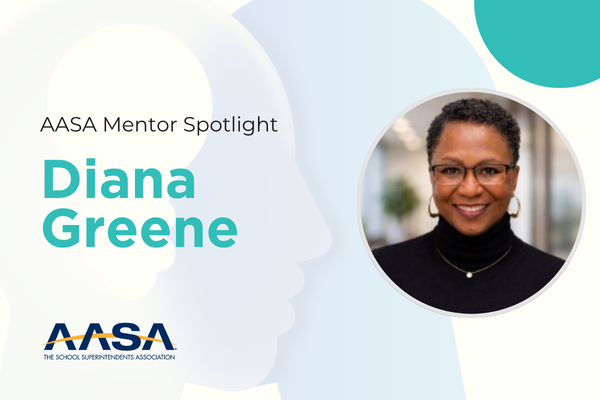
AASA mentors help district leaders see their own potential, navigate complex challenges, and stay focused on what matters most for students. In this conversation with Diana Greene, a mentor of the AASA-Howard Urban Superintendents Academy, you’ll read why effective leadership demands both wisdom and humility, how the right questions accelerate growth, and what it means to lead with courage when students are always at the center.
From your perspective, what are the qualities that make a good mentor?
The best mentors bring deep and varied experience in executive leadership, but they do not lead from a place of expertise alone. Strong mentors use their lived experience to create space for reflection, not prescription. A good mentor understands that mentees are not empty vessels—they come with their own leadership stories, instincts, and earned wisdom.
A good mentor helps mentees examine their practice thoughtfully, ask better questions of themselves, and grow their capacity to learn at an accelerated pace. Mentorship, at its best, strengthens a leader’s ability to think critically, discern when to lead and when to follow, and make decisions grounded in both purpose and context.
Ultimately, effective mentors focus on developing leaders who empower others—leaders who bring out the best in those around them and create conditions where teams, systems, and communities can thrive. A good mentor does not push their own philosophy onto the mentee; instead, they help the mentee clarify and embrace their own philosophy and chart a personal path toward excellence.
The best mentors bring deep and varied experience in executive leadership, but they do not lead from a place of expertise alone. Strong mentors use their lived experience to create space for reflection, not prescription.
What is the most valuable piece of advice you have received from a mentor?
The most valuable advice I received from a mentor was to be as cunning as a snake and as humble as a dove. That guidance stayed with me throughout my leadership journey and shaped how I approached some of the most complex decisions I faced.
I learned to embrace it as a reminder to be wise in my planning, thoughtful in my interactions, and intentional in my actions—aware of the power and influence that comes with the superintendent’s role; never allowing ego to shape my decisions but always grounded in humility. Leadership brings power, influence, and access, and I was taught to use those tools carefully and for good.
I led with urgency and fearlessness when the moment demanded it, but I never lost sight of who the work was for. Children, families, and employees remained at the center of every decision, serving as my constant guide and measure of whether I was leading well.
The educational landscape is changing rapidly — politically, culturally, and technologically. What does effective superintendent leadership look like in this moment?
I often describe effective leadership in this moment as requiring a-FATA Attitude.
F — Feel. Feel represents your “why.” It is the deep commitment to children, educators, and communities—and the belief that every student deserves access to a high-quality education. This purpose anchors leadership, especially when external pressures threaten to pull focus away from students.
A — Ask. Effective superintendents ask the right questions. They use data to drive inquiry—asking how systems can improve, where gaps exist, and how outcomes for students can be strengthened.
T — Think. Leaders must think critically about solutions. This includes developing strategic plans, anticipating challenges, and empowering others to help design and lead meaningful change.
A — Act. Plans have little value without action. Leadership requires implementation, follow-through, and accountability to ensure decisions translate into real improvements for students.
Even when superintendents are making principled, student-centered decisions, they must do so knowing their tenure is not protected. Effective leadership in this moment requires courage—choosing to act in the best interest of children and families despite personal and professional risk. When leaders ground themselves in their why, ask the right questions, think critically, and act with intention, they can maneuver through today’s complex educational landscape with clarity, courage, and fearlessness—always keeping students at the center of the work.
Effective leadership in this moment requires courage— choosing to act in the best interest of children and families despite personal and professional risk.
How has mentoring changed the way you think about your own leadership?
Mentoring has deepened my understanding of leadership as a continuous learning journey. It reminds me that no matter how much experience I bring to the role, I must remain a listener first.
Working with mentees has sharpened my own leadership practice because they bring insight, perspective, and wisdom that challenge my thinking. Their questions push me to reflect more deeply, stay current, and examine my decisions with greater intention.
Mentoring has also reinforced for me that effective leadership is not about having all the answers. The mentor–mentee relationship is grounded in collegiality and mutual respect, and through that exchange, I grow alongside those I support. It has made me a more reflective, more grounded leader—committed to continuous learning and to becoming a better version of myself in service of others.



