
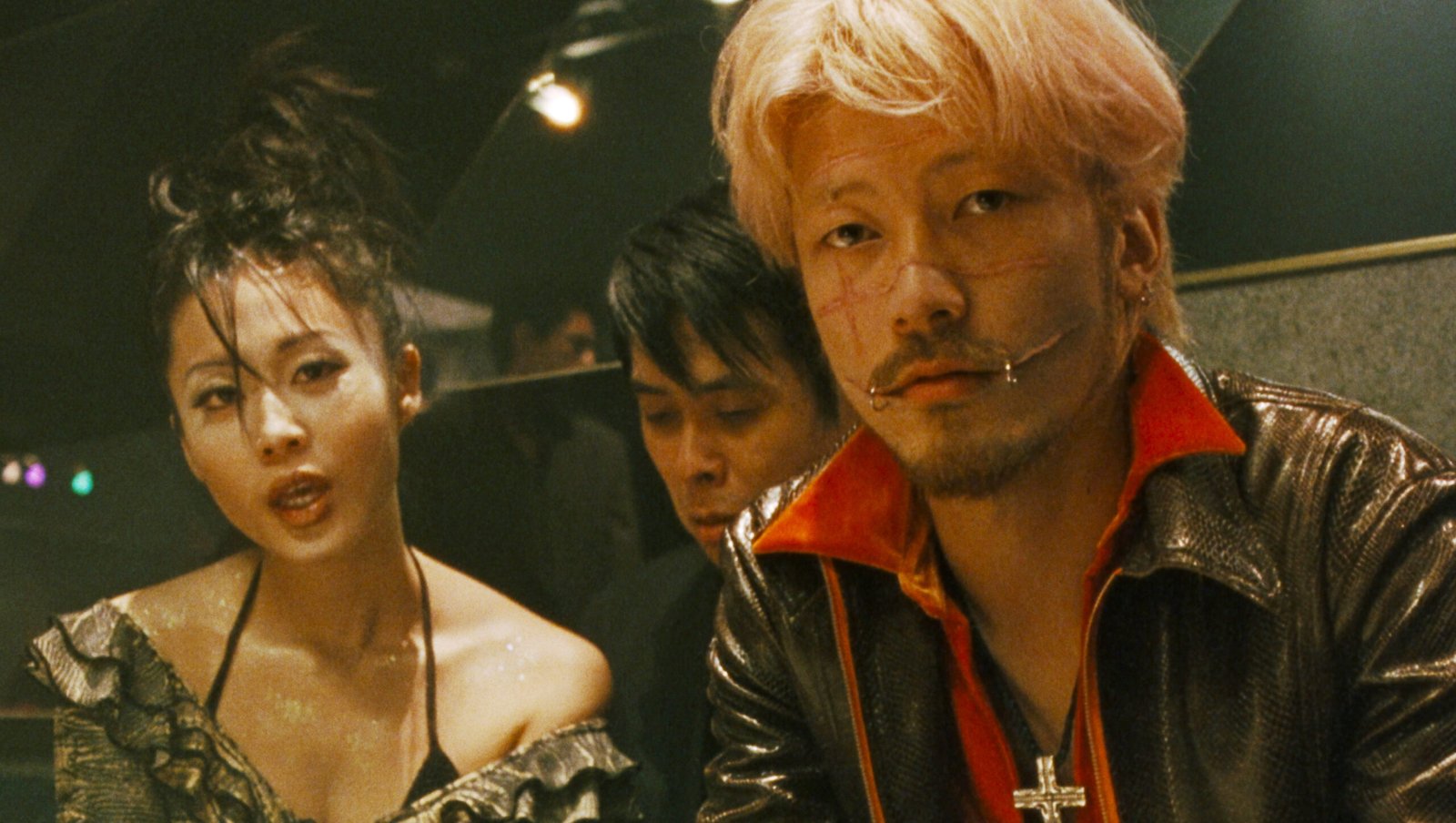
One of the most infamous titles in Japanese cult cinema is set to return to theaters in a newly restored format, as Takashi Miike’s “Ichi the Killer” celebrates the 25th anniversary of its original release. First unveiled in 2001, the ultra-violent crime story, adapted from the controversial manga by Hideo Yamamoto, quickly gained notoriety worldwide for its shocking imagery and uncompromising depiction of violence. Now supervised by director Takashi Miike and cinematographer Hideo Yamamoto, the film has been restored in 4K and will return to Japanese theaters under the title “Ichi the Killer 4K,” opening nationwide on May 15. The re-release will begin at venues including Shinjuku Musashino-kan and Human Trust Cinema Shibuya before expanding to additional locations across the country.
Set in the neon-lit criminal underworld of Kabukicho in Tokyo’s Shinjuku district, the story begins with the mysterious disappearance of the boss of the Anjo yakuza group, along with 300 million yen in gang money. His disappearance triggers a violent chain reaction among the remaining members of the organization. Leading the search is Kakihara, portrayed with electrifying intensity by Tadanobu Asano. A sadomasochistic yakuza who derives pleasure from the pain inflicted upon him by his boss, Kakihara becomes convinced that the missing leader has been kidnapped and remains alive. His obsessive investigation quickly turns Kabukicho into a battleground of brutality as he interrogates and tortures members of rival gangs in pursuit of the truth.
During the search, Kakihara hears whispers about a mysterious assassin known simply as Ichi. Played by Nao Omori, Ichi is a deeply disturbed individual whose violent impulses manifest in a grotesque fashion: a former victim of relentless bullying, he murders his targets while crying uncontrollably. Fascinated by the sheer brutality of Ichi’s killings, Kakihara develops an obsessive fascination with the elusive killer, expressing an almost ecstatic desire to meet him and experience the ultimate despair of death at his hands. As the two men move through the chaotic streets of Kabukicho, repeatedly missing one another, the tension builds toward an inevitable confrontation.
Miike’s adaptation of Yamamoto’s manga remains one of the most extreme cinematic explorations of human depravity ever brought to the screen. The narrative revolves around two profoundly disturbed figures, a psychotic killer manipulated by unseen forces and a sadomasochistic yakuza underboss whose worldview revolves around pain and domination. In this universe, morality is conspicuously absent. Violence is not simply a narrative tool but the driving force of the entire experience, an aesthetic and thematic centerpiece that defines the tone of the work from beginning to end.
The film’s notoriety at the time of its release was immense. Its graphic imagery shocked audiences and censorship boards around the world, leading to heavily edited versions in multiple territories, while Norway famously banned the film outright, prohibiting not only its exhibition but even its distribution and ownership. Scenes of grotesque torture, mutilation, and psychological cruelty quickly became part of the title’s legend among cult cinema audiences.
Among the most infamous moments is the sequence in which Kakihara tortures the boss of a rival gang, played by Susumu Terajima. Suspended from the ceiling by hooks piercing his skin, the victim endures a series of increasingly sadistic acts as Kakihara calmly drives needles into his face and pours hot oil over his body. The shocking power of the scene lies not only in the graphic imagery but also in Kakihara’s unsettling composure and delight throughout the ordeal, a performance that cemented Tadanobu Asano’s portrayal as one of the most unforgettable villains in modern Japanese cinema.
Beyond its brutality, however, “Ichi the Killer” also stands out for its distinctive visual style and anarchic creative energy. Hideo Yamamoto’s cinematography captures the grimy, neon-drenched atmosphere of early-2000s Kabukicho with a raw immediacy, while Yasushi Shimamura’s rapid editing and Seiichi Yamamoto’s aggressive musical score often give the picture the rhythm of a frenetic, violent music video. Michiko Kitamura’s flamboyant costume design further amplifies the film’s grotesque aesthetic, particularly through Kakihara’s now-iconic appearance.
The cast surrounding Asano and Omori includes a remarkable lineup of Japanese talent such as Shinya Tsukamoto, SABU, Jun Kunimura, Suzuki Matsuo, Susumu Terajima, Kiyohiko Shibukawa (credited as KEE), Shun Sugata, Toru Tezuka, and Yoshiki Arizono. Together they populate a chaotic underworld that perfectly reflects Miike’s fascination with the darkest corners of human behavior.
To commemorate the anniversary re-release, a special collaboration has also been announced with the streetwear brand weber. Official merchandise connected to the title has historically been extremely limited, making the new collection particularly notable for longtime fans. The lineup will feature apparel incorporating key artwork and iconic scenes from the production, designed to evoke the aesthetic sensibilities of the late 1990s and early 2000s through careful attention to layout, printing techniques, and fabric textures.
A quarter of a century after its original release, “Ichi the Killer” remains a landmark of extreme cinema, a work that pushed the boundaries of what mainstream audiences could tolerate while simultaneously achieving cult status around the world. The new 4K restoration offers viewers the opportunity to revisit Miike’s shocking masterpiece on the big screen, rediscovering a work that continues to provoke, disturb, and fascinate in equal measure.
“Ichi the Killer 4K” opens in theaters across Japan on May 15.



