
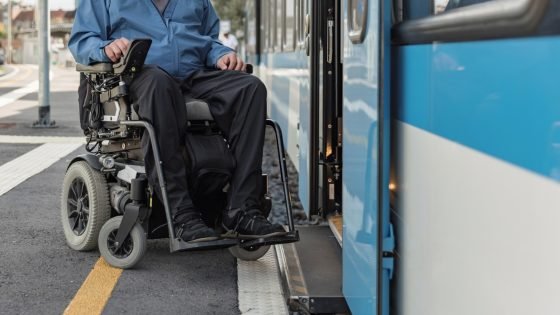
Parliament’s transport select committee has questioned whether the Railways Bill’s proposed Passengers’ Council will have enforcement power required to create a railway accessible by all.
The committee of cross-party MPs published two reports earlier this week stemming from inquiries conducted since late 2024. The first inquiry was to scrutinise the Railways Bill, which would reform the UK rail sector by creating Great British Railways (GBR), and the second examined the investment pipeline that is due to outline the work needed to integrate the network more efficiently under GBR.
Within the Railways Bill is the provision to create a new Passengers’ Council, referred to by the Government as the Passenger Watchdog. This will be formed from the current transport user watchdog, Transport Focus.
While transport secretary Heidi Alexander has said the watchdog will “set tough standards, independently monitor the experience of passengers, investigate persistent issues, and relentlessly push for a more accessible railway”, the transport select committee has questioned how this will actualise itself.
As stated in the Bill, the Passengers’ Council must “have particular regard to the interests and needs of disabled people”.
However, in the outcomes from its inquiry, the transport committee has argued that this might not be possible under the current terms of the Bill as the Council will not have enforcement powers of its own. The enforcement powers will fall to the Office of Rail and Road (ORR) while the Passengers’ Council will be given power to set standards which will become part of GBR’s licence.
The committee’s report states: “Accessibility organisations were particularly concerned that the reliance on ORR’s discretion to enforce the outcome of investigations would fundamentally undermine the role intended for the council.”
Accessibility transport access charity Transport for All told the committee: “Disabled passengers already face disproportionate obstacles when raising complaints, and this indirect model appears to add another layer of bureaucracy without increasing accountability.
“We worry that it will create further delays, weaken enforcement, confuse passengers, and result in inconsistent redress.”
Charity Whizz Kidz, which advocates for young wheelchair users, also said: “The Passengers’ Council must be given adequate powers for its role.
“For example, should the group identify a significant issue and suggest an improvement, what power will there be to ensure changes happen?
“What redress will be given if no change is made? Without the addition of a mechanism for enforcement and consequences for failure to make improvements, monitoring performance and advocating for improvements will likely not be enough to improve services for disabled passengers.”
While the transport committee said “the inclusion of the needs of disabled users of the railway in the duties applying to GBR and the Passengers’ Council is welcome”, it believes there should be more emphasis on accessibility to the railway requiring improvement under the Bill.
It said: “The Bill should be amended to require that at least two members of the Passengers’ Council have lived experience of travelling as a disabled person.
“The Government should also clarify the relationship between the new duties in this Bill and existing duties under the Equality Act 2010.”
Transport for All said: “The duty is vague, subjective and unenforceable.
“It does not guarantee improvements, define measurable outcomes, or create accountability for delivering meaningful accessibility change.”
Concluding in its inquiry, the Transport Committee states that standards set by the Passengers’ Council will be “a crucial tool in improving the passenger experience of the railways”.
It agrees with the Government on its intention for the council to set the standards but finds it “odd that the Bill only confers on it the power to do so rather than requiring this to happen”.
The committee said: “The Bill should be amended to this effect.
“The Government’s intention that the Council be able to set standards in areas other than passenger information, compensation, complaints and accessibility should be reflected more clearly in the legislation.
“The Bill should explicitly state that the Passengers’ Council has discretion to set standards on any other matters it deems necessary for the fulfilment of its statutory duties.”
Network Rail’s current programme to help improve accessibility of the rail network is known as Access for All (AfA).
Since the inception of the AfA programme in 2006, more than 270 stations have been upgraded with step-free accessible routes.
The previous government announced in May 2024 that it would start feasibility work on 50 stations to receive accessibility improvements, but without clear funding plans for delivering the upgrades.
Earlier this year, rail minister Lord Hendy stressed the need for a more rigorous and financially sustainable approach under the current administration. As a result, eight of those 50 promised projects will move straight to delivery. These include Ash Vale, Colchester, Port Sunlight, Thirsk, Walton (Merseyside), Bellgrove, and two stations already underway: Aigburth and Rock Ferry.
A further 23 projects have advanced to the detailed design phase, with upgrades planned at stations such as Battle, Bodmin Parkway, Castle Cary, Esher, Falkirk Grahamston, and Yeovil Junction among others.
Nineteen projects, however, will not proceed at this stage. These include stations such as Bushey, Chinely, Dudley Port, Maidstone West, South Croydon and Stroud.
In 2024, Network Rail admitted that the AfA programme “significantly underperformed” between 2019 and 2024, and NCE found that there was a £99M underspend on the programme in that period.
Like what you’ve read? To receive New Civil Engineer’s daily and weekly newsletters click here.
Source: www.newcivilengineer.com



