
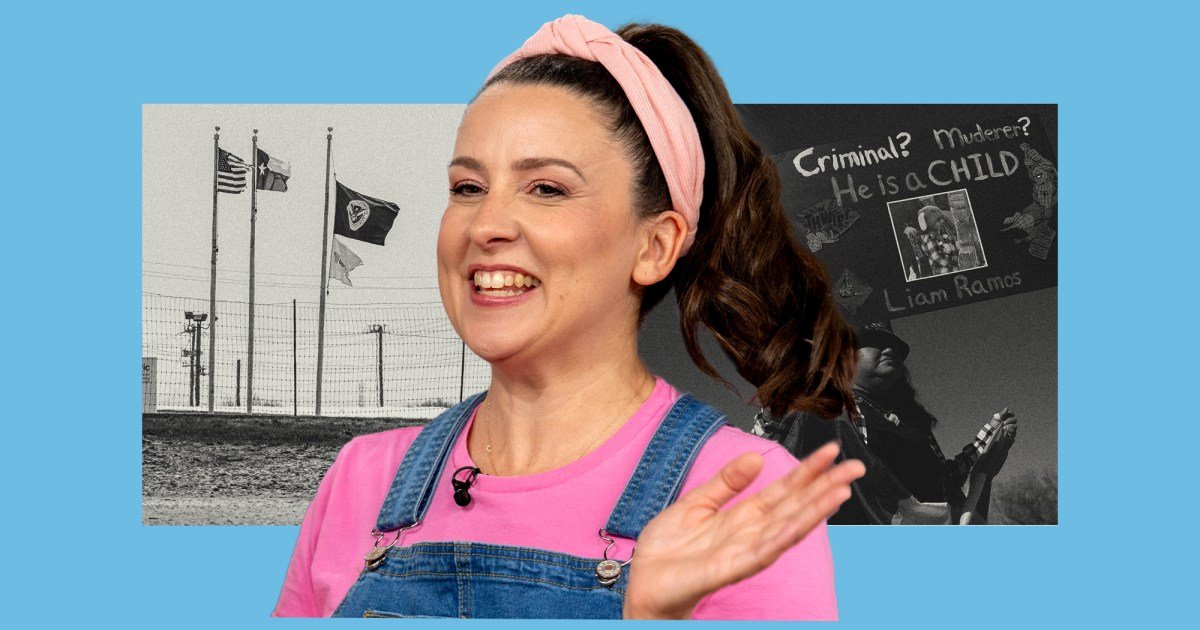
Mother Jones illustration; Nathan Congleton/NBC/Getty; Laura Brett/Sipa USA/AP; Eric Gay/AP
“One woman became so sick from eating the food that she began vomiting blood.”
“My kids are terrified; we are all depressed.”
“I always ask my children for forgiveness for making them suffer through all of this.”
Though the number of families inside Dilley Immigration Processing Center in Texas has dropped dramatically in recent months, for dozens of children still inside, such brutal conditions remain. Now, at the risk of their stories fading to the background of the Trump administration’s cascading crises, Ms. Rachel, the beloved children’s educator, is calling on the public to fight for their release.
“We have to hold on to hope for families who are locked in Dilley and keep going,” Ms. Rachel, whose real name is Rachel Griffin Accurso, told Mother Jones. “I do believe the public outcries and the people who have come together and worked on this long before I have are making a huge difference.”
“I do believe the public outcries and the people who have come together and worked on this long before I have are making a huge difference.”
It’s difficult to overstate Accurso’s influence, both among young children and their parents, many of whom see her as today’s Mister Rogers. Dilley is the new focus of Accurso‘s social media presence, where in recent weeks, she has highlighted the story of Deiver Henao Jimenez, a 9-year-old boy who has been detained with his family, asylum-seekers from Colombia, since early March after a routine immigration appointment in New Mexico.
“I don’t want to be here anymore,” Deiver told Accurso in a Zoom call she posted to Instagram. He repeatedly described how much he wanted to “go to the spelling bee.”
“It was devastating to hear him talk about just wanting to attend his spelling bee,” Accurso said. “I never thought I’d be on a call with a 9-year-old who was begging me for help to get out of a prison-like detention center. It was devastating and surreal.”
In a surprise move days later, Deiver and his family were released. So, too, was Gael, a 5-year-old nonverbal boy whom Accurso met over video and similarly spotlighted on her Instagram.
“When we started talking about Dilley, Deiver and his mom held each other and started crying…They are an amazing family, and I’m honored to know them.”
The Department of Homeland Security did not respond to questions about what led to their releases. But coming within days of being featured on Accurso’s Instagram, which has over 5 million followers, it’s hard not to connect what had happened with the power of her advocacy.
“I FaceTimed Deiver on Friday, and I saw a smile that was not present in Dilley,” Accurso said after the boy’s release. “He had just come home from his first day back at school with a huge card the school community had made for him. They missed him so much.”
Accurso reflected on the intensity of the experience of their conversation. “When we started talking about Dilley,” she recalled, “Deiver and his mom held each other and started crying. We know that trauma can have lasting effects on children in immigration centers. They worry and care so much for other families still at Dilley. They are an amazing family, and I’m honored to know them.”
The attention on ICE is a new political focus for Accurso, but it is not the only one. Over the past year, she has used her platform over the past year to call attention to the war in Gaza, where UNICEF reports 64,000 children have either been killed or seriously injured. Some parents have viewed such outspoken advocacy as inappropriate for a children’s educator; last year, the group StopAntisemitism wrote a letter to Attorney General Pam Bondi demanding an investigation into whether Accurso had ties to Hamas. But Accurso sees her advocacy as a natural, if not crucial, extension of the same message she imbues her educational videos on YouTube and Netflix: All children deserve to be seen for their humanity.
I asked Accurso about the disconnect she sees between critics of ICE’s detention of children and those who support such a policy.
“I think it’s really important to think of each child in this position as we think of our own children if we are parents, or a child we love, or even ourselves as a child,” she said. “Christianity and the other religions call us to practice the Golden Rule and love our neighbors as ourselves. That means to really put yourself in their shoes and imagine what they are experiencing.”
“I’ve worked with kids across so many communities, and they have beautiful differences, but they are also so similar,” Accurso continued. “They want to play, they want to learn, they care about each other. It devastates me, thinking about them watching us and seeing us not have compassion for each other. We have to do better for kids.”



