Relevancy is as fleeting as it is subjective. Look no further than your typical classroom, where a book being passionately taught by a professor is undoubtedly being judged as utterly meaningless by at least one of their students. Some people can accept these disagreements, but for M, the unnamed protagonist played by Rachel Weisz in “Vladimir,” they’re unacceptable. Edith Wharton’s work may be open to interpretation, but it’s still valuable. Anyone who thinks otherwise simply doesn’t understand, and she sees it as her job to make sure they do.
M isn’t just a professor, after all; she’s a writer, a parent, and a woman — roles that come with a certain degree of influence. In “Vladimir,” as much as M is saddened and frustrated by her fading relevancy as a professor, writer, and parent, she fixates on her waning relevancy as a wanted woman. If, as a person over 50, she can’t be convincing anymore, she’s damn sure going to be coveted.

Weisz playing such a character is the first indication “Vladimir” may not have made a smooth transition from page to screen. While readers of Julia May Jonas’ exhilarating 2023 novel could imagine anyone they wanted as their unreliable narrator, seeing a movie star with such palpable magnetism pretend she’s “lost the ability to captivate” is jarring. That she says this line directly to camera proves extra grating, in part because you’re staring directly into Weisz’s radiant chestnut eyes when she claims to be withering into some sort of sexless crone, and in part because of how poorly “Vladimir” goes about breaking the fourth wall.
Paired with their shared theme of forbidden desire and shared choice to mask their leads’ real names, “Vladimir” quickly evokes “Fleabag,” but comparison does this clumsy, incurious successor no favors. Where Phoebe Waller-Bridge’s masterpiece is provocative, nuanced, and sincere, “Vladimir” is forced, repetitive, and farcical. Ambition is a fitting, exciting trait for a show about a woman who’s desperate to feel needed, but Jonas’ adaptation of her own book keeps M at a distance even when it tries to bring us in, and makes a mockery of its hot-and-heavy central relationship without landing its evocative punchline.
At the start of “Vladimir,” M is already mid-spiral. Her husband, John (John Slattery), is suspended from teaching while the school they both work for investigates claims of sexual impropriety. He doesn’t deny sleeping with his students, only that it was wrong. If his wife knew about them, which she did, and both parties were consenting adults, which he believes they were, then what’s the problem? Beyond that, John — and, to an extent, M — contend the illicit nature of an affair between professor and student is part of the allure. The tingle, the charge, the energy you feel when wanting what you can’t have can be even more valuable than the physical fulfillment of actually hooking up.
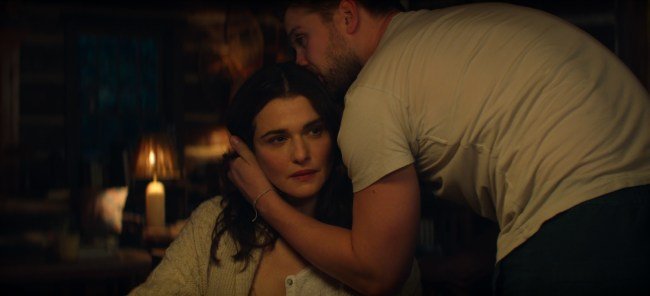
M hasn’t felt that energy in some time, it seems, but she’s quickly reacquainted when Vladimir (Leo Woodall) arrives on campus. A hotshot novelist whose latest book is the buzz of the literary world, Vlad isn’t just an attractive and brilliant twenty-something. He’s the “it” guy, and M wants “it” in every way. She fantasizes about Vlad constantly, inching ever closer to acting on her naughty impulses.
Naughty, mainly, because Vlad is a married man with a three-year-old daughter. His wife, Cynthia (Jessica Henwick), teaches at the school, too, and while she isn’t a professor like M, her career is clearly on the rise while M’s remains in a lengthy ebb. That is, until Vlad arrives and stakes a claim on her every waking thought. Soon enough, her heated crush sends her scurrying to put pen to paper, since she can’t bring herself to put Vlad on his back.

M’s argument for relishing lust as motivation for life would carry a lot more weight if she wasn’t struck so very, very dumb by love. If “Vladimir” committed fully to being a farce, perhaps M’s foolishness could be awkwardly funny, but the series treats its audience as equally witless. Characters speak in absurd double entendres no human being could leave unacknowledged. The most obvious mistakes are handled like unavoidable twists of fate. Esteemed writers fall back on lazy analogies and text like drunk high schoolers. (My god, M’s flirty messages make it all but impossible to believe this woman ever wrote an email, let alone a book.) I get that a runaway libido can make people say and do ridiculous things, but “Vladimir” pushes a relatable emotional state beyond the pale.
Worse yet is how the series depicts its unreliable narrator. From the jump, there’s no pretending M is a trustworthy guide to her story. The Netflix-mandated flash-forward opening (which, at least, originated in Jonas’ novel) shows Vlad tied up and screaming while she casually writes nearby. OK, that’s suspicious, got it. But the direction simultaneously won’t stop reminding us, “Hey, she might be lying!” while refusing to establish that the camera has a perspective of its own.
Early in the premiere, M brags about her party guests devouring her fancy salad. Then the camera pans down to reveal an untouched bowl of greenery. OK, she’s lying, got it. She’s trying to spin the narrative she prefers. But why did the camera show us that when it’s otherwise her camera? It shows us her inner fantasies, and she’s the only one to acknowledge its presence. And yet it betrays her? Is it her subconscious? Is it someone else? Let’s see where this goes…
Spoiler alert: It goes nowhere. For breaking the fourth wall to work, “Vladimir” would need to fully commit to M’s perspective, which it doesn’t. It regularly visits other characters when she’s not around, and it doesn’t even use those scenes to flesh them out or pointedly counter M’s manipulative narration. There’s no big reveals about what she’s kept from us or dramatic shifts in perspective brought on by outside characters forcing her to see who they really are (or not soon enough, anyway). When it comes to assessing who’s telling the story, the inconsistency is maddening, especially as it undercuts the sexual tension between M and Vlad, a huge chunk of the eight-episode series.
On the one hand, their lack of chemistry is intentional, since the main reason M doesn’t act on her impulses is because she keeps wondering if their flirtation is all in her head. But it’s also impossible to believe Vlad could remain oblivious to her feelings for as long as he’s required to, given how brazen (and bad) her ogling gets. She may as well turn into Slick McWolf, complete with googly eyes popping out of her head.
Weisz, who delivered a career-best performance in her last limited series, seems lost here. Not only is she perhaps too beguiling for the role, she also struggles with M’s direct-to-camera addresses. They’re unnatural in timing and content, with too much space in her quick, mid-scene asides and too little urgency when she’s all alone, with ample opportunity to share her private thoughts. Her discomfort with the formal technique seems to throw off her traditional character work, as well. Sometimes M is exaggerated for comic effect, sometimes she’s grounded, and rarely can you tell which version is appropriate for the moment.
In its final third, “Vladimir” assembles enough of its faulty pieces to get a few meaningful points across. Who we desire says more about us than them. Fearing irrelevance is only a short hop away from recognizing our mortality, and accepting our relative insignificance in the universe is as vital as pinpointing what we really need to do with our lives. “That’s why you should write,” Vlad says to M. “No one cares whether you do it or not. Something secret, dirty, only for you.”
“Vladimir” never achieves that level of intimacy. Much like M, it gets so caught up in proving its own relevancy, it overlooks the core principles of a good story. Obscurity awaits the show. Luckily, the book is still there, and infinitely better.
Grade: C-
“Vladimir” premieres Thursday, March 5 on Netflix. All eight episodes will be released at once.