
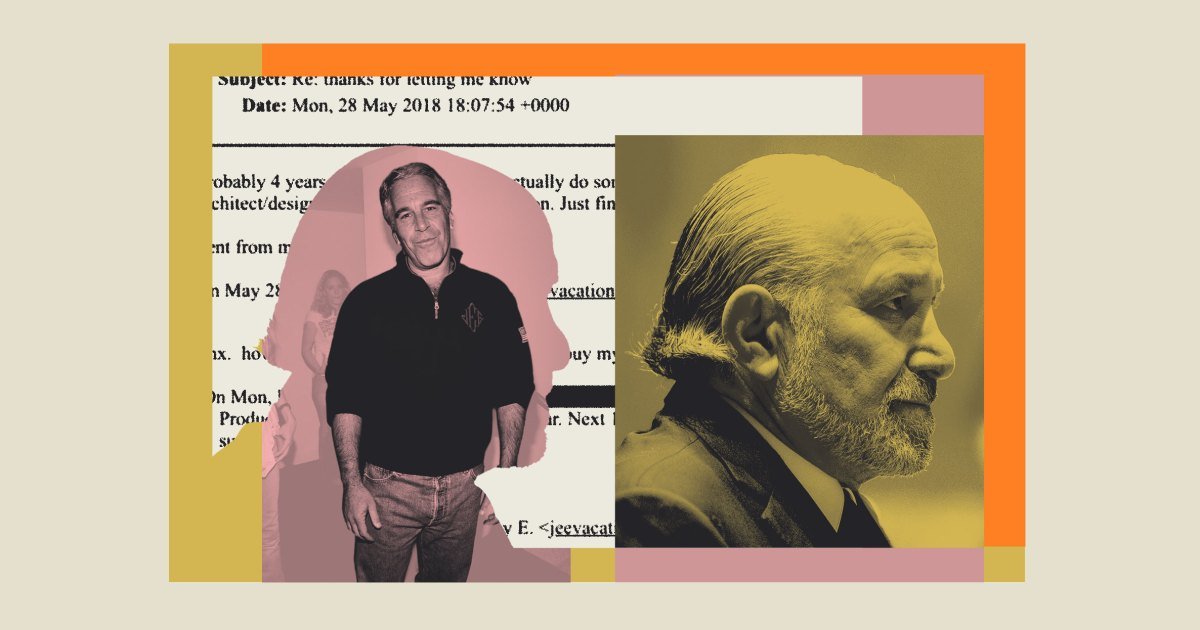
Mother Jones illustration; Neil Rasmus/Patrick McMullan/Getty; Bill Clark/CQ Roll Call/Zuma
There’s more bad news for Commerce Secretary Howard Lutnick in the Epstein files: Previously unreported documents show he hasn’t been accurate—or, perhaps, honest—about the extent of his business ties to Jeffrey Epstein.
Lutnick has had a big problem since the trove was released last month. He previously insisted he and his wife cut ties with Epstein in 2005, after they moved next door to Epstein’s mansion in New York City. In an interview last year, Lutnik said that Epstein had given them an unsettling tour of his home and that he vowed he would “never be in the room with that disgusting person ever again.”
But the files showed that Lutnick and his family visited Epstein on his private island in 2012, that Epstein in 2017 donated $50,000 to a charity dinner honoring Lutnick, and that the following year the two communicated about countering an expansion of a neighboring museum.
Earlier this month, CBS News revealed more on their connection by reporting that Lutnick and Epstein each signed a contract in 2012—four years after Epstein pleaded guilty to sex crimes—to invest in a digital ad technology company called AdFin Solutions Inc. The deal was dated just five days after Lutnick and his family visited Epstein on his private island. Lutnick signed on behalf of a limited liability company controlled by Cantor Fitzgerald, the investment firm where he served as CEO.
Lutnick’s camp has tried to minimize his involvement with Epstein through their shared investment in AdFin. A spokesperson for the Commerce Department told CBS News, “Secretary Lutnick had limited interactions with Mr. Epstein in the presence of his wife and has never been accused of wrongdoing.” And a source close to Lutnick told the network that Cantor was “a small minority investor” in the venture. This source added that at “the time of doing the deal, as a minority investor, Mr. Lutnick would not have any knowledge of who the other investors were.”
That is misleading. Emails and documents in the massive Epstein release not yet reported reveal that Lutnick went on to become a prominent figure in AdFin—not merely a minority investor—and that he and his company were financially interconnected with Epstein in the venture for at least six years. They also show that Cantor essentially took over AdFin, as Epstein played a role as an investor in the struggling firm. It is highly improbable that Lutnick did not know Epstein was a key shareholder.
The Department of Commerce did not respond to a request for comment. Cantor Fitzgerald did not respond to a request for comment.
An email exchange from May 28, 2018, shows “HWL” (Lutnick’s middle name is William) discussing AdFin with Epstein—an apparent sign that Lutnick was aware of Epstein’s involvement in the company and that he maintained a business relationship with Epstein far longer than he has acknowledged.
In this exchange, the two discussed AdFin’s status. Epstein asked HWL, “what do you think the prospects for adfin are?” In an email marked “confidential” and “the sole property of Cantor Fitzgerald LP and its affiliates,” HWL replied, “Producing revenue finally. This is their year. Next 12 months they need to become economically self sufficient.”
HWL and Epstein in these emails also had a friendly discussion about real estate, including a reference to a property HWL called “pierre.” (Lutnick bought the penthouse in the Pierre Hotel in 2017.) Epstein asked, “i can buy my guest house?” HWL responded, “Haven’t even picked an architect/designer yet.”

The documents in the Epstein files about the AdFin deal were uncovered by a British whistleblower who has asked to remain unidentified. He is a former managing director at BGC Financial, an affiliate of Cantor Fitzgerald, who has been in an employment dispute with BGC in the United States, claiming he faced retaliation for reporting to financial regulators wrongdoing at the firm. After he filed whistleblower reports with the Commodity Futures Trading Commission regarding BGC Financial, the CFTC imposed a $3 million sanction in 2019 on BGC for “numerous supervision, reporting, and recordkeeping violations.”
The AdFin deal started at the end of 2012 with a stock purchase agreement for the firm that both Lutnick and Epstein signed on behalf of corporate entities they controlled. It included a schedule of purchases for each of the eight investors in the coming year. In April 2013, Epstein, through his Southern Trust Company, put in $500,000. In July, he invested another $125,000. As part of that investment round, Lutnick invested $350,000 through CVAFH I LLC. The parent company for this firm was Cantor Fitzgerald. By March 2017, Epstein’s investment in AdFin would be up to $875,000, according to his own records.
At the end of 2013, Lutnick’s company became more deeply involved in AdFin when it loaned the company $2 million. Epstein was one of the three non-Cantor shareholders who had to approve the loan—and he did, signing an agreement that was also signed by a Cantor official who served as the CFO of CVAFH I.
In January 2014, David Mitchell, a real estate developer and another investor in the company, emailed Epstein to share additional details about the funding from Cantor. Because of the loan, Cantor was now in a position to gain a board seat at AdFin, Mitchell wrote. But Mitchell also reminded Epstein that he, Epstein, and a founder of AdFin could work together as a group that “could block certain actions of the Company.” In short, Lutnick’s company was gaining a larger stake in AdFin, but Epstein would remain an influential investor in the firm. (Mitchell did not respond to a request for comment.)
Epstein continued to keep an eye on the investment. In one 2014 email to an unidentified recipient, he called the firm, which was offering technology to track digital ads, “very tomorw” and noted it would be a “great internship.”
By July 2015, according to an archived page of AdFin’s website, Lutnick was listed as one of five “board members/investors” at the company. Epstein was not cited on this list—though he had retained his shares in the firm.
In February 2016, Mitchell sent a letter to AdFin investors informing them that Cantor was investing another $1,750,000 in the company and that “the shares that you purchased a number of years ago will be diluted.” He wrote, “Personally, I feel very badly that this happened as I introduced you to this investment to co-invest alongside me.” A chart accompanying the letter noted that Epstein’s holdings in the firm would decrease from 8.8 percent of the shares to 5.6 percent.
An addendum to the letter from Mitchell said that Cantor would control the board of directors, and Lutnick would join the board. “Cantor will effectively control decision-making power at the Board and stockholder level,” it noted, adding that AdFin “will be majority owned by Cantor.”
In February 2018, AdFin asked if Epstein’s Southern Trust would be interested in an additional investment in the firm alongside a new injection of funds from Cantor. But Epstein wanted out. He emailed his accountant, Richard Kahn, and said, “you can tell them we are a seller at cost. 875 and we are out”—a reference to his investment of $875,000 in the firm. At that time, Epstein was the third largest investor in AdFin.
Kahn expressed Epstein’s interest in selling his AdFin shares in an email to the company’s CEO. He added, “can you please communicate [this] to existing investors”—which would have included Lutnick and Cantor.
Nothing happened right away. Six weeks later, AdFin’s CEO wrote Kahn, “sorry for the delay. We were trying to get a response from Howard and Jonathan on your ask, but there is apparently no interest at this time on the sale of your interest.” After that, Mitchell told Epstein there was an offer of $100,000 for Epstein’s shares. He added, “I need to get him up to a rational number that at least gets you back your investment.” Epstein replied, “ok i can wait, we have 875 in.”
On May 2o, 2018, Lutnick contacted Epstein to ask if he was aware that a renovation of the Frick Collection on the Upper East Side would “block our park views.” He added, “What should we do about it? Time is of the essence.” Epstein’s assistant wrote back that Epstein “was not aware…thank you for letting us know.”
A week later, Lutnick asked Epstein to “Write a letter and send a lawyer” to delay or stop the Frick expansion. Epstein responded through an intermediary, “WILL DO!”

The same day, Epstein wrote an email saying, “tell your lawyer that darren my lawyer will contact him.” In response, the HWL account replied, “Meeting is tomorrow morning,” presumably referring to a meeting about the proposed museum renovation.
That was the day Epstein directly asked HWL about the “prospects for adfin,” and HWL provided an optimistic assessment, noting it was finally producing revenue, adding, “This is their year.”
That was not to be. AdFin shut down in October 2019, three months after Epstein was arrested on federal sex crime charges and two months after he died in prison.



