
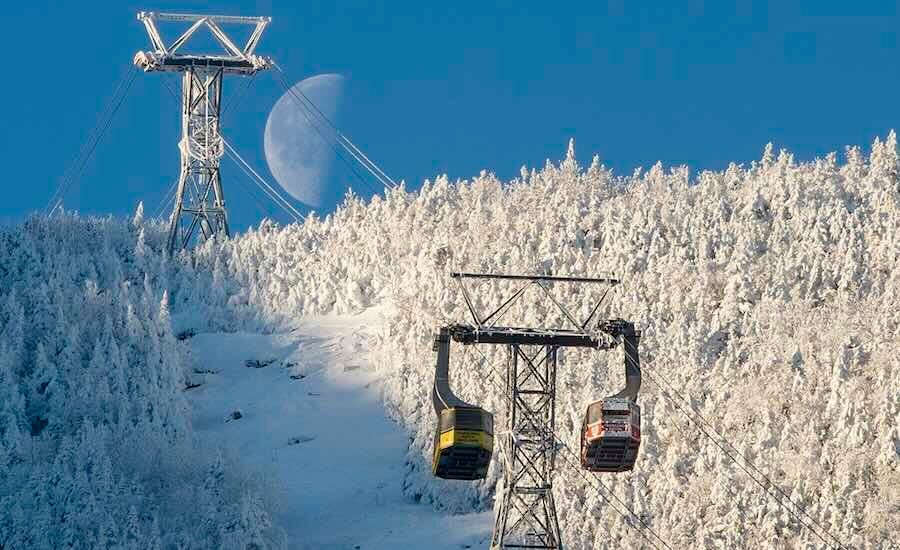
The ski area that built North America’s first aerial tramway is gearing up for another big first.
Almost 90-years after launching its original tram, New Hampshire’s Cannon Mountain will publish a bid request in May to build what will be North America’s first third-generation tramway when completed, according to officials at the state-owned ski area.
The 4,080 ft mountain—the state’s highest ski area summit—secured $27.2 million for the project through state funding, and additional capital resources are expected.
“Given previous estimates and a 2023 bidding process from which no action was taken and only a single bidder responded, the project is estimated to cost between between $25 million and $33 million,” Jace Wirth, Cannon Mountain general manager, told ENR in an email.
Cannon is currently working to prequalify two aerial lift manufacturers for the bid: Doppelmayr USA and Leitner Poma, a subsidiary of Poma S.A., headquartered in France.
“It is important to note that a tramway is a unique piece of equipment with only a couple of manufacturers in the world that install these types of systems,” Wirth said at a recent State House hearing.
Preliminary Analysis
The ski area, part of Franconia Notch State Park, retired its iconic second-generation tramway in October after 45 years in operation. It will remain closed for at least two years while the new tramway is installed.
Cannon hired SCJ Alliance, a Boulder, Colo.-based engineering consulting firm, to collect data on site before conducting structural analysis of the existing tramway infrastructure—including the tram towers, terminals and foundations—to decide whether any modifications were necessary to support the designs and loads of the next-generation tram, Wirth said in a statement. SPJ was hired to provide detailed evaluation and design.
SPJ’s preliminary analysis indicates that Cannon Mountain’s existing infrastructure can support construction of its planned third-generation tramway at Cannon Mountain, Wirth said. “The existing infrastructure still works.”
Under its contracted scope, SCJ as structural engineer, will help revise the specifications of the prior 2023 contracted scope for a tramway, which received state approval for an $18 million appropriation to the Dept. of Natural and Cultural Resources for maintenance and operation of the tramway, Wirth said.
Cannon Mountain seeks to remove ambiguity surrounding the structural design and its capacity, which led the manufacturer to remove its bid in 2023, he said. Wirth did not disclose the manufacturer’s name.
Wirth said it’s unclear how much load from the rope and entire ropeline system the towers, terminals and foundations can handle. “When a tram on a haul rope travels up a line, the tram cable is trying to almost tear out the tower from the foundation,” he said at the State House hearing. “When wind, ice, and other weight loads move on the line, the steel can deflect in an associated way.”
A recent paper published in the in a science and technology journal called Elsevier acknowledges the dearth of knowledge about “ice accretion, ice detection, and mitigation solutions for safe operations of gondola infrastructure,” notes that “severe ice can Cannon Mountain’s original tramway opened in 1938. Photo courtesy Cannon Mountain
accumulate” mostly on the windward side of the lift, “altering the aerodynamic profile and adding significant mass to the supporting components.” This can lead to problems when non-uniform icing intensifies drag forces, leading to “additional sway and mass imbalance” that can put the lift at risk.
In Wirth’s “progress report” to state legislators, he said that while more load analysis remains for the towers, only “localized issues” are under examination. The terminals, however, will require more work, specifically the summit terminal, where a structural engineer is performing additional testing to evaluate any additional needs, he said.
During the next month, the SCJ team will evaluate rock anchors that hold footings in place, rather than initiating additional testing on tower one, a very steep slope, which should be a cost-effective solution for the state, he added.
During the hearing, Wirth also requested approval for improvements in three main areas including, $220,000 for facilities maintenance and repairs, lift infrastructure upgrades including outer fix jaw tramway infrastructure replacements, and supplies to build a ramp for onloading/offloading foot passengers onto a scenic detachable chair lift that will help offset some of the tram revenue losses, and improvements for deteriorated pipeline infrastructure for snowmaking.
Generation to Generation
During its 45-year lifespan, Cannon’s now-retired second-generation tram made a one-mile ride to the summit in less than seven minutes and has carried more than nine million passengers, Cannon Mountain says.
Olympic Skier Alec Bright spearheaded construction of the original tramway, which opened in 1938, WMUR reported. The native of Cambridge, Mass., visited ski resorts with trams in Europe and thought New Hampshire was well-suited for one too.
Source: www.enr.com



