
This story was originally published by Inside Climate News, a nonprofit, nonpartisan news organization that covers climate, energy and the environment. Sign up for their newsletter here. Inside Climate News and NJ Spotlight News are part of a collaborative of news organizations working together to provide comprehensive climate change coverage for New Jersey.
As solar and offshore wind projects stall, New Jersey just awarded its biggest incentives to battery storage projects to help reach its climate goals and stabilize electricity prices for consumers.
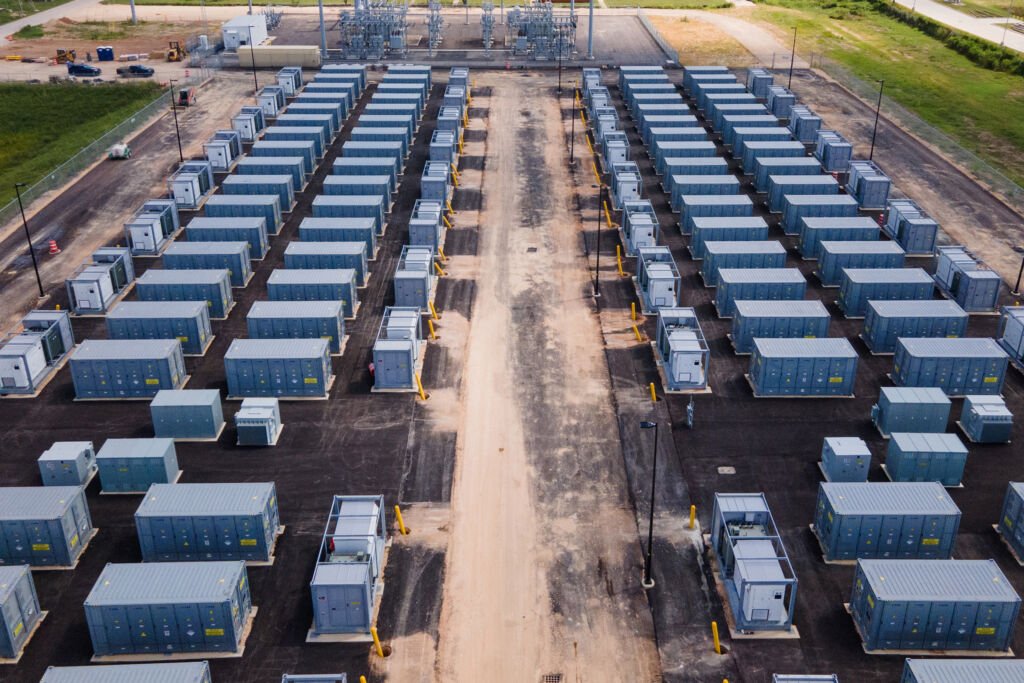
The New Jersey Board of Public Utilities earlier this month announced incentives for three large battery storage projects totaling 355 megawatts under the Garden State Energy Storage Program.

The board said the projects will provide flexible, on-demand power to the PJM regional electricity grid and are expected to generate more than $169 million in savings for ratepayers over the program’s life.
The award comes as New Jersey looks for energy projects that can come online faster than many other resources. Under state law, New Jersey aims to reach 2,000 megawatts of energy storage by 2030. That’s enough to power about 725,000 residences for a year.
Energy storage works by saving electricity for later use. The batteries store power when it is plentiful and cheap, then send it back to the grid when demand is higher and electricity is more expensive.
Hitting that target matters more than ever as other clean energy technologies face tougher conditions under President Donald Trump’s second term, including a federal tax-credit phaseout timeline hanging over solar projects and a virtual ban on offshore wind.
“Storage tax credits remain available,” Katharine Perry, deputy director of clean energy at the Board of Public Utilities, said in an interview. “It reduces the need for increasing state incentives or state support for storage facilities. We’ve been a little bit more insulated.”
The projects awarded are Woods Landing Storage, a 200-megawatt project in Sayreville; Two Rivers Energy Storage, a 150-megawatt project in Ridgefield; and North America Energy Storage Corp, a 5-megawatt project in Bordentown.
Under the board order, Woods Landing would receive $15 million, Two Rivers would receive $12.28 million and North America Energy Storage Corp. would receive $300,000 a year for 15 years. That’s about $413.6 million over 15 years if all three projects meet the program’s conditions.
The awards are funded through clean-energy money collected under the state’s Societal Benefits Charge on energy bills.
Most of that capacity comes from the Woods Landing battery project developed by Texas-based Jupiter Power at a former coal plant site in Sayreville. Dan Watson of Jupiter Power, the Woods Landing project, said the award was crucial to moving the project ahead.
“This award, it gives us a commitment from the state of New Jersey,” Watson said. “And that long-term commitment is necessary, mainly to finance the project, secure the capital necessary to make this kind of investment.”
For Eric Miller, the New Jersey policy director for the Natural Resources Defense Council NRDC, an advocacy group, the Woods Landing project also shows how New Jersey can repurpose old fossil fuel sites for new energy infrastructure.
Miller pointed to the Sayreville project’s location on a long-retired coal plant site, where developers plan to reuse existing transmission infrastructure while remediating the property.
“That is an amazing example of environment-friendly, climate-friendly, smart energy redevelopment,” Miller said.
The Board of Public Utilities chose the awards through a competitive process aimed at selecting the most cost-effective projects. Perry, the board’s deputy director, said Woods Landing “on its face was the most affordable project that we have.” She said the board also looked closely at whether projects would provide a clear net benefit to ratepayers.
The utilities board expects the winning projects to be operational in two and a half years, or around 2028. They should help stabilize electricity prices by 2029, Perry said.
Electricity prices in New Jersey jumped roughly 17% to 20% in June 2025 as a result of a regional energy auction. State officials have tied those increases to a broader supply-and-demand crunch at PJM Interconnection, the regional grid operator, as power-hungry data centers come online.
To help control prices as quickly as possible, Perry said, the state was deploying what she described as a “whole suite of efforts.” For the utilities board, that includes battery storage, solar and other efforts to bring new resources online quickly.
Through her first two executive orders, the state’s newly elected Democratic governor, Mikie Sherrill, declared a state of emergency on utility costs, directed the Board of Public Utilities to freeze residential electricity supply rate increases and deliver bill credits, and ordered the agency to move quickly on expanding solar and battery storage.
The board also opened an applications round for the storage incentive program, with a second solicitation for 645 megawatts of capacity. The award is open to stand-alone storage projects as well as solar-plus-storage projects.



