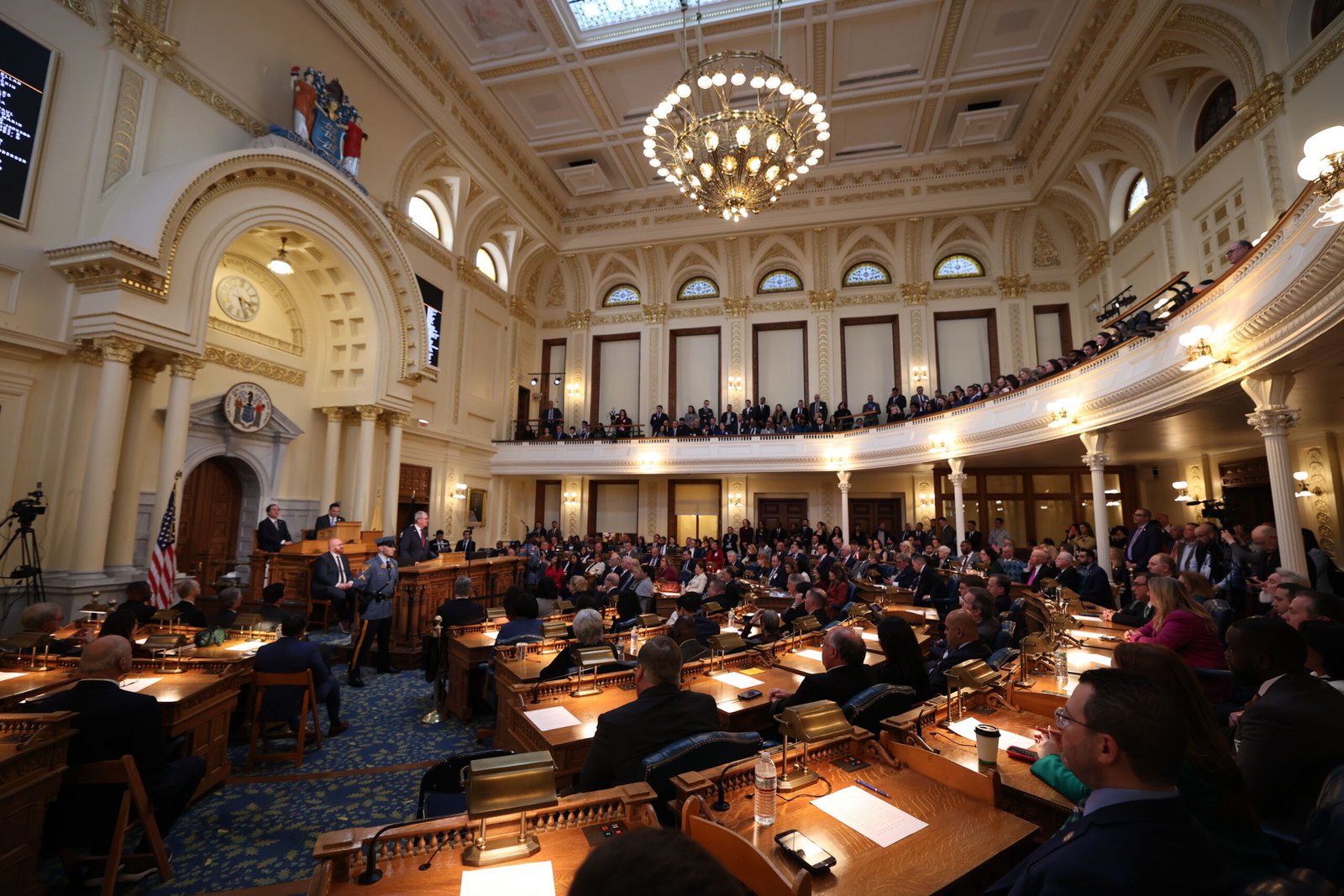
The 222nd New Jersey legislative session began last Tuesday, with a dozen new Democrats in a state Assembly that is slightly less diverse and has fewer women than the Legislature it replaced.
Assembly and Senate lawmakers are getting higher pay for the first time in 24 years, an increase of two-thirds to $82,000. Legislators are part-time, with most having full-time careers elsewhere. The increase was approved, along with raises for the governor and cabinet members, quickly with little time for debate at the end of the 2023-24 legislative lame duck session. By law, a state Legislature can’t increase pay for itself, but can for future lawmakers.
The raises will cost state taxpayers $9 million this year, according to an analysis by the nonpartisan Office of Legislative Services.
The increase makes New Jersey legislators the sixth-highest paid in the nation, according to the National Conference of State Legislatures’ 2025 compensation survey. New York lawmakers get the most, at $142,000 a year.
Legislative sessions are two years. Among lawmakers’ first tasks is considering Gov.-elect Mikie Sherrill’s nominees for cabinet and other key positions. The caucuses retained their leadership: Assembly Speaker Craig Coughlin (D-Middlesex) and Sen. President Nicholas Scutari (D-Union).
Democrats grabbed a supermajority of 57-23 in November, when all 80 Assembly seats were open. That means members could override a gubernatorial veto, in the unlikely scenario of a clash with Sherrill, a fellow Democrat. Their dominance also could help Coughlin push his agenda should he be bucked by any of the four new members who ran without Democratic party backing. Democrats maintain their comfortable 25-15 majority in the Senate, whose next election is in 2027.
Fewer women
One retirement and six election defeats led to the loss of seven women in the Assembly for a decline in female representation. Just three of the 12 newcomers, all Democrats, were women, for a net loss of four. All told, 36 of 120 state lawmakers are women, the smallest number in a decade, according to data from the Center for American Women and Politics at Rutgers University.
At the height, the Legislature had 43 women serving in 2023 — 16% more than today but still far below half, which is roughly the proportion of the state’s female population. New Jersey’s rank among the states for female legislative representation dropped this year from 27th to 34th.
“These are dispiriting results for women in the Garden State and another reminder of the responsibility that the political parties in the state hold to recruit and champion women candidates, run them in winnable races, and support them when they are in office,” said Jean Sinzdak, associate director of the Rutgers center. “It is also a reminder for all women in New Jersey that your state needs you, and there are resources available to you to begin your political journey.”
The center operates Ready to Run, a campaign training program, that is accepting registrations.
Women comprise a larger part of Democratic legislative ranks than Republicans: 38% of Democratic Senate and Assembly members are women, compared with 13% of the GOP. That’s been the case for many years.
The Assembly’s 2025 primaries were the first without the county line endorsement, a system that was struck down in court because it enabled party bosses to place their favored candidates most prominently on ballots. That tradition had been cited as one reason why women weren’t entering the Legislature.
Women, though, didn’t fare well on the redesigned ballots.
Three incumbents who lacked party backing were defeated – two of them by candidates who were endorsed by county party bosses. Diversity among the Assembly also declined slightly. Replacing the six white, three Black and three Hispanic lawmakers who left office were seven white, three Black, one Hispanic and one Asian members.
The Legislature continues not to reflect the state’s diversity. Almost 70% of members are non-Hispanic white. By contrast, slightly less than half of 9.5 million residents in 2024 were white, not Hispanic.
Here are the Assembly newcomers:
- 2nd District (part of Atlantic County) — Maureen Rowan, a retired attorney from Atlantic City.
- 8th District (parts of Atlantic and Burlington counties) – Anthony Angelozzi, a Hammonton high school history teacher and union president.
- 20th District (part of Union County) – Ed Rodriguez, former director of planning and community development in Elizabeth.
- 21st District (parts of Middlesex, Morris, Somerset and Union counties) – Vincent Kearney, a Union County sheriff’s detective from Garwood, and Andrew Macurdy, an attorney from Summit.
- 25th District (parts of Morris and Passaic counties) – Marisa Sweeney, a doctor of clinical nutrition from Morristown.
- 28th District (parts of Essex and Union counties) – Chigozie Onyema, a senior director at PolicyLink who lives in Newark.
- 31st District (part of Hudson County) – Jerry Walker, a former Hudson County commissioner from Jersey City.
- 32nd District (part of Hudson County) – Ravi Bhalla, former mayor of Hoboken, and Katie Brennan, founder of WonkWorks, from Jersey City.
- 33rd District (part of Hudson County) – Larry Wainstein, a small business owner from Union City.
- 35th (parts of Bergen and Passaic counties) – Kenyatta Stewart, a former Newark corporation counsel who lives in North Haledon.