
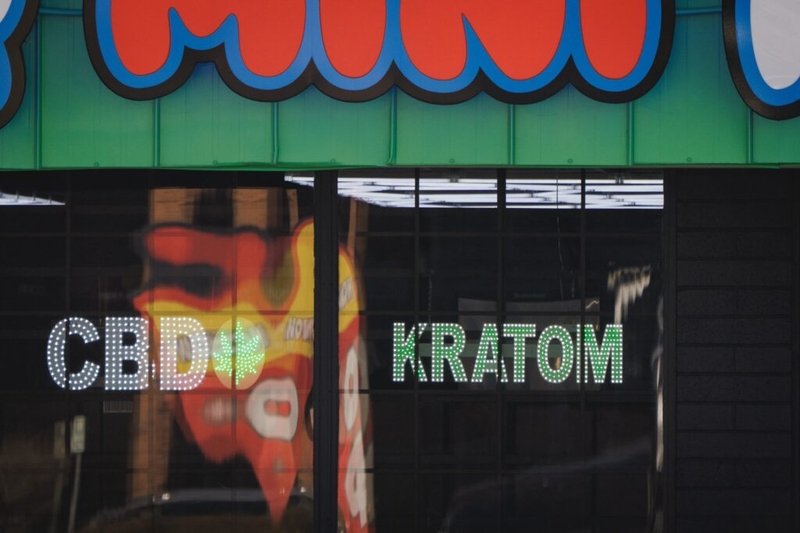
New legislation would ban 7-OH, a compound in the herbal supplement kratom that some say is a safe alternative to opioids but critics call dangerously addictive. (Photo by Spenser Heaps for Utah News Dispatch)
New Jersey lawmakers took the first step on Monday to make it illegal to possess or sell 7-OH, a compound in the herbal supplement kratom that some say is a safe alternative to opioids and others insist is addictive, overly accessible, and an emerging threat.
The state Senate health committee unanimously advanced legislation to add 7-OH, or 7-hydroxymitragynine, to New Jersey’s list of Schedule I controlled substances, a list that includes heroin, mescaline, peyote, and dozens of other drugs classified as highly addictive and not medically valuable.
Synthesized as tablets or candies and sold under brand names like ‘Dopium’ and ‘Zohm’, witnesses said 7-OH products, which act as sedatives, are now available at gas stations, corner stores, and online with few restrictions.
Jersey City hospital closure leads to calls for state intervention
“If I can find an opiate within a quarter mile from my home, I don’t trust myself to stay sober,” John Mopper, a behavioral health counselor from Somerset County, told the panel.
Mopper said he was addicted to heroin 20 years ago and has struggled to recover his life and secure a career and a family. He said one taste of 7-OH had him hooked again, and he dismissed suggestions from kratom advocates that it is a safe opiate alternative to treat pain or help people wean off more addictive drugs.
“No. It’s the equivalent of heroin that is being sold legally in local stores around our community. And it’s evil,” he told lawmakers.
As of last year, at least seven states have banned kratom entirely, and at least half have opted to regulate the plant-based drug or its components in some way, according to Stateline. The U.S. Food and Drug Administration has issued warnings about 7-OH, calling it an “emerging opioid threat” in a recent report, and is considering adding 7-OH to the federal schedule of illegal drugs.
Under the New Jersey bill, which faces additional votes in both chambers of the Legislature before it could be signed into law, possession, manufacturing, or distribution of an ounce or more of 7-OH would be a second-degree crime.
Michele Ross, a national advocate for kratom products, told the Senate panel that people have safely consumed 1.5 billion doses of 7-OH nationwide (she said her father has used it, too). When used at appropriate levels, the products are safe and non-fatal, she said.
“Let responsible adults access these products that they so desperately need,” Ross said.
Instead of an outright ban on 7-OH, Ross urged lawmakers to consider regulating access by limiting purchases to adults or restricting where it can be sold and how it is packaged. Making it illegal would lead people to buy unsafe products online or on the black market, or turn to more dangerous illegal drugs, she said, a situation that would “drive overdoses up.”
“People will die,” she said.
Ross, who mentioned her own family history with addiction, also questioned the authenticity of Mopper’s testimony, something that drew a sharp rebuke from Sen. Holly Schepisi (R-Bergen), who called Ross’s comments “offensive and disingenuous.” Schepisi said she has seen first-hand the dangerous impact of kratom products, citing a relative who struggled with addiction and the damage it had on his family.
Sen. Raj Mukherji (D-Hudson) said he agreed the product should be regulated, but feared making it a Schedule I drug could be excessive.
“I still have some trauma about Schedule I, just from cannabis,” Mukherji said.
Marijuana was long included as a highly controlled substance in New Jersey until state law was amended to allow for medicinal and then recreational use. But “erring on the side of caution,” Mukherji agreed to support the 7-OH ban.
Sen. Joe Vitale (D-Middlesex), the committee chairman, said a ban is necessary because the kratom industry has not opted to regulate itself in a meaningful way. He said 7-OH manufacturers only seem concerned with sales, not the impact the product has on people’s health.
“This isn’t akin to vaping,” Vitale said. “This isn’t like getting someone to come off opioids onto Suboxone,” he said, referring to the gold-standard medication for opioid addiction. “This is a dangerous drug. It’s highly addictive.”
GET THE MORNING HEADLINES.



