
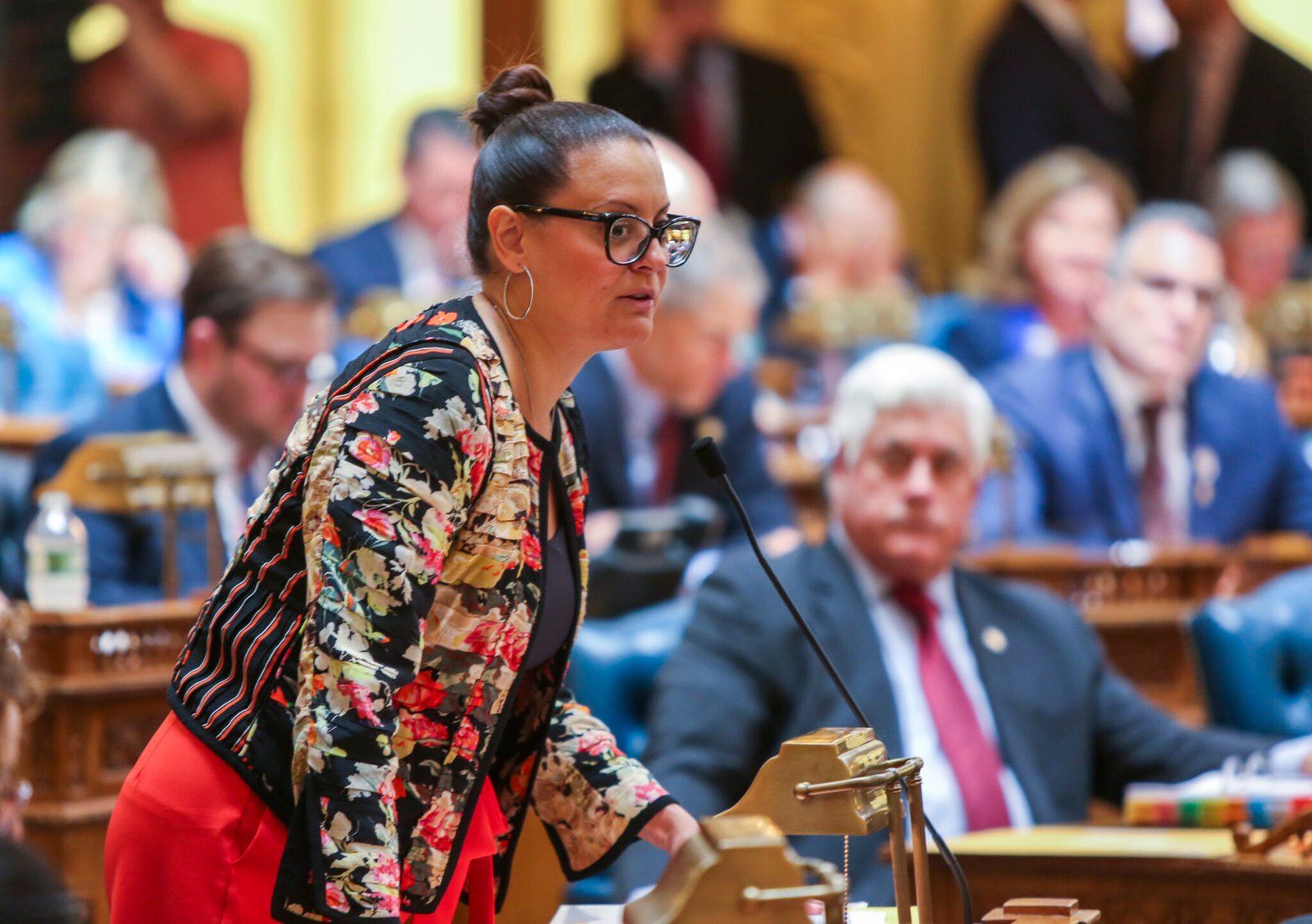
Members of the Assembly Budget Committee on Monday indicated they want funding restored for legislative priorities that Gov. Mikie Sherrill excised from her first proposed state budget.
Sherrill’s $60.7 billion spending plan for the budget year that begins on July 1 would cut roughly $700 million in items lawmakers added to the current year’s budget, cuts Sherrill said she wants made as she seeks to shrink New Jersey’s structural deficit, the gap between its recurring revenue and expenses.
Lawmakers routinely add spending items to the annual state budget via budget resolutions. Because they often direct funding to causes in sponsors’ legislative districts outside of the competitive processes or formulas used elsewhere in state government, they are sometimes derisively called “pork” or “Christmas tree items.”
Assemblywoman Eliana Pintor Marin (D-Essex), who chairs the Assembly’s budget committee, defended them during Monday’s hearing.
“There has been a lot of discussion around what is being labeled as Christmas tree items. It is important to step back and call these investments what they actually are: They are funding for organizations that serve our most vulnerable residents,” Pintor Marin said. “They are improvements to parks where our children play, where some may never be able to afford a vacation.”
Sherrill has made budget resolution spending a target for cuts, though her administration has indicated it’s willing to work with legislators to restore funding if savings can be found elsewhere in New Jersey’s budget.
“Gov. Sherrill has made it clear: She understands there’s likely going to be spending at the end of this budget,” state Treasurer Aaron Binder told the committee Monday, adding, “What she had said was that she would hope we can work together to find additional cuts, so if there are additional spending items that we find cuts to offset them.”
Sherrill’s predecessor, Phil Murphy, routinely axed legislators’ spending requests from his annual budget proposal, though they invariably found their way back in by the time a budget was signed into law in late June.
In response to questioning from Assemblyman Brian Rumpf (R-Ocean) on Monday, Binder declined to say whether the governor’s stance means the overall cost of New Jersey’s next spending bill may grow beyond its present $60.7 billion price tag.
Sherrill’s proposal calls for New Jersey to spend about $1.7 billion more than it brings in, spending that’s forecast to take New Jersey’s surplus to about $5.4 billion, from the roughly $7.3 billion projected for the end of the current fiscal year.
“This budget proposal represents the governor’s attempt to prioritize the constrained resources. We understand there are programs that are not funded in here. That’s the nature of finding $2 billion in cuts,” Binder said.
More than once, Treasury officials on Monday worried that failing to close the state’s structural deficit — the administration hopes to do so in fiscal year 2028, Binder said — would leave the state exposed in the case of an economic downturn.
The state’s reserves would be key to its recovery if the nation’s sluggish economy lurches into a recession, and legislators acknowledged draining them would leave the state ill-prepared for an emergency.
“Part of the reason why we had such a hard time getting out of the recession is because we didn’t have money to put back into the economy,” Pintor Marin said. “I think that we do have to be careful in how we move forward.”
On Monday, officials with the Treasury and the nonpartisan Office of Legislative Services unveiled their revenue projections.
The nonpartisan office said it expects the state to bring in $59.1 billion in revenue in the next fiscal year, just $12.9 million more than the Treasury’s forecast. The two sides’ predictions for specific revenue sources diverged more broadly.
Disagreements over revenue projections have been rare in recent years, but they have occasionally spurred governors to freeze funding approved by law. Murphy froze $235 million in state spending in 2019, for example, but released the funds after a prepandemic revenue swell.
Officials in May will deliver another update on revenue that includes a fuller picture of taxes paid in 2025.
Lawmakers must pass, and the governor must sign, a budget before July 1 to avoid a government shutdown.
GET THE MORNING HEADLINES.



