
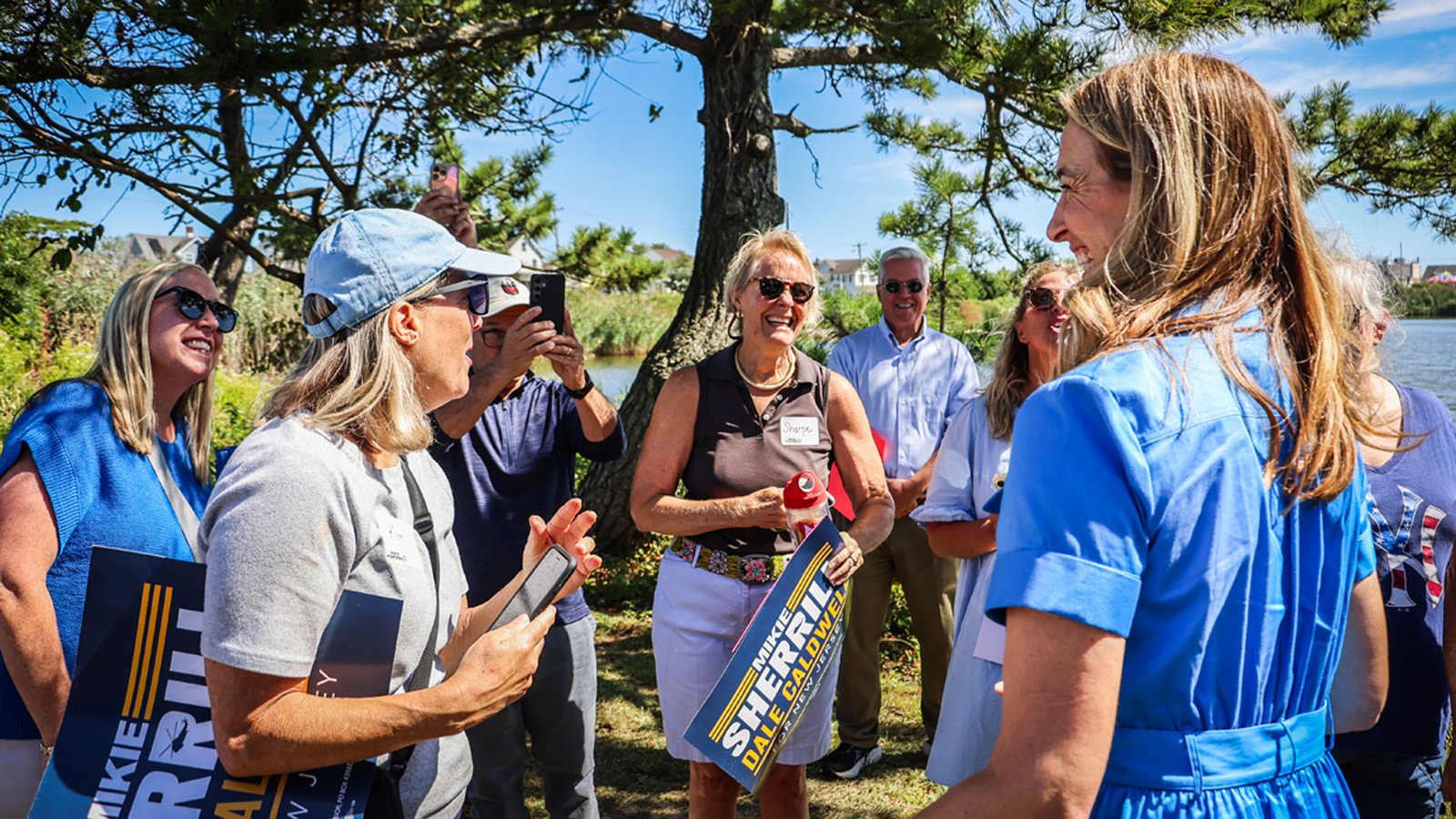
Gov. Mikie Sherrill is only the second woman elected to New Jersey’s highest office. At one time, New Jersey was a national leader in the number of women who held elected office. But that representation has stagnated, and even dropped in the last election. The Center for American Women and Politics at Rutgers University is trying to change that with its annual Ready to Run event this week, and it’s encouraging anyone interested to participate, even if they don’t have a particular office or race in mind.
The center’s associate director, Jean Sinzdak, tells NJ Spotlight that the recruitment pipeline needs work. This interview has been lightly edited.
Joanna Gagis, anchor: Where does New Jersey stand in terms of women holding elected office, particularly looking at our Legislature?

Jean Sinzdak: We just had legislative elections this past November and we lost women in the Legislature. We’ve slid backwards in the national rankings for women in state legislatures. And currently, New Jersey is 34th in the country. We have been hovering sort of in the middle of the pack for a long time.
There was one time, not too long ago, that we were in the top 10 for women’s representation in the legislatures. And it’s not so much that overall New Jersey has done poorly since — it’s that other states have done much better. Now we’re sliding backwards. And so the news is not good on that front.
Same win rate as men
JG: Looking at the last election I believe six women chose not to run for reelection. One retired. That was a loss of seven and then three new women were elected. So a net loss of four. Looking at New Jersey, why is it that we see women either make the choice not to run for reelection or not choosing to run at all?
JS: It mirrors a lot of what we’re seeing around the country. And part of it is the power of incumbency and how many opportunities there are for women and other newcomers. The other piece of that is that we know women aren’t asked to run for office at the same rates that men are.
When they do run, they win at the same rates as men do in comparable races. So it’s not the winning — it’s the recruitment pipeline challenge.
Things have changed a little bit after the party line on the ballots got erased. Theoretically, that’s opened up new opportunities for more women candidates.
But we do know that party organizations still have a tremendous amount of power in terms of both recruiting and then supporting the candidate. We really need to do some work on the recruitment pipeline to get more women to run for office.
JG: We’ve also heard from women at all levels of elected office, but particularly Senate and Assembly representatives, who’ve said there’s a real toxic work environment for women in Trenton in particular. I know former Senator Loretta Weinberg was a champion for women, kind of changing that that environment. She created a female task force to address it.
Why is it important for women to have representation in the Legislature and other elected office, including the Governor’s Office?
JS: The complaints about a toxic environment have been a problem in New Jersey, but also around the country. It’s a near universal story. With more women serving on these governing bodies they can change that environment and make it more open and welcome. And that’s the only way it’s going to change for the long term.
Running? Or curious?
JG: Can you tell us about Ready to Run?
JS: Ready to Run is our annual nonpartisan campaign training program. We have numerous leaders who come as keynote speakers, party officials, elected officials, other women leaders in the community who come and help train women to run for office. It’s this Friday and Saturday, March 20 and 21 on the campus in Rutgers, New Brunswick.
Online registration will be open for another couple of days. On Friday, on-site registration will be available. We do encourage any women who are interested in running for office or even thinking about getting involved in politics, since we have two tracks.
Track one is: I’m running for office, now what? And you’ll get the real nuts and bolts of launching campaigns. But track two is: I’m not quite sure yet. I want to get involved, but I don’t know where to start. And covers everything from how to get involved in party organizations to getting appointed to working on campaigns and then hopefully running some day themselves. So there really is something for everyone, no matter where you are on the the political spectrum in terms of your involvement.
JG: What are the characteristics that someone considering should ask themselves — whether they possess or perhaps work towards — strengthening within themself?
JS: People say that to us all the time: “Do I have what it takes?” and “What do I need to do — some prep work?” Campaign training is really helpful. But the No. 1 requirement to running for office is that you are committed to the community that you live in and you want to make a difference. The rest of it you learn as you go. We need public leaders from all walks of life, all backgrounds to run and serve. That will make all of our communities richer. You don’t need any special qualifications except the desire to serve.
JG: Can people just show up on the campus or do you need to register in advance?
JS: Ideally, people would register online. If you miss the online registration, we’ll be there at the Douglass Campus Center on Friday through Saturday.
This story is made possible in part by the Corporation for Public Broadcasting, a private corporation funded by the American people.



