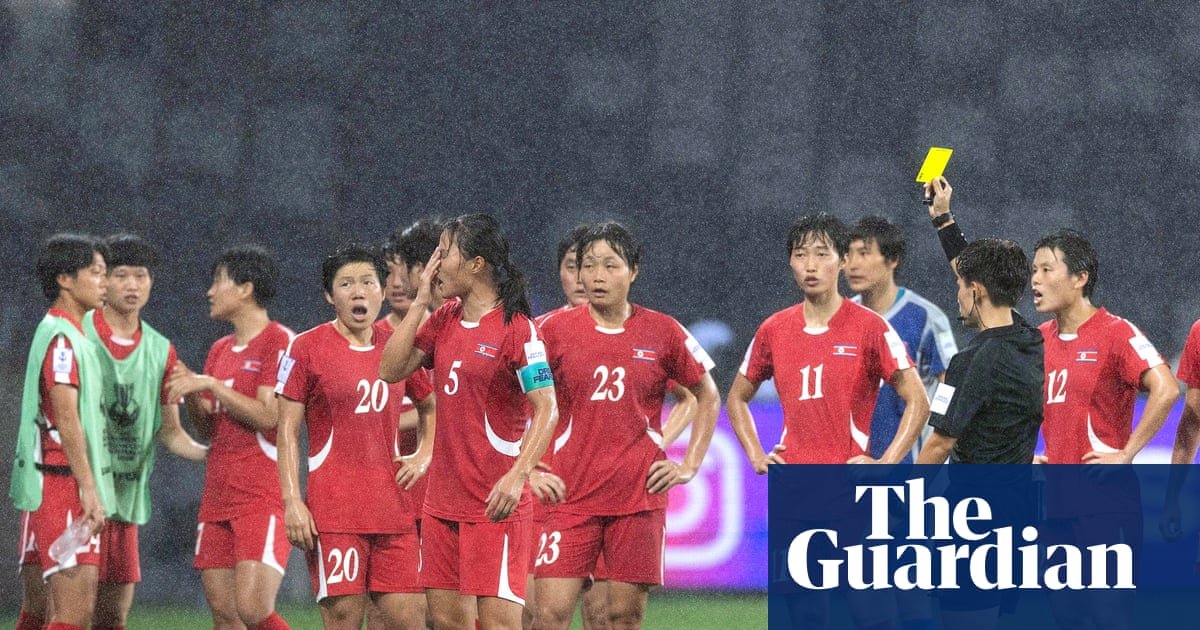
Boos are barrelling around Parramatta Stadium. Wang Shuang, China’s star midfielder who had given her side a 2-1 lead in stoppage time of the first half, is gesturing to the crowd to get louder.
The referee is in the centre-circle, staring furiously at the sideline where all of North Korea’s players are gathered, refusing to return to the field. Their captain, An Kuk-hyang, keeps pointing at the VAR screen and then, condescendingly, to her own eyes. Wang’s goal had initially been ruled offside but was then awarded after VAR review.
Five minutes pass. Eventually, the exasperated referee whistles the half to a close and stomps off the field.
🎙️ “It’s really disappointing to see that this is still a tactic being deployed by DPR Korea”
Ash Sykes sounds off on the drama heading into the half, after refusing to take the field after China’s go-ahead goal in stoppage time
Watch #PRKvCHN live on Paramount+ 📺 pic.twitter.com/cBKyuzxQzl
— Paramount+ Australia (@ParamountPlusAU) March 9, 2026
It was an extraordinary moment among many extraordinary moments that have already defined this Asian Cup, and something that the Matildas may need to brace themselves for as they prepare to face North Korea in their quarter-final on Friday. Because these kinds of tactics are not unusual for the tournament’s most mysterious participant.
At the 2006 Women’s Asian Cup in Adelaide, North Korea played China in the semi-final. China were winning 1-0 when, deep into stoppage time, North Korea equalised.
However, the Italian referee disallowed the goal due to offside, and the North Korean players were so furious that, after the final whistle, goalkeeper Han Hye-yong charged across the grass and kicked the referee from behind. Then, according to former Matilda Kate Gill, “all hell broke loose.”
“The support staff and coaches picked up water bottles and were throwing them at the referee,” Gill says. “The Chinese supporters then started throwing bottles at the North Koreans from the stands, and then players started throwing them back.
“We were watching this unfold like, ‘man, we’ve never seen anything like this.’ It escalated really quickly out of nowhere; it was obviously a decision they didn’t agree with and felt aggrieved about, and that was their response.”
The referees had to be escorted out by security, with the North Koreans accusing them of plotting against their country, demanding life bans and a rematch. Instead, the Asian Football Confederation (AFC) suspended the goalkeeper for a year, with shorter bans imposed on two other players, in addition to fines.
Something similar happened in 2010, when North Korea travelled to Australia to play a two-match friendly series against the Matildas. They had drawn 2-2 in the first match, but the second game in Brisbane turned farcical.
“We got a penalty just before half-time, ” Gill recalls. “They disagreed with the outcome, so the coach signalled to the players to walk off the pitch. There was no VAR at the time, so it was purely a refereeing decision, calling it how they saw it.
“We were all just standing around wondering what was going on. There was a 10-minute delay because they refused to go back on the pitch, which they needed to do so we could take the penalty.
“Eventually they did, and I took the penalty and scored. That was the first time us as a nation had experienced that … They very much did what they did against China the other night.”
The Matildas played North Korea in the final of the Women’s Asian Cup later that year and defeated them on penalties, winning their first – and, so far, only – continental title. For Gill, while the tactics of the team were frustrating, she recognised that North Korea’s players were also under immense pressure and monitoring from their government back home.
“It got me thinking about the bigger picture of it all and how lucky we are to live in a country where we have autonomy over the decisions we make,” she says. “But for a country that’s so shut off from the world and not exposed to good sporting standards or expectations, they’re probably acting how they’ve been told to.
“When I was looking back at it, the directions always came from the support staff and head coach who coordinated the players to walk off the pitch or retaliate. I would hate to be the player on the North Korea team who thought that kind of thing wasn’t right, and they didn’t want to act in those ways. What would be the repercussions for that?”
Australia will meet their old foes once again on Friday in Perth, with the winner qualifying for the semi-finals and the 2027 Women’s World Cup. The Matildas will need to improve on last week’s messy performance against South Korea – in particular by tightening their midfield, shoring up a now-shaky defence with Steph Catley unavailable due to concussion, and capitalising on the few chances they will get in the box.
North Korea are known for their sharp passing, quick transitions, and intense physicality, but based on their history, it might be more than just the football Australia will need to be ready for.