Work is ongoing to overcome sub-optimal ground conditions in preparation for the start of tunnelling on the Lower Thames Crossing in late 2028, according to the project’s tunnels director.
The Lower Thames Crossing is a major new road and tunnel project in the UK, intended to alleviate congestion at the Dartford Crossing and enhance connectivity between the South East, Midlands, and North. This £11bn project involves constructing a 4.2km tunnel under the Thames Estuary, linking the A2 and M2 in Kent to the A13 and M25 in Essex.
Construction of the tunnel will be undertaken by Bouygues Travaux Publics-Murphy joint venture (BMJV) using a 16.4m diameter TBM – the largest ever used in Europe and one of the largest in the world. The project has decided to use a single TBM for both bores, starting the drive from the north side of the Thames, rotating it in the south and then sending it back again for the second drive.
With this operation targeted to start in late 2028, there is a significant amount of work to do on site in preparation, Lower Thames Crossing project director for tunnels and approaches Keith Bowers said at NCE’s Tunnelling conference on 4 December.
He started by discussing what is happening on the project currently. “The contractor mobilised at the start of last year [2024] so we are well into the design process; we’re in detailed design for many elements of the project,” Bowers said. “We got the development consent order [DCO] in place near the start of the year [2025] and we now have many secondary consents with any other stakeholders, third party agreements, that sort of thing, which means the design has to be developed in order to work through the detail.”
However, Bowers said that “size is our issue”, as the site and works spread widely.
Precursory activities
Alongside design work, there are “fields full of archaeologists” on site, according to Bowers. “We’re in an area where the Romans were very busy,” he continued. “In Roman times there was a lot going on there; [we’ve found] quite fine Roman pottery from Europe. Obviously, this was a trading location.”
He said the archaeology work would be continuing into early 2026 and that they are “very excited by what we are finding”.
“We are learning quite a lot about the history of the area, so we will indue course, when we finish the site works, be thinking about how to publicise what we’re finding more fully,” he said.
“But of course, in delivery terms, this is just a precursor activity. We have to clear the archaeology before we can do anything else on a lot of these sites.”
Ecology is also a consideration prior to delivery. “There are quite a lot of ecological mitigation sites that we have to provide along the route and generally we have to provide them before we’re allowed to start work on the main work civil engineering,” Bowers said. “So those archaeology and ecology sites become critical path works for us.”
He explained that work on permanent assets in this regard would start around Christmas, highlighting a particular site that would support bird life passing through the estuary area.
“There’s actually a lot of earthworks, in that there’s utility movements, there’s logistics, there’s site setups – all the things you do on any big job become quite significant when you’re dealing with sites of this nature,” he said.
He also said that site offices, including the tunnel’s main site office, had been established around the end of November. “We are starting to look a bit more like what you might expect a classic civil engineering project to look like,” he said. “It’s quite exciting seeing some of this becoming real – and it also opens up things like community engagement with people around us.”
Ground conditions
Casting ahead to the first civil engineering works that will take place for the tunnel construction, Bowers said “a lot of what we’re looking at is derived from the geology”.
“Most of it is a chalk tunnel – that’s relatively straightforward, isn’t it?” he continued. “It’s chalk. It’s got some flints. Up to about 5.5-6 bar of water pressure in the middle when we’re under the river. All of that is fine.
“The trickier stuff is particularly at the north end, which is where we have to launch the machine. There we’re in what is historically and geologically the Thames flood plain; the Thames marshes. There is a layer of terrace gravel and then [above] we have very deep peat and alluvium. Then it’s nicely topped off with some non-engineered landfill – delightful.
“We have to work from the north end, so we have to tackle those materials straight away. The north side active landfill is where the Tideway spoil went and various other tunnelling projects fed this. We’ve also got power station fly ash […] so it’s very much an industrial landscape without basic services like roads and water and so forth.
“I think a lot of people’s first reactions the first time we saw the ground conditions out there was ‘help!’ – this is not really where you want to be doing anything much. It’s quite difficult to walk across; it’s a bit of an operation to drive a Land Rover across it. You can lose machines in there and all sorts. It’s generally quite challenging. There’s a lot of work going on developing the solutions for that.”
Bowers went on to explain that the site for the tunnelling works will extend quite far beyond where the works will take place as it will need to be used for assets like segment factories and slurry treatment plants.
“The plans are developing rapidly now for that,” he said. “There will be a combination of techniques used on a very large scale; things like cutter soil mixing [CSM] and batten drains are very much at the forefront of how we deal with some of those areas.
“A lot of work has been going on in the background in the last few months looking at the actual mix designs. It’s very clear we need to add material in some way to the ground to make it fit for walking on, to use it for the CSM in particular, so we have been testing a range of mixes there.”
Moving on to the earthworks near where the TBM will be launched, Bowers said there is a block of ground almost 300m long that needs to be treated to ensure the stability of the rings in the tunnel’s early stages.
“It’s down in into the gravels, 25m maybe more in depth,” he added. “It’s very wide because it’s got to span two 16m diameter tunnels. These are huge volumes of treatments.
“A lot of the work we have to do in the next year or two is delivering this bulk work to make it fit to tunnel.”
Portals
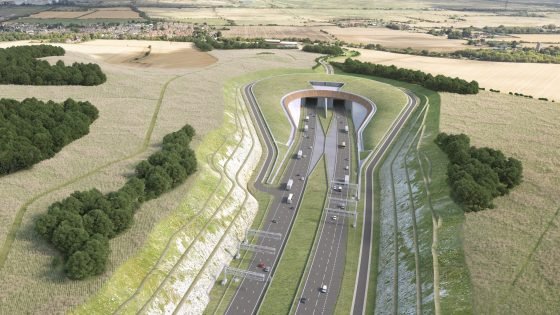
He also discussed the portals themselves, which will be the first elements built.
“We need to create the launch structure right in the middle of that difficult ground before we can tunnel,” Bowers said. “Our plan, essentially, is a caterpillar style structure as the launch structure, joined to a diaphragm wall section of cut and cover tunnel with the service buildings over it.
“We’ll look to get double the use out of the foundation wherever we can here, so we often have things used in the temporary case that are then used in the permanent case.
“Then [the caterpillar structure] leads to a long trough section that brings us up to ground level.
“That’s our northern end and work on that is due to start summer [2026], the early stages of it. It will take only 18 months to deliver the bulk of it up to the point where we have enough created to launch the TBM.”
Moving on to the south portal, where the TBM will be rotated and sent back under the Thames, Bowers said “it never gets the headlines of being on the critical path, because it shouldn’t be”.
“Also, the geology is simpler,” he continued. “It’s dry chalk, effectively. But scale is a factor here. The approach cutting up to that portal is over 2.5Mm3 of excavation. That’s a big amount of earth moving – and with no diesel, so new technologies; different types of plant potentially doing that operation.
“In common, though, on both sides of the crossing, the arisings from the work will be used in the immediate areas around the portals. In fact, we’re creating landscape Parkland both sides of the river with that.”
Tunnelling
Giving a summation of the tunnelling work ahead, Bowers said: “We tend to think of this job in three parts: get the north portal in place, then get the tunnel drives done and then get the fit out done. It’s roughly two years of activity in each [part], that sort of order.
“What we can do here, though, is because the tunnel is so huge, we can actually do quite a bit of fit out activity concurrently with the TBM operations. What we’re going to do is put the road deck in fairly close behind the TBM. That leaves us with the ability to segregate below deck and above deck and effectively separate clean and dirty trains, if you like.
“The key milestone in all of it is launching the TBM in late 2028. That’s the key objective for all of the first stage activities.”
BMJV recently started the procurement for the TBM, inviting tenders from potential suppliers. If procurement proceeds to schedule, the TBM is expected to be purchased next year and be manufactured and delivered to site in time for the planned late 2028 launch.
“Then the other milestone is at the point where we open the road in the early 2030s,” Bowers said.
“So that’s not a complicated programme: Build north portal, drive out from it, build the other portal in time to receive the machine and turn it around, drive the machine back, fit [the tunnel] out, test it, commission.
“It sounds very easy, doesn’t it?”
Funding
Lastly, Bowers discussed the funding of the Lower Thames Crossing, which is now expected to cost £11bn. The government is looking for the private sector to majority fund it, as was confirmed by the chancellor in the recent Autumn Budget where £891M of public funding was committed to complete the “publicly-funded works” for the project.
“This scheme is funded by the Treasury up to a point around about the end of 2027, early 28,” Bowers said. “The plan is that at that stage it will be taken into private funding. It won’t be a PPP [public private partnership]; it’s a very different model to Silvertown and elsewhere.
“This will be transferred to what we call the Lower Thames Crossing Company that’s being spun out of National Highways. That company will essentially take the assets in perpetuity, take the revenue that the assets generate, but it will commit the funding to deliver the tunnelling phase and the later phase.
“The process to set up that funding arrangement is in its early stages. There will be quite a lot more said about it in the coming months.”
Like what you’ve read? To receive New Civil Engineer’s daily and weekly newsletters click here.
Source: www.newcivilengineer.com