
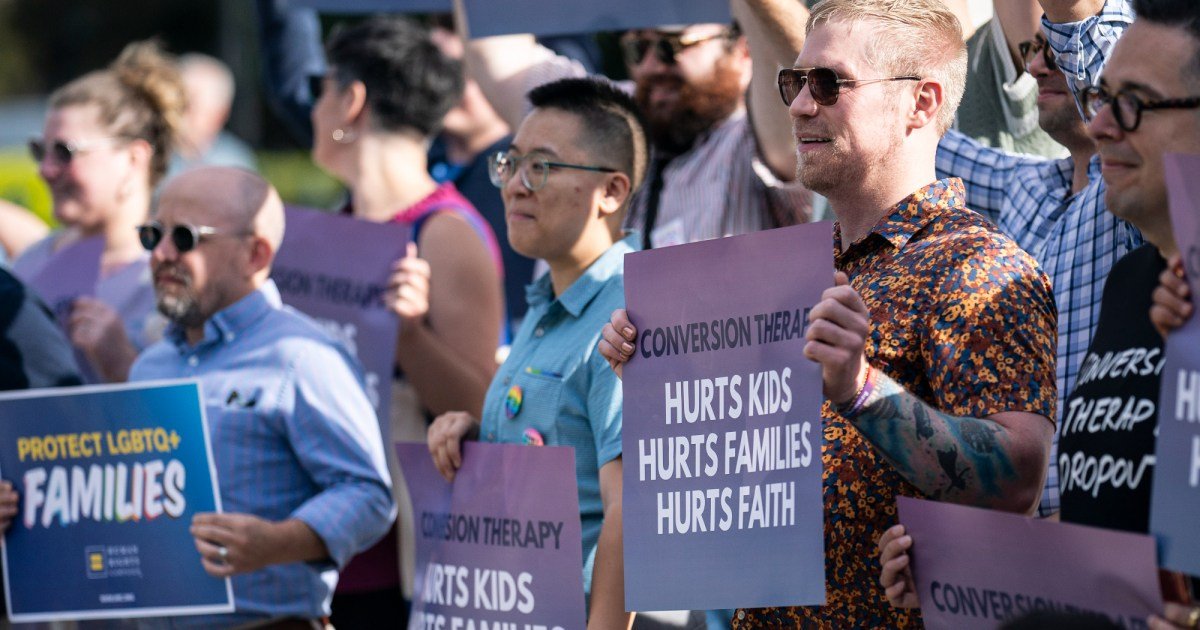
Demonstrators with Human Rights Campaign stand outside as the United States Supreme Court is set to hear free speech challenge to a ban on conversion therapy, on Capitol Hill on Tuesday, Oct 07, 2025 in Washington, DC. Jabin Botsford/The Washington Post via Getty
In an 8-1 decision on Tuesday, the Supreme Court ruled against a Colorado law forbidding licensed therapists from trying to change a child’s sexual orientation or gender identity—a practice known as conversion therapy that the medical profession has long since discredited and condemned.
Decades of research show not only that conversion therapy doesn’t work, it puts individuals at higher risk of depression and suicidality. In response to those findings, and a rising tide of acceptance for LGBTQ people since 2012, 23 states have forbidden licensed mental health practitioners from attempting conversion therapy on minors. The decision in the case, known as Chiles v. Salazar, now threatens to overturn those laws nationwide.
The case was brought by a Christian counselor named Kaley Chiles, represented by the Alliance Defending Freedom—the religious-right legal group behind many of the Supreme Court’s recent anti-LGBTQ and anti-abortion rulings. Chiles argued that because she practices talk therapy, not the painful aversion therapy widely used in the past, the Colorado law censors her speech and violates the First Amendment.
Justices Elena Kagan and Sonia Sotomayor agreed, joining the court’s conservatives in a majority opinion authored by Justice Neil Gorsuch. “Colorado may regard its policy as essential to public health and safety,” Gorsuch wrote. “Certainly, censorious governments throughout history have believed the same. But the First Amendment stands as a shield against any effort to enforce orthodoxy in thought or speech in this country.”
“As applied to Ms. Chiles, the State seeks neither to regulate her speech incident to any conduct, nor does it seek to compel disclosure of factual and uncontroversial information,” Gorsuch wrote. “Instead, it seeks to silence a viewpoint she wishes to express.”
In a concurring opinion, Justice Kagan wrote that Colorado’s law could have potentially survived if it regulated the content of a therapist’s speech, but did not draw lines based on the therapist’s viewpoint on matters of sex and gender.
“A law drawing a line based on the ‘ideology’ of the speaker—disadvantaging one view and advantaging another—skews the marketplace of ideas our society depends on to discover truth,” Kagan wrote. The Colorado law, she added, “prevents a therapist from saying she can help a minor change his same-sex orientation, but permits her to say that such a goal is impossible and so she will help him accept his gay identity.” A law banning therapists from affirming trans kids’ gender identity, she added, would also run afoul of the First Amendment.
Justice Ketanji Brown Jackson, the sole dissenting judge, wrote that Chiles “does not dispute that conversion therapy can be harmful to minors in certain circumstances” and “does she contest that Colorado has a significant interest in protecting minors from harm.” But, she continued, “Chiles complains nevertheless” because “the particular form of conversion therapy she wants to offer clients utilizes only speech.”
Jackson added that the Colorado law as written did not prohibit Chiles from sharing any views on sexuality, gender identity, or conversion therapy outside of individual talk therapy sessions—like in discussions with patients and their families. The “aim of the statute is not suppressing speech,” she wrote in her dissent. “Talk therapy is a medical treatment. So, why wouldn’t such speech based medical treatments be subject to reasonable state regulation like any other kind of medical care?”
As we’ve reported before, the science on conversion therapy has been considered settled for over a decade:
The science on conversion therapy is unambiguous: it’s both ineffective and dangerous. All the way back in 2009, an American Psychological Association task force issued a landmark report documenting the lack of evidence behind sexual orientation “change efforts,” as scientists refer to them. Since then, APA has only strengthened its stance against both anti-gay and anti-trans conversion efforts. In October 2015, the federal Substance Abuse and Mental Health Services Administration published a report concluding that sexual orientation and gender identity change efforts were “coercive, can be harmful, and should not be part of behavioral health treatment.”
Nonetheless, conversion therapists have continued to practice on the fringes of the profession, typically working with conservative religious clients. In recent years they’ve turned their attention on transgender youth, capitalizing on politicized controversy over medical treatments for trans kids, a Mother Jones investigation found in 2024. And they’ve embraced so-called “gender exploratory therapy”—a treatment posed an alternative to gender-affirming medical care for transgender minors in a Health and Human Services report last year.
The justices’ decision on Tuesday fell on Transgender Day of Visibility, created by Rachel Crandall-Crocker over 15 years ago. It’s a day to celebrate transgender people and draw attention to the ongoing challenges the community faces. Being a visible, civically-active trans person in the United States is becoming increasingly more volatile as Republican legislators—local to federal—seek to codify discrimination against trans and gender nonconforming people.
In 2025, according to the independent research organization Trans Legislation Tracker, 1,022 bills that would negatively impact the transgender and gender nonconforming community were considered; 126 passed. In 2026, so far, 747 such bills are under consideration—a number that is expected to grow. These laws target people’s ability to seek out gender affirming healthcare, use the bathroom in public and private buildings, dictate what their personal identification says, serve in the military, and celebrate Pride Month, among other things.
This push is buoyed by President Donald Trump and his administration, who supported the therapist’s position in Tuesday’s Supreme Court case. On day one of his second term, Trump signed an executive order declaring that it would be “the policy of the United States to recognize two sexes, male and female,” requiring agencies to base decisions on an outdated and scientifically inaccurate gender binary and providing a runway for anti-trans attacks across the nation.
Shannon Minter, legal director of the National Center for LGBTQ Rights, who helped lead the effort to pass state laws banning conversion therapy, said in a statement on Tuesday that legal avenues remain to fight back against conversion therapy. “Survivors can still bring malpractice and consumer fraud claims,” he said. “Licensing boards can still discipline providers who engage in unethical or harmful conduct”
“Though today’s ruling is not the outcome we sought, our commitment remains unwavering—as does that of the families, survivors, and advocates who have stood beside us for thirty years,” he added.
The Trevor Project, the leading suicide prevention and crisis intervention nonprofit for queer young people, is one of the groups that filed an amicus brief in Chiles v. Salazar in support of upholding nationwide statutes that ward against conversion therapy. It’s CEO, Jaymes Black, called Tuesday’s ruling “a tragic step backward for our country that will put young lives at risk.”
“The Court’s decision today is painful,” Black said in a statement, adding, “but our community has dealt with difficult outcomes time and time again throughout our history. And we will deal with this, too.”



