
Outside groups have spent more than $4.3 million to sway voters in the crowded race for Gov. Mikie Sherrill’s former congressional seat, with the biggest pot of money coming from a pro-Israel super PAC intent on defeating former Rep. Tom Malinowski in Thursday’s special primary.
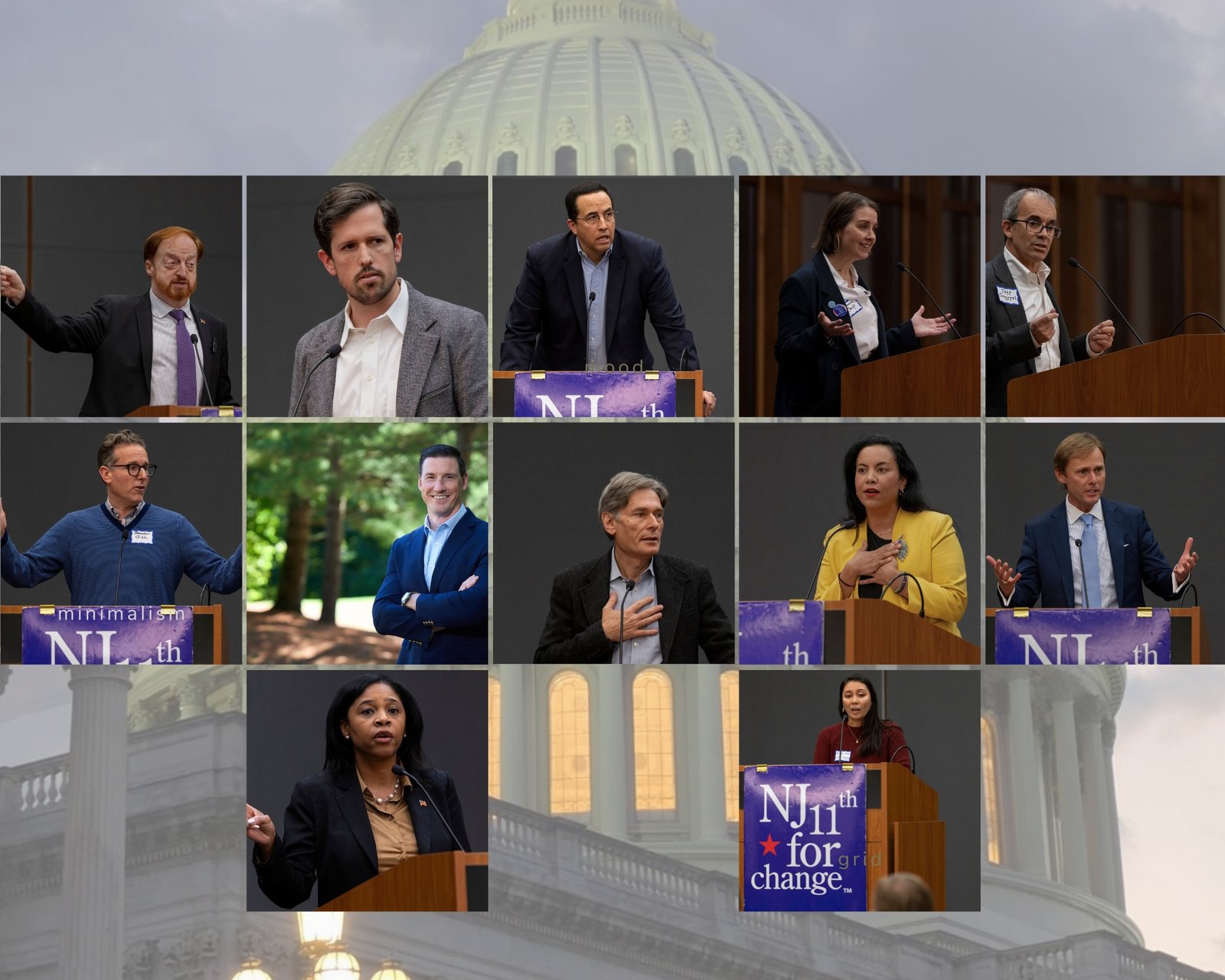
Eleven Democrats hope to land their party’s nomination to represent the 11th Congressional District, but just three benefit from the bulk of outside spending — Malinowski, former Lt. Gov. Tahesha Way, and Essex County Commissioner Brendan Gill.
As of Jan. 30, the United Democracy Project, a pro-Israel super PAC affiliated with the American Israel Public Affairs Committee, spent more than $1.8 million to buy TV ads, mailers, and more to trash Malinowski, while the Democratic Lieutenant Governors Association PAC spent over $1.6 million since Jan. 31 on TV ads, text campaigns, and more to support Way.
Trump administration sued over Gateway tunnel funding
A pro-Malinowski PAC called the 218 Project spent $734,274 to fund media production and broadcasts supporting his campaign. The union-backed Affordability and Progress PAC spent more than $170,000 on mailers and more to promote Gill.
Voter turnout is expected to be abysmal because the special election is on a Thursday in February. But the race is regarded as an early indicator of public sentiment heading into November’s midterms, when Democrats hope growing disapproval of President Donald Trump will help them seize control of Congress. The 11th District covers parts of Essex, Morris, and Passaic counties, and is largely seen as a safe district for Democrats.
“Any special election is going to be such a tiny portion of the voting public, typically those high-propensity voters that turn out for every election and those who are most civically engaged,” said Ashley Koning, director of the Eagleton Center for Public Interest Polling at Rutgers University. “But this is a seat that Democrats can’t afford to lose in the House, that’s not only consequential for New Jersey but that the party at large will want to hold on to going into 2026. I think that’s why we see so much money pouring into this race.”
The outside spending could have an outsized impact at the polls, Koning added.
“Clearly, they’re spending more money per vote, if we have fewer votes and massive amounts of money being piled into the primary race,” Koning said. “This is about trying to set the way of what kind of Democrat is going to win that seat — and then potentially hold that seat for several cycles thereafter.”
The winner of Thursday’s Democratic primary will face Republican Randolph Mayor Joe Hathaway in the April 16 special election (Hathway is the only Republican in Thursday’s GOP primary). The winner of that race will fill out the remainder of Sherrill’s term, which ends on Jan. 3, 2027.
Good-government watchdogs have long blasted outside spending, which has no caps and requires little transparency, as a saboteur of democracy. And many candidates themselves aren’t happy about it either, whether they benefit from it or not.


Democrat John Bartlett, a voting rights attorney and Passaic County commissioner, has gotten no outside funding in his run for Sherrill’s old seat. Bartlett said election outcomes have been increasingly influenced by private money from unclear sources since the U.S. Supreme Court equated money with speech and barred limits on outside spending in political campaigns, in rulings like Buckley v. Valeo in 1976 and Citizens United in 2010.
“The idea that corporations can spend unlimited amounts of money to influence the political process creates incredibly expensive campaigns like this one, and it creates a political environment where candidates may be tempted to search for patrons and not for votes,” Bartlett said.
The deluge of ads funded by so-called dark money organizations — usually nonprofits that don’t have to disclose their donors — shows the country needs comprehensive campaign finance reform, he added.
“We need a system where elected officials answer to the people that elect them, and anytime you’ve got the disproportionate influence of a very small number of funders, I think it puts that principle at risk,” Bartlett said.
Malinowski seconded that sentiment, warning that many groups use money as a cudgel to bend politicians to their will. Malinowski served two terms in the House representing the 7th Congressional District before voters ousted him in 2022.
AIPAC, which had supported him in the past, soured on him because while he supports aid to Israel, he refused to pledge unconditional, unrestricted support, he said.
“They told me that they’re also concerned that I’ll be influential. And so my small deviation from their hard line is scarier for them than if I were some super-progressive candidate who isn’t going to be a leading voice on foreign policy in the party,” Malinowski said. “I think they’re sending a message to our incumbent Democratic members of Congress — from this point on, they have to get with AIPAC’s hard line or be destroyed.”
Other outside groups are watching the New Jersey race, ready to deploy similar tactics to influence races in November’s midterms, Malinowski added.
“I think the stakes are pretty high,” he said. “We get to say the Democrats are immune to that in this first of the midterms, and the party as a whole will be more emboldened to vote its conscience in the House and the Senate.”
United Democracy Project spokesman Patrick Dorton confirmed to The Hill that the group is not happy Malinowski would place conditions on aid to Israel.
“That’s not a pro-Israel position, and he knows it,” Dorton said.

To Dan Cassino, a surge of dark money in a race — especially when it funds attack ads — can be both unfair and effective.
Cassino, professor of government and law at Fairleigh Dickinson University and the executive director of the FDU Poll, pointed to AIPAC-funded ads that don’t mention Israel at all, like one that tapped into the national furor over immigration enforcement and accused Malinowski of voting in 2019 to fund ICE.
Malinowski, who has been a longtime, staunch critic of Trump’s immigration strategy, told supporters last month he was “f—ing furious” about the ad, which he called “the worst of politics.” The 2019 emergency appropriations bill the AIPAC ad references included humanitarian aid, as well as more border control, and all but three members of New Jersey’s congressional delegation supported it, including Sherrill.
But the ads have been effective with some voters, Cassino said.
“I’ve had three different conversations with Democrats who asked me, ‘Well, who can beat Tom Malinowski? I’ll vote against him because he voted for ICE.’ And I felt like, ‘OK, those ads are pretty misleading, here’s what really happened.’ But I can’t talk to every voter in NJ-11. The question is whether that overwhelms the enormous advantage he had in name recognition going into this race,” he said.
Cassino said the AIPAC spending also shows the sheer volume of money flooding the race. He pointed to a push poll done last week. That’s essentially a phone campaign in which callers pose as pollsters but instead ask negative questions about the candidate they want to lose.
Push polls are a campaign strategy that fell out of favor decades ago because of the prohibitive cost of getting live callers to connect with enough people to influence an election’s outcome, Cassino said. A push poll happening in this race “is like when they found the coelacanth,” he said. A coelacanth is a deep-sea fish thought to have gone extinct 65 million years ago that was rediscovered in 1938.
“That is a sign that there is more money in this race than anyone knows what to do with,” Cassino said. “You don’t do a push poll unless you’re like, ‘Well, we’ve got a million bucks to spend. We’ve got a week to do it. What the hell are we going to spend this money on?’ And you start throwing money at stupid stuff.”
Nikita Biryukov contributed.
GET THE MORNING HEADLINES.



