
The Attorney General’s disrespect for opponents is matched by her gushing praise for Trump, however off topic; for Bondi, who has been reported to be on thin ice with the President, there is no ignoring the audience of one. “The Dow is over fifty thousand right now, the S. & P. at almost seven thousand, and the Nasdaq smashing records, Americans’ 401(k)s and retirement savings are booming,” Bondi said on Wednesday. “That’s what we should be talking about.” At another point, Bondi insisted that her questioners should apologize to Trump for having impeached him twice during his first term. “You-all should be apologizing,” she said. “You sit here, and you attack the President, and I am not going to have it.”
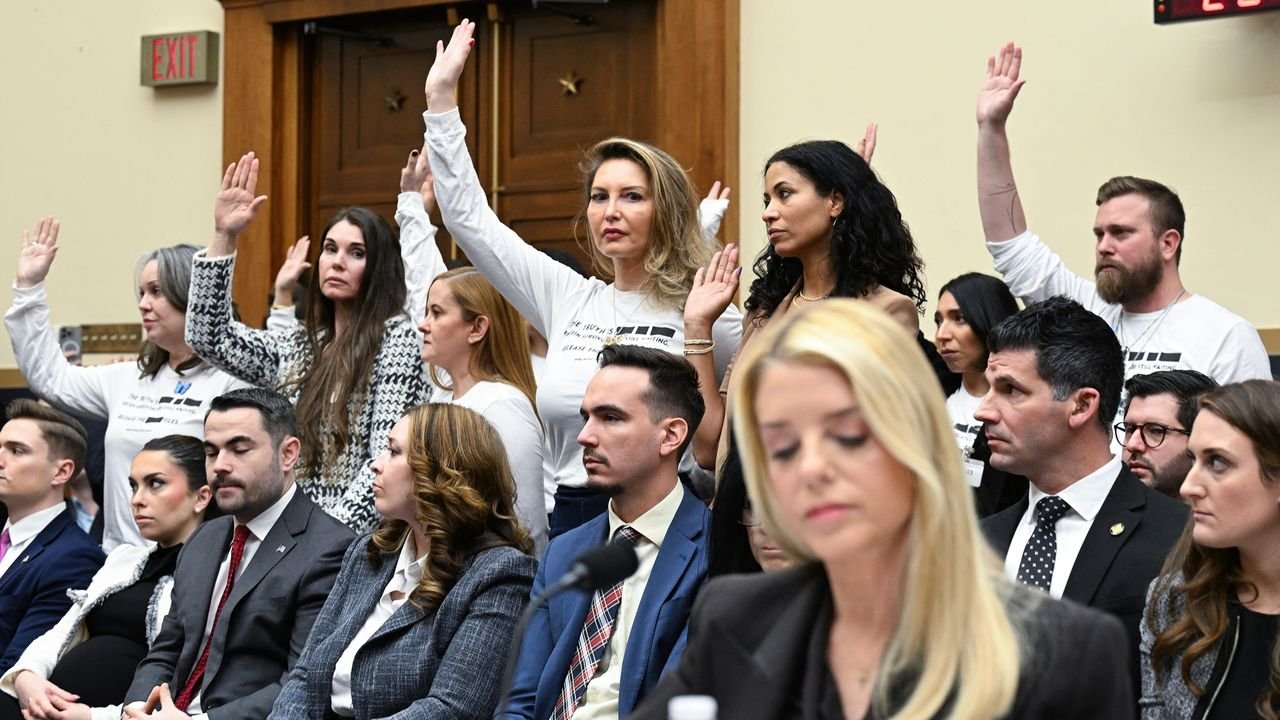
Wednesday’s hearing, like so much else in Washington these days, was consumed by questions about Epstein—in this case the Justice Department’s handling of the release of the files and its treatment of Epstein’s victims. The Administration has been criticized both for redacting too much information in the documents and for exposing victims’ identities. (The department has removed thousands of documents in response to victims’ complaints.) Lawmakers had invited a dozen victims and their family members to attend the hearing, and they were wearing white shirts with blacked-out text and the message “The truth is—Epstein survivors are still waiting.” Democrats did not refrain from introducing them like so many useful props.
Pramila Jayapal, a Democrat from Washington, asked the survivors to stand and raise their hands if they had not been able to meet with the Justice Department. Their hands went up. Jayapal asked Bondi, “Will you turn to them now and apologize for what your Department of Justice has put them through with the absolutely unacceptable release of the Epstein files and their information?” Bondi invoked Garland, and then, not surprisingly, demurred. “I’m not going to get in the gutter for her theatrics,” Bondi said, waving her hand dismissively. Jayapal, along with a number of other legislators, had viewed the unredacted Epstein files. Photographers at the hearing captured shots which appeared to show that the Attorney General had a document with Jayapal’s search history. Jayapal later described such surveillance as “totally inappropriate.”
As a political matter, the demands for the full release of the Epstein files, which were a rallying cry for Republicans during the 2024 election season, have now become an even more effective cudgel for Democrats. Bondi botched her handling of the matter from the outset, by claiming that she had an Epstein “client list,” releasing little to nothing, and announcing that the investigation was complete. Even after the congressionally mandated release of a searchable database of millions of documents, questions remain about whether the Justice Department is continuing to protect Trump or other friends of Epstein’s by imposing unwarranted redactions or failing to pursue avenues of inquiry.
But Democrats’ focus on Epstein also distracts attention from the deeper problems of the department under Bondi—ones that go to the core of its mission and that threaten its ability to operate even after Trump leaves office. Most alarming is Trump and Bondi’s overt weaponization of the department to pursue Trump’s political enemies. In September, 2025, Trump used a Truth Social post to demand that she bring charges against James Comey, Letitia James, and the California senator Adam Schiff, insisting, “We can’t delay any longer, it’s killing our reputation and credibility.” Shortly after, Bondi secured indictments of Comey and James—both of which were ultimately dismissed by a federal judge. As Raskin told Bondi in his opening remarks, “Trump orders up prosecutions like pizza and you deliver every time. . . . Nothing in American history comes close to this complete corruption of the justice function and contamination of federal law enforcement.”
Lawmakers, however, dealt with these and other instances of Justice Department overreach only glancingly. They did not mention the threatened indictments of the Federal Reserve’s Jerome Powell and Lisa Cook. They did not ask Bondi about the latest embarrassment for the department, which had occurred the day before the hearing, when a federal grand jury in the District of Columbia took the rare step of rejecting the proposed indictment of six members of Congress for reminding servicemembers that they do not have to obey unlawful orders. Lawmakers spent little time on the Justice Department’s refusal to investigate an ICE agent’s killing of Renee Nicole Good in Minneapolis, or on the reported resignation of six federal prosecutors there after the office was tasked with investigating Good’s widow instead. Bondi was not asked directly about the department’s raid on the home of the Washington Post reporter Hannah Natanson, or about the F.B.I.’s seizure of voting records from the 2020 election in Georgia. According to Trump, Bondi instructed the director of National Intelligence, Tulsi Gabbard, to take the extraordinary step of going to the scene, but Bondi was not asked to confirm that. Also unaddressed: the evisceration of the department’s Civil Rights Division and the debilitating vacancies in U.S. Attorneys offices nationwide.



