
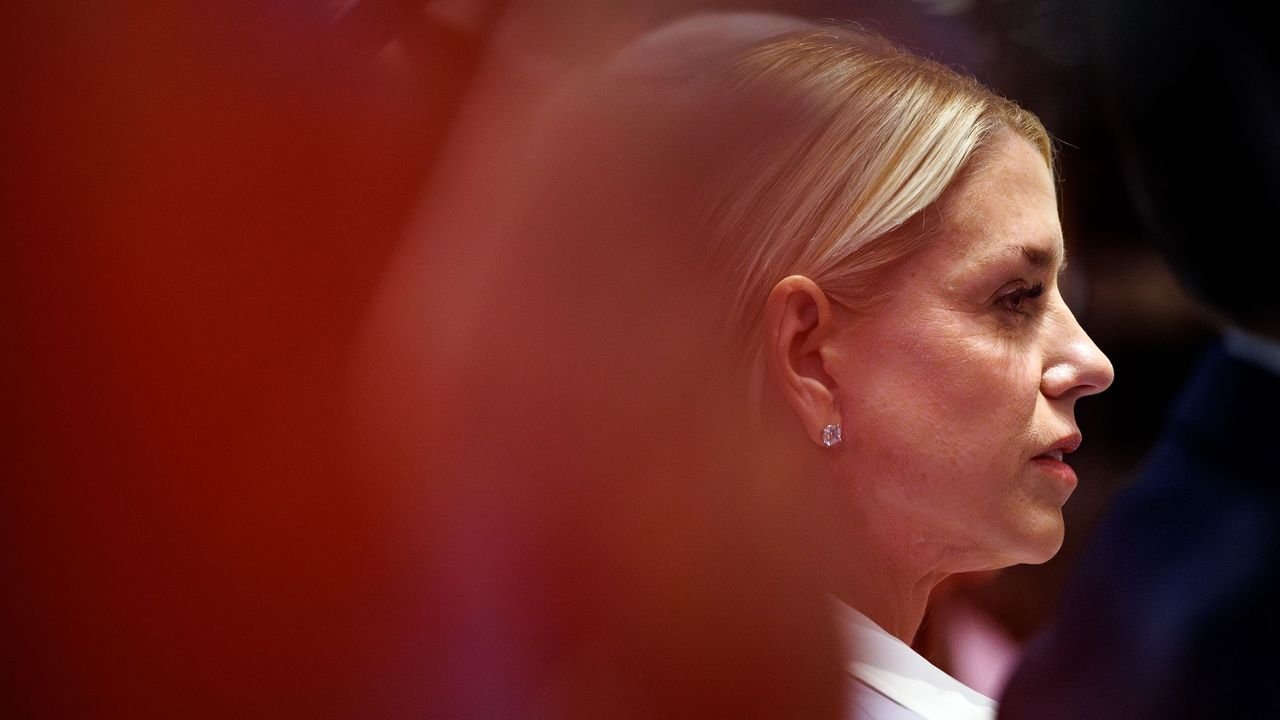
But Bondi’s departure does not augur a better world to come. Like the former Department of Homeland Security Secretary Kristi Noem, whom Trump fired in March, Bondi had become a political liability. She had, in the words of the White House chief of staff Susie Wiles, “completely whiffed” on dealing with conservative clamor for the Epstein files. As Wiles told Vanity Fair, “First she gave them binders full of nothingness. And then she said that the witness list, or the client list, was on her desk. There is no client list, and it sure as hell wasn’t on her desk.” No single issue has plagued Trump’s second term more than his dealings with the convicted sex offender, and Bondi botched the matter from the start—a reality underscored by the Republican-controlled House Oversight Committee’s vote, last month, to subpoena Bondi’s testimony regarding the Epstein files.
Trump’s move to get rid of Noem, however, also reflected some degree of recognition that the mass-deportation campaign had gone too far, or at least turned off too many Trump supporters. In Bondi’s case, the President was reportedly furious not because she went too far but because she had failed to do his bidding swiftly and effectively enough. His dwindling patience emerged in a Truth Social post from September, 2025—Trump reportedly had meant it as a private message to Bondi—in which the President addressed her as “Pam” and railed about the department’s failure to secure indictments against the former F.B.I. director James Comey, the New York attorney general Letitia James, and the California senator Adam Schiff. “We can’t delay any longer, it’s killing our reputation and credibility,” Trump instructed Bondi. “They impeached me twice, and indicted me (5 times!), OVER NOTHING. JUSTICE MUST BE SERVED, NOW!!!” The department duly secured indictments of Comey and James, only to have them dismissed after a federal judge found that Lindsey Halligan, the insurance lawyer tapped by Trump to serve as the U.S. Attorney for the Eastern District of Virginia, had been improperly appointed. Since then, the department has been stalled in its efforts to secure the kind of prosecutions that he has demanded. Prosecutors were stymied in their efforts to find a criminal case in President Joe Biden’s use of an autopen to grant pardons. A federal grand jury refused to indict six Democratic members of Congress who had posted a video reminding service members they are not obliged to follow illegal orders. In Virginia, grand juries twice balked at indictments of James after the original charges were tossed.
The new Attorney General is apt to be just as destructive as Bondi—maybe even more so, given that Bondi, who had little familiarity with the federal legal system, was not terribly effective in the job. Trump named the Deputy Attorney General, Todd Blanche, formerly one of the President’s criminal-defense lawyers, as acting Attorney General. Blanche is a veteran of the prestigious Manhattan U.S. Attorney’s office, and there was some hope, when he was named to the department’s No. 2 role, that he would help stand up for its independence. But there is little evidence that Blanche has tempered Trump’s worst instincts, and ample illustration that he is fully on board with the President’s agenda. He conducted a credulous interview with Ghislaine Maxwell, last July, which looks even shoddier now than it did then, in light of the Epstein documents that have since been released. Last week, Blanche spoke at CPAC, the Conservative Political Action Conference, a venue far more partisan than is common for a Deputy Attorney General. Blanche did not shy away from politics—he plunged in. Disputing reports that he had been a Democrat, Blanche paused. “Everybody’s supposed to say ‘Boo,’ ” he told the audience, before thanking them when they responded accordingly. This is not acceptable behavior from a senior law-enforcement official.
Maybe Blanche will get the job permanently. Maybe Trump will turn to Lee Zeldin, the Environmental Protection Agency administrator, who has no prosecutorial experience but has demonstrated the primary requirement: unswerving fealty to Trump. Years ago, during his first term, Trump was lamenting the perfidy of his first Attorney General, Jeff Sessions, the former Alabama senator. Sessions was insisting on recusing himself from the probe into the Trump campaign’s involvement with Russia; Trump wanted him to stay, the better to protect his interests. “Where’s my Roy Cohn,” Trump demanded, referring to the legendary former fixer who had shown Trump how to bend the legal system to his will. With Bondi gone—she’ll be “transitioning to a much needed and important new job in the private sector,” Trump announced in a post—his quest for the next Roy Cohn continues. Anyone he picks for the post will understand clearly what that entails. ♦



