Early congressional fallout from the U.S. military incursion into Venezuela to capture the country’s president, Nicolás Maduro, has been marked by Republican triumphalism and effusive praise for the Trump administration as well as outrage over what Democrats see as a stark violation of the Constitution’s war powers clause that risks an expensive and draining U.S. embroilment in more nation-building.
This early on, it’s unclear if Democratic fears will prove correct that President Donald Trump has instigated another long-running, open-ended U.S. military commitment in a country with competing power factions and long-standing animosity toward U.S. interference.
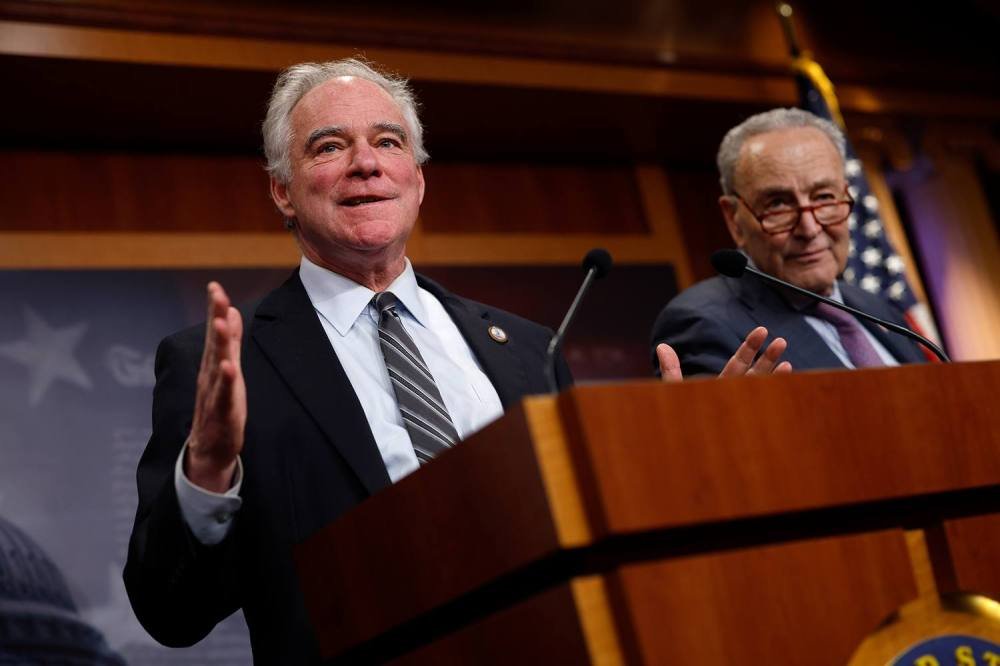
Still, Democrats are not expected to wait to see if their fears are proved correct. This week, Sen. Tim Kaine plans to force another floor vote on a resolution under the War Powers Act that would ban U.S. military operations in Venezuela that are not authorized by Congress.
In November, the Senate narrowly rejected a similar resolution from Kaine, with nearly all Republicans accepting the administration’s assertion that its campaign of lethal strikes on alleged drug-smuggling boats in the Caribbean and eastern Pacific was aimed at combating alleged “narcoterrorists” and not at forcing regime change in Venezuela.
“Many of my Republican colleagues told me that President Trump was only bluffing and voted no for that reason,” Kaine said during a Tuesday night Senate floor speech, urging more Republicans to now back his resolution. “In the aftermath of this invasion, with the administration claiming it has the right to seize Venezuelan oil and ‘run Venezuela’ under the supervision of the U.S. secretaries of Defense and State, and the president threatening to put boots on the ground and conduct additional strikes to control the country, we see that this was no bluff.”
But with nearly all Republicans still falling in line behind the administration’s insistence that the weekend’s covert military operation in Venezuela—which resulted in no U.S. fatalities but reportedly dozens of dead Cubans and Venezuelans—was perfectly legal, it’s not expected that the Kaine war powers resolution will pass the Senate.
So Democrats may look to amend the defense spending bill for fiscal 2026, which could finally be released in the coming weeks ahead of a Jan. 30 funding deadline, to restrict Defense Department funding for unauthorized military actions in the Caribbean and Venezuela.
Senior Democratic leaders said they were not yet ready to discuss what actions they might pursue if the Kaine resolution fails.
“I think we’re entitled to a vote on war powers, separate and apart from the defense appropriations process,” said Sen. Brian Schatz, who is a member of the Senate Democratic leadership team.
The administration and its Republican backers on Capitol Hill are insisting that the capture of Maduro was not a military coup perpetuated by the United States but a legal “law enforcement operation” to bring the long-running authoritarian leader to New York City to face drug-trafficking charges.
Republicans, including those with oversight of the military and State Department, said they were comfortable with the lack of notification that the administration gave lawmakers, including the so-called the Gang of Eight, going into the Jan. 3 operation. The Gang of Eight consists of the four Republicans and four Democrats who lead the Senate and the House as well as the two chambers’ intelligence committees. By law, the president is required to notify the Gang of Eight as soon as possible after a finding for covert military action is issued.
“I had appropriate notice,” said Sen. James Risch, noting that he was speaking in his capacity as both the Senate Foreign Relations Committee chairman and as the longest-serving Republican on the Senate Intelligence Committee.
The Republican head of the Senate Armed Services Committee, Sen. Roger Wicker, said he thought the president was “well-advised” to not notify congressional party leaders and intelligence heads before the Maduro operation because of the potential for leaking—a fairly remarkable statement considering how historically tight-lipped and protective of their exclusive oversight responsibilities the members of that august group have been.
The full Gang of Eight, as well as the Republican and Democratic leaders of the House and Senate’s Foreign Affairs and Armed Services committees, received notification of the covert action to capture Maduro at a classified briefing on Capitol Hill on Monday night.
Heading into the briefing, Sen. Mark Warner, the lead Democrat on the Intelligence Committee, said the administration’s claim that seizing Maduro was not about regime change but, rather, about combating drug smuggling was not credible. Warner said Trump’s recent pardon of former Honduran President Juan Orlando Hernández, who had just begun serving a 45-year prison sentence for facilitating the smuggling of massive amounts of cocaine into the United States, illustrated the contradictions in the administration’s drug-smuggling stance.
“This kind of activity doesn’t pass the smell test that this was a legal action,” Warner said. “You don’t send 20 percent of the fleet, 150 airplanes, and the Delta Squad in. That’s military.”
The Monday night briefing went on for more than two hours, an unusually long time for such an event and all the more notable considering that only a few lawmakers were permitted to attend. This suggests that those in attendance put many questions to Secretary of State Marco Rubio, Defense Secretary Pete Hegseth, and the other cabinet officials.
“This briefing, while very extensive and long, posed far more questions than it ever answered,” said Sen. Chuck Schumer, the leader of the Senate Democrats, adding that the administration plan he heard for how Venezuela is to be run post-Maduro was “vague, based on wishful thinking, and unsatisfying.”
Republicans repeated the talking point made by Rubio and other administration officials that the capture of Maduro shouldn’t be viewed as a military coup or regime change in Venezuela.
“This was a law enforcement operation where a person was arrested and is facing charges in the United States,” Risch said. “Certainly, a side effect of that is that when he is in custody in the U.S., he can’t be running the Venezuelan country anymore, but that wasn’t the objective of what was done here. Obviously, there was military involvement, but it was a law enforcement operation.”
“This is not a regime change. This is a demand for change of behavior by a regime,” added Republican House Speaker Mike Johnson.
Johnson said he was hopeful that the “interim” government of Venezuela under Delcy Rodríguez, a trusted Maduro ally who until this week was the country’s vice president, would implement the policy changes that the administration wanted, which include reducing Caracas’s ties with China, Russia, and Iran.
“We have a way of persuasion, because their oil exports have been … seized,” the speaker said. “I think that will bring the country to a new governance in very short order. So, we don’t expect troops on the ground, we don’t expect direct involvement in any other way beyond just coercing the new interim government to get that going.”
Perhaps undermining the administration’s assertion that the Maduro capture was a mere law enforcement action, the top senators with oversight of the Justice Department were excluded from Monday night’s classified briefing,
“There is no legitimate basis for excluding the Senate Judiciary Committee from this briefing,” said the committee’s Republican chairman, Chuck Grassley, and Democratic ranking member, Dick Durbin, in a rare joint statement that also noted Attorney General Pam Bondi’s participation in the briefing. “The administration’s refusal to acknowledge our committee’s indisputable jurisdiction in this matter is unacceptable and we are following up to ensure the committee receives warranted information regarding Maduro’s arrest.”
Additional briefings on Venezuela for the full Senate and full House are scheduled for Wednesday.