
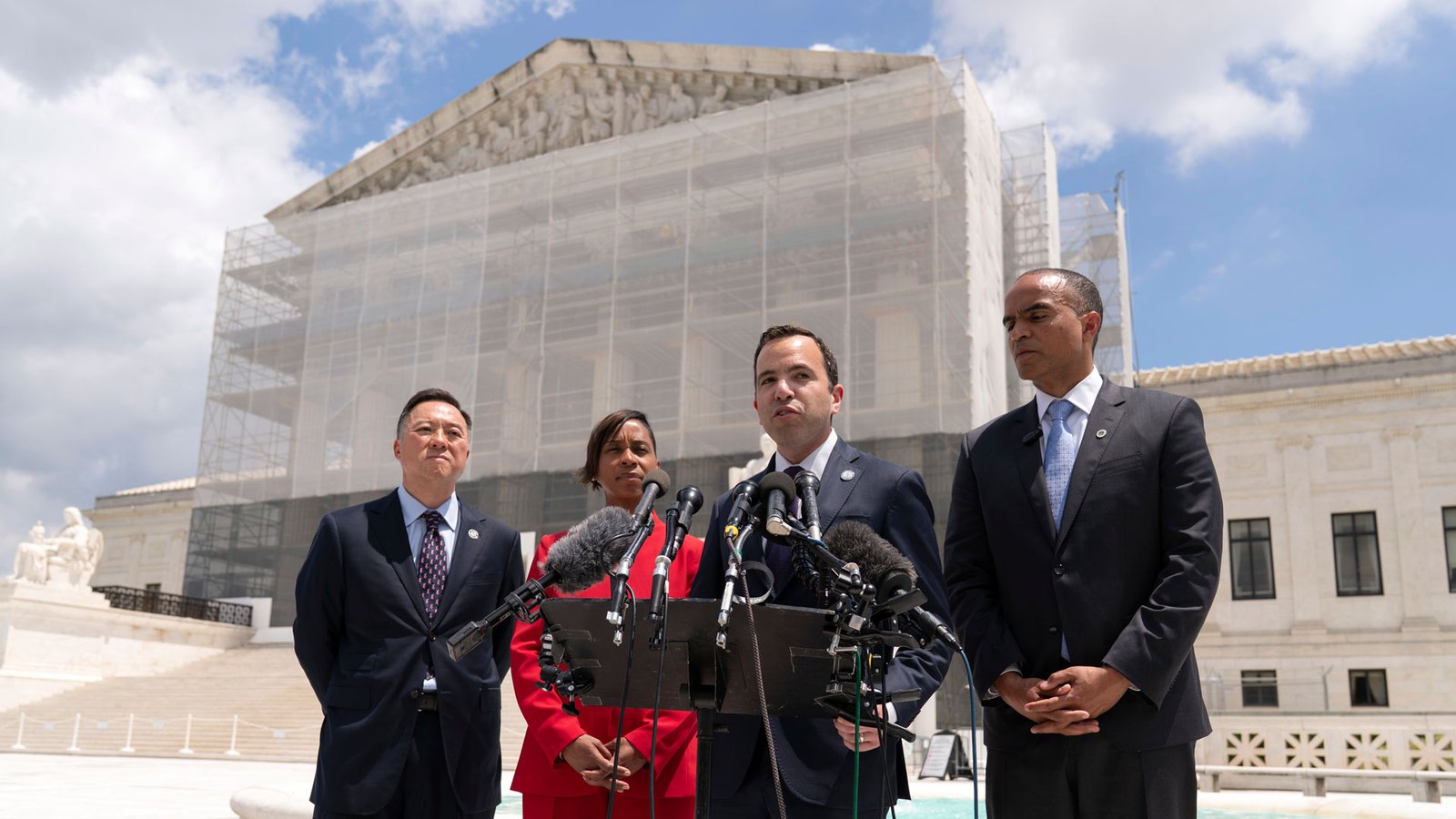
The U.S. Supreme Court heard arguments Wednesday in the landmark birthright citizenship proceeding.
The case, Trump v Barbara, is rooted in an executive order signed by President Donald Trump on the first day of his second term. The order — blocked by lower courts — ends automatic citizenship for children born in the United States and instead makes citizenship dependent on their parents’ immigration status.
Former New Jersey Attorney General Matt Platkin led the coalition of states that sued to block the executive order. This interview has been lightly edited.
Joanna Gagis, anchor: The case that you brought against the president’s executive order is different than what’s being heard before the Supreme Court. Tell us what you laid out in your arguments as to why this was unconstitutional.
Matt Platkin: The cases are very similar. The case that the court heard today was on behalf of private individuals; the case that we brought was on behalf of a coalition of states.
We filed that case at 11 a.m. the morning after the order was signed. It was signed at 8 p.m. on his first day in office, the first time in 157 years that the president of the United States tried to rewrite the 14th Amendment to say that babies born on U.S. soil were not entitled to the same rights and privileges that they had been entitled to since the Civil War.
We actually litigated the case up to the United States Supreme Court. Our Solicitor General Jeremy Feigenbaum argued that case in order to preserve our right to seek what was called a nationwide injunction. So now the court has heard it a second time, on the merits of the case.
Let’s be clear: there is no good argument that the government has put forth against the understanding we’ve had, for a century and a half ,that babies born here are citizens of this nation. They simply don’t have any good argument to support their position.
JG: As we heard oral arguments play out today, what is your interpretation of the questions that some of the justices were asking in terms of how they’re approaching this case?
MP: The justices, having been through many Supreme Court arguments, were quite skeptical of the government’s position. Of course they’re going to ask probing questions of both sides; that’s what the Supreme Court does. But clearly skeptical of the government’s position.
Remember, it isn’t just the text of the 14th Amendment, and there’s really no good argument that’s subject to the jurisdiction thereof, doesn’t include children born on U.S. soil. But the Supreme Court also considered the over a century of precedent since the Wong Kim Ark decision in the 1890s, numerous acts of Congress that codified the exact same understanding that we put forth.
To say they had an uphill battle would be generous. This was a political act put forth by a president attempting to usurp the powers of the Constitution and of Congress and of the American people to rewrite a provision in the Constitution that we had a Civil War over. We had a Civil War to settle whether babies born here were, in fact, citizens of this nation. Clearly, the challengers to the order are going to prevail.
JG: You just referenced the Wong Kim Ark case, and the average viewer may not know what that case is.
MP: Wong Kim Ark was a child born here, and that case was in the 1890s — right around the same time, by the way, as the court was doing a whole bunch of other things that were not exactly quote unquote, progressive. So this wasn’t the most liberal court in American history.
It was about whether he was a child born here, similar to what we’re talking about now: Was he, in fact, a citizen of this nation, or whether he’s a citizen of somewhere else? And the court said — clearly in that case — that birthright citizenship under the 14th Amendment is the law of the land, codifying the understanding that we had had since the amendment in 1867.

Following that decision, now 125 years ago, we have had numerous acts of Congress and numerous cases that relied on it. No one questioned it. No one seriously thought the 14th Amendment didn’t say exactly what the Supreme Court said in Wong Kim Ark — that everybody born here had understood it to say since that time, until this president came into office on Jan. 20, 2025, and took a Sharpie to the 14th amendment of the Constitution.
That’s why I was proud to lead the coalition of states fighting it. I’m proud to stand with many, many advocates across the country who are standing up today in court and across the country speaking out for the rights of immigrants in this nation. People born here who enrich this nation, who pay their taxes, who run businesses, who are Americans. And we’re saying that in New Jersey, in a state that lives in the shadow of the Statue of Liberty and of Ellis Island.
I don’t think we could have been a more appropriate lead state for this case.
JG: What are the possible implications depending on how this court rules? Either way, we do know that the solicitor general said that this would not be retroactive to people already here if the Trump administration rule took effect.
MP: Well, first of all, he’s saying that for this argument. That has no binding effect on the administration. They have argued, in court, that the president unilaterally can decide what is constitutional under the 14th Amendment, or arguably, of the right under any provision in the Constitution — an alarming and crazy escalation of presidential authority.
But the practical consequences of this — this is not a theoretical risk. The practical consequences would be extraordinary. The order that the president signed says that babies born here under certain conditions are not U.S. citizens. It doesn’t say what they are; it doesn’t give them a second class of citizenship that we’ve never had in this nation. It doesn’t say what nation they are citizens of.
“This administration, when they put forth the order, they said it would come into effect in 30 days. As a reminder, this administration can’t even get you in the airport in under six hours. But they’re going to figure out how to impose a new class of citizenship in 30 days?”
So you could have this permanent subclass of residents of this nation that don’t belong in any country. And for states, you think about the benefits we provide: educational benefits, health care benefits. How are you going to go through and parse through what rights and privileges a child has? I think Justice Jackson asked, ‘Are you going to have to depose the mother to determine what rights the baby has?’
It’s an absurd formulation, and I think the fact that this administration, when they put forth the order, they said it would come into effect in 30 days. As a reminder, this administration can’t even get you in the airport in under six hours. But they’re going to figure out how to impose a new class of citizenship in 30 days? It’s not serious. It was a political act, and it was a flagrant violation of the Constitution.
JG: Twenty-four states originally, I believe, filed the lawsuit seeking a preliminary injunction. What happens to those cases now, depending on the ruling here? Do they move forward? Does this set precedent?
MP: Well, I’ll certainly let the state speak for itself, but I assume and I think the general view, based on the arguments today, that the court is going to side with the advocates challenging this order. I think they are going to reaffirm what they said in Wong Kim Ark, that birthright citizenship is the law of the land, and hopefully that ends this and this administration stops trying to strip away the rights of babies born here.
But certainly I know the states that were in that coalition, who I was proud to litigate with and who stay strongly on the side of immigrants born here, will continue to fight for birthright citizenship and continue to fight for the rights and privileges of all Americans and the the rule of law.
This is not an abstract concept. Like I said, the rule of law means the president cannot tell a mother that their child born here is not an American citizen simply because he wants to.



