
SAN DIEGO – Locally born quick-service restaurant chain Jack in the Box Inc. (Nasdaq: JACK) appears to be headed toward a proxy fight, with an activist investor calling for change on the company board.
Sardar Biglari, 48, runs Biglari Capital Corp. and Biglari Holdings (NYSE: BH) as well as other businesses. He is CEO of Steak ’n Shake and owner of the Western Sizzlin steakhouse chain. Biglari’s entities have amassed slightly less than 10% of Jack in the Box stock.
A proxy statement sent to Jack in the Box stockholders by Biglari Capital states that “shareholders need to send a strong message” to their board “that the status quo is unacceptable. This message can be rendered by voting against the reelection of Chairman David Goebel.” Jack in the Box has set its annual meeting for Feb. 27.
The moves come as Jack in the Box works to stem losses and get back on the path to growth following several setbacks, including the purchase and money-losing sale of Del Taco.
A company representative said people should get their information from the proxy statement filed by Jack in the Box Inc.
“The Board recommends that you simply disregard any materials sent to you by, or on behalf of, the Biglari Group,” says a proxy statement filed by the corporation, dated Jan. 21. “We are not responsible for the accuracy or completeness of any information provided by, or relating to, the Biglari Group contained in any proxy solicitation materials filed or disseminated by, or on behalf of, the Biglari Group or any statements that the Biglari Group or its representatives have made or may otherwise make.”
Goebel, 75, has been a company director since 2008 and chairman since 2020. He brings more than 40 years of leadership in retail, food service and hospitality to his job as chairman.
“We believe that, under the right leadership and oversight, JACK can achieve long-term success, and we remain committed to working with leadership toward that end,” the proxy statement from Biglari Capital says. “In our view, however, the incumbent board does not have the right experience, skill set and/or willingness to address strategic missteps and reverse years of stockholder value destruction. As such, we felt compelled to take further action by bringing these issues directly to shareholders and allowing them to voice their dissatisfaction with the board and the company.”
In addition to removing a board member, Biglari Capital’s proxy statement asks shareholders to reject pay raises for executives.
Proxy statements from both Jack in the Box and Biglari Capital give timelines of events.
According to Biglari Capital’s proxy statement, Biglari met with company officials in 2024 and 2025 to discuss finances, operations, his desire to sit on the board and whether his representatives might sit on the board.
The Jack in the Box proxy statement says at one point, Biglari Group notified the company it was withdrawing its nomination of Biglari to the board.
In November, Jack in the Box appointed two new board members and enlarged the board from eight to 10 members. Mark King and Alan Smolinisky joined the board in connection with a cooperation agreement between the company and one of its stockholders, GreenWood Investors LLC.
Biglari Capital’s proxy statement alleges that Jack in the Box lost $460 million in its purchase and subsequent sale of Del Taco. “How can shareholders trust a board that just squandered $460 million?” the proxy statement says. The document also takes issue with the board hiring three CEOs in the last decade.
This is not Biglari’s first push for change in the restaurant industry.
According to Fortune magazine, the executive has attempted seven proxy battles with Cracker Barrel Old Country Store Inc. and took part in the spirited national debate when the restaurant chain changed its logo last year.
Biglari Holdings also includes Abraxas Petroleum Corp., Southern Oil Co., Southern Pioneer Property & Casualty Insurance Co. and Maxim Inc., publisher of the men’s magazine.

Marking a Milestone Year
A shareholder dispute is not the kind of thing Jack in the Box’s marketing team wants to focus on. In addition to steering customers toward Jack in the Box stores, they would prefer to celebrate the 75th anniversary of Robert Peterson opening his first Jack in the Box store on El Cajon Boulevard in 1951. The year will bring several promotions and limited-time menu items to the chain, which now has roughly 2,135 company-owned and franchise outlets across the United States.
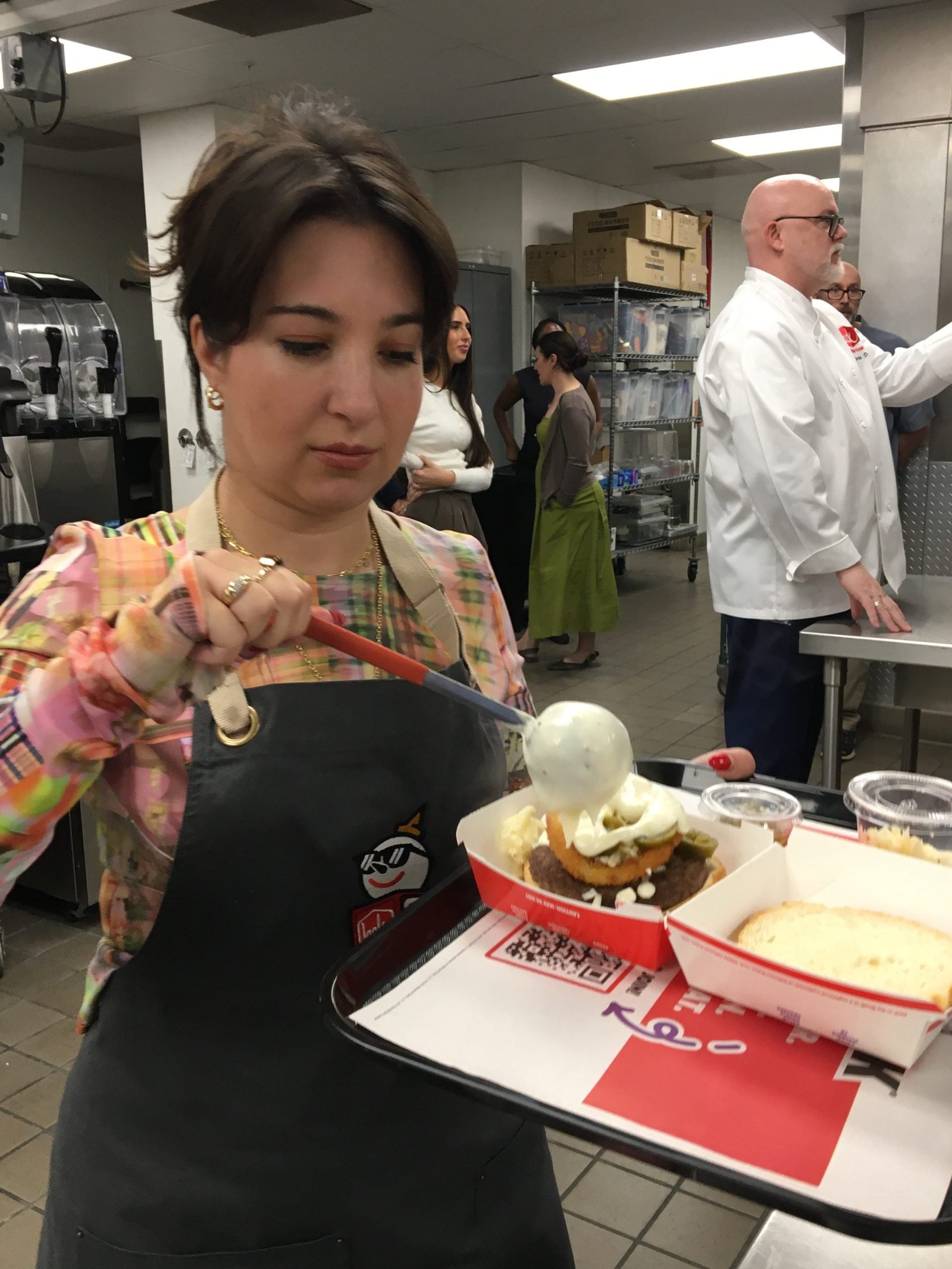
On Jan. 14, the company invited a dozen reporters, bloggers and TikTok videographers to the big kitchen in its corporate headquarters on Kearny Mesa. There they got the lowdown on 2026 promotions and assembled their own “Hot Mess” cheeseburgers, replete with runny cheese sauce, jalapeños and onion rings, all on a sourdough roll. The concoction was introduced in 2013 and will be available in stores this month.
Meanwhile, the company is working on its financial situation.
In mid-November, Jack in the Box reported same store sales in its fourth quarter declined 7.4% over Q4 of 2024, far surpassing the 2.1% decline reported one year ago. The business attributed the loss to a decrease in transactions and what it called “an unfavorable menu mix.” The business plans to report quarterly financial results again on Feb. 18.
Shortly after the beginning of the year (Jan. 9), Jack in the Box announced that it repaid $105 million in debt – specifically its Series 2019-1 4.476% fixed rate senior secured notes, Class A-2-II.
The move “reflects the meaningful progress we continue to make toward strengthening our balance sheet and positioning the company for sustainable growth under ‘JACK on Track,’” said CEO Lance Tucker, referring to the campaign to improve the business.
“Our efforts to improve long-term financial performance, accelerate cash flow and simplify our company while preserving growth-oriented capital investments are working, and we remain committed to executing against these strategic priorities to deliver value for our shareholders.”
The business says it plans to continue to pay down debt through a combination of cash on hand and targeted real estate sales. Jack in the Box announced on Dec. 22 that its sale of Del Taco Holdings Inc. to Northern California-based Yadav Enterprises had closed, bringing in approximately $109 million cash. The remaining $10 million is in the form of a 21-day promissory note.
As Jack in the Box works to improve its financial situation, the promotions roll on.
One of Jack in the Box’s giveaways this year is a collection of “Jibbi” bag charms – Jack in the Box characters rendered in the popular Japanese-inspired style.
The company has also collaborated with The Hundreds, the Los Angeles-area streetwear brand. Here a sweatshirt depicts a round-headed character named Adam Bomb marked up with graffiti to make him resemble Jack of Jack in the Box.
“The partnership taps into a larger cultural moment where food, fashion and identity are all becoming one, as brands move beyond traditional categories to meet fans where they are,” according to marketing materials.
Jack in the Box Inc.
FOUNDED: 1951
CEO: Lance Tucker
HEADQUARTERS: San Diego (Kearny Mesa)
BUSINESS: Franchisor and operator of Jack in the Box quick service restaurants
REVENEUE: $1.47 billion in fiscal 2025; $1.57 billion in fiscal 2024
STOCK: JACK (Nasdaq)
WEBSITE: jackinthebox.com
CONTACT: 858-571-2121
NOTABLE: Jack in the Box is one of the nation’s largest hamburger chains with approximately 2,130 restaurants across 22 states.




