
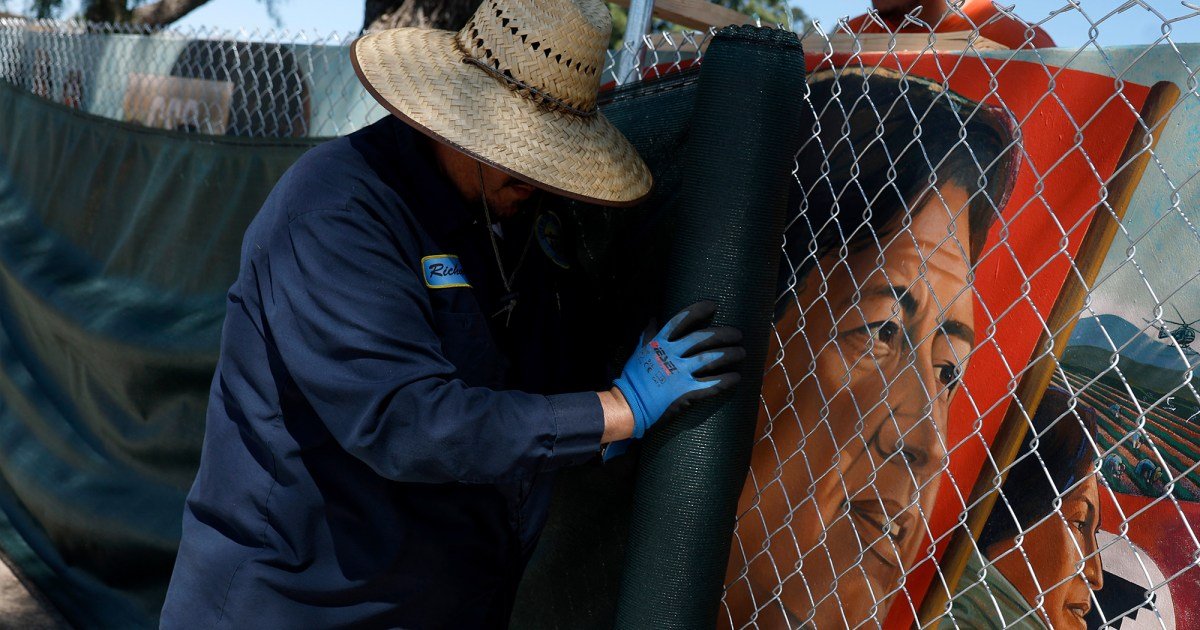
San Fernando city workers cover a mural of labor leader and civil rights activist Cesar Chavez at the Cesar E. Chavez Memorial Park on March 20, 2026 in San Fernando, California.Justin Sullivan/Getty
It’s 6:15 a.m. on Wednesday, March 18, and I’m being driven to Los Angeles International Airport by a loved one. The freeway is congested—traffic unrelenting. I bring out my phone to check my messages and am stunned to discover the New York Times’ investigation into the allegations of sexual abuse by multiple women at the hands of United Farm Workers co-founder Cesar Chavez. I tense up remembering that my loved one has suffered sexual abuse at the hands of family members. I’m reluctant to talk to her about the reporting. “Read it out loud,” she says defiantly.
For the next hour and 15 minutes of LA traffic, I find myself awkwardly reading the shocking report out loud, occasionally pausing so that she can catch her breath. After reading that Chavez raped children, I, too, need to catch my breath.
Pain, anger, and betrayal burn through me as I finish the story. I want to talk through what I’m feeling. Not surprisingly, my loved one processes in silence, not unlike the women Chavez abused.
Cesar Chavez was never a squeaky-clean movement leader. I was once undocumented and I grew up knowing he hated the likes of us (“wetbacks” and “illegals,” he called us). I looked past this because I felt U.S. Latinos needed a Mexican American leader to look up to. But the rape of women and children is not something any of us can look past.
I often speak to high school and college classes, and when I ask young people what they know about Cesar Chavez, some identify him as a labor leader while others think he was a boxer, and a few even think he was a revolutionary akin to Che Guevara. Ironic, if you consider that Che Guevara, much like Chavez, was better at revolutions than he was at governing.
According to Miriam Pawel’s The Union of Their Dreams: Power, Hope, and Struggle in Cesar Chavez’s Farm Worker Movement, Chavez’s lack of interest in establishing a well-run union was the main factor in the United Farm Workers weakening over time. Chavez saw how the 1975 Agricultural Labor Relations Act, which offered guarantees for union organizing, would shift the core work of the UFW from protest to administration, and he was not interested. Like Guevara, he was more interested in toppling institutions than in governing them.
The way Latino communities are rallying around the women who were raped and abused by Chavez should serve as an example to the nation for how to handle men who commit such crimes.
Records from those early days show that Chavez’s leadership relied on a kind of cultlike group therapy, known as the Game, which he borrowed from Synanon, the notoriously violent and controlling cult of the 1970s. (You can listen to “American Rehab,” our three-part investigation of Synanon and the rehab industry it spawned, here.) As author Jeffrey W. Rubin wrote for Dissent, “Playing the Game, a harsh variant of the encounter group therapies popular in the 1970s, participants ganged up verbally and emotionally against one member, hurling brutal insults and criticisms, ostensibly with the goal of strengthening the group. By mid-1977, the Game was played weekly at La Paz [the UFW headquarters], and almost everyone there joined in, along with union staff from around the state.” This toxic nature of his management led to the exodus to some of the brightest leaders in the movement.
The way the U.S. Latino community is rallying around the women who were raped and abused by Chavez should serve as an example to the nation for how to handle men who commit such crimes. No man is greater than a movement, and I include our founding fathers, who owned slaves, and Donald Trump, who for some ungodly reason continues to protect pedophiles on the Epstein list.
Chavez was a hero to many of us, yet the cruelty of our current president can be found in his cruelty. How he didn’t allow dissent in the ranks. How he demanded absolute loyalty. The way he assumed the movement was him, and vice versa. It is well documented that Chavez insisted on sacrifice and total commitment from the people within the movement. That’s how he kept power, and as we all know, absolute power corrupts absolutely.

As we begin to tear down statues of Cesar Chavez in our public squares, let us also tear down the statues of the Confederates who committed treason against our country. Only then can we begin to imagine a better nation. One where our statues, streets, and holidays are equally named after women—the founding mothers, long unsung and forgotten, but always the backbone of every movement.
As we continue to reckon with Chavez’ legacy, we must highlight the survivors, not just the perpetrator. So when it comes to that list of women and girls who process in silence, it’s important we do what my loved one told me to do that Wednesday morning: “Read it out loud.”
Ana Murguia. Debra Rojas. Dolores Huerta. Let’s put their names on some of those streets and squares.
Rafael Agustin, a member of Mother Jones’ board of directors, was a writer on the award-winning CW show Jane the Virgin and is the author of the bestselling memoir Illegally Yours and a producer of the new documentary Los Lobos: Native Sons.



