
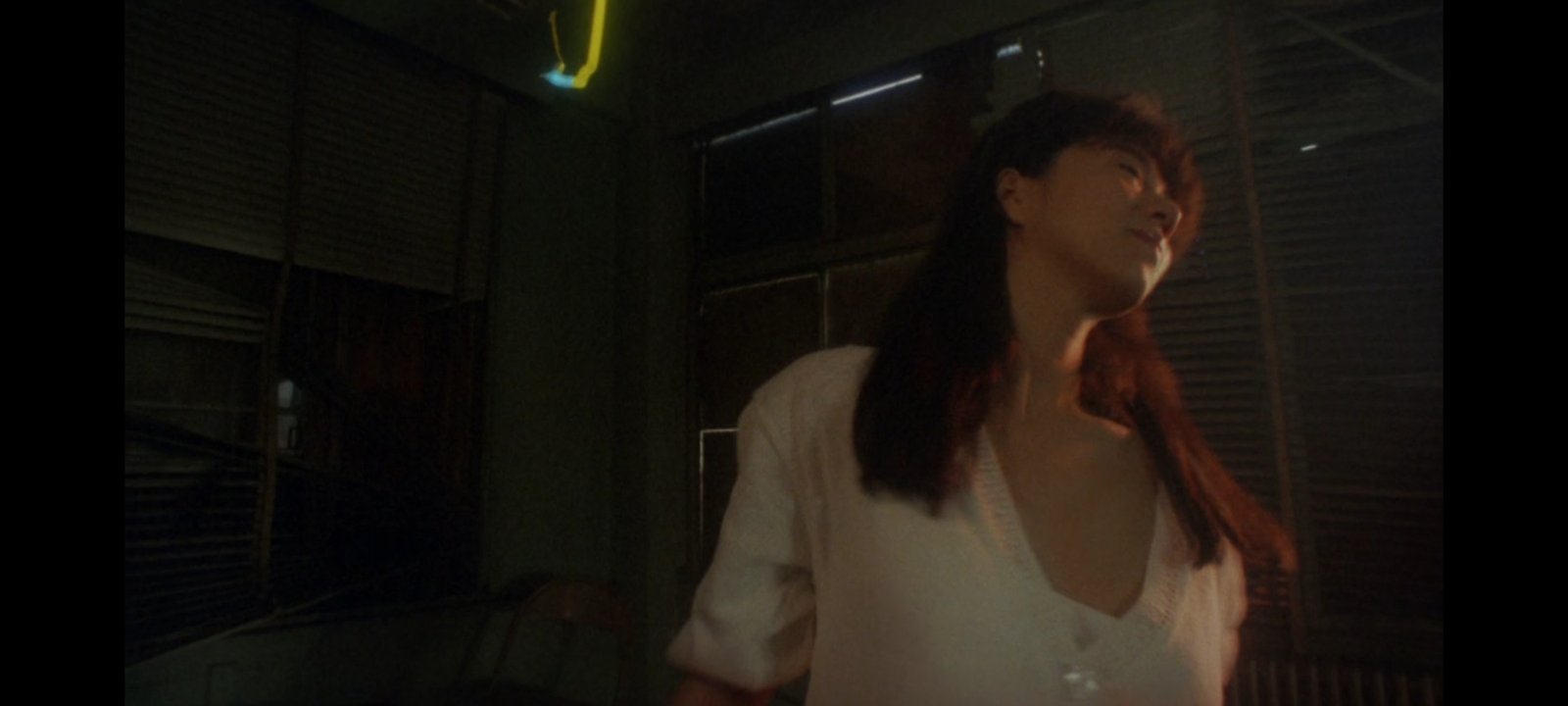
Unlike the previous films in the “Angel Guts” series, where the filmmakers tried to elevate Takashi Ishii’s source material, or at least to infuse it with their own style, the fifth part titled “Red Vertigo” could be seen as “back to the roots”. The reason is that Ishii himself took full control over the series by directing this part. The result was that “Red Vertigo” ended the series, and when it got re-booted once again with “Red Lighting” in 1994, also under Ishii’s directing, Nikkatsu did not produce it any longer.
Buy This Title
on Terracotta by clicking on the image below
This time, Nami (Mayako Katsuragi who appeared in Lloyd Kaufman’s Troma-trash movies later on) is a nurse who gets overworked and sexually assaulted by her patients at hospital. Back at home, she tends to help her erotic photographer boyfriend Kenji (Hirofumi Kobayashi), only to finally find out that he has not been faithful to her. In a parallel plot line, we meet the stock broker Muraki (Naoto Takenaka) who embezzled his clients’ money and is on the run from them.
The two stories collide (pun intended) when Muraki hits Nami with his car, and, instead of giving her a lift to a hospital to get treated, he abducts her, takes her to an abandoned factory and makes her his sex slave. After a while, she goes along with it and falls in love with her captor. However, the life has more surprises for them in its pocket.
With Ishii claiming full control over the series, its nonsensical and vile premise about rape serving as an introduction to romance gets central stage here, while there is little other than that in the background to provide at least some counter-balance. The thing with that kind of premise is that it is not exactly new and shocking, since it is rooted in early psychoanalysis. Simply told, it seems that the author-turned-filmmaker is fascinated with the act of rape, female fear and submission, after a mandatory, almost ritual resistance.
As a director, Ishii has only a few ideas how to transfer his own material from one medium to another, and they usually dry up after playing with lighting (dim + neon), crooked angles and alternations between handheld and static camerawork in long takes. Maybe his boldest idea is a montage sequence of sex scenes between the main “couple” in the second half of the film.
Although slightly longer than its predecessors from the series, “Red Vertigo” is not any richer in terms of the plot, and it actually plays out like a classic porn movie (although, with blurred genitalia) where the “score” and the “story” burden, confront and cancel out each other. That kind of quality spills over to the acting as well, since Katsuragi fails to achieve any dramatic depth in Nami and Takenaka uses broad moves and turns out quite clumsy and phony as Muraki. The presence of the main actress from the previous film, Jun Izumi, in a minor role does not help either, as it refreshes the memory how “Red Porn” was sufficiently sleazy, while showcasing some of the “proper” movie qualities.
Eventually, “Red Vertigo” could be seen as a swan song both for the series and for the genre of “Pink Film”. The times are changing constantly, and the new winds started to blow in all the following realms: pornography, softcore erotica and cinema. Some division lines got blurred, others clarified. Movies started to be made differently, Hollywood entered the market with its erotic dramas and thrillers, and stuff like “Red Vertigo” and the whole “Angel Guts” series started looking like a relic of the past based on questionable ideas and conceptions.



