
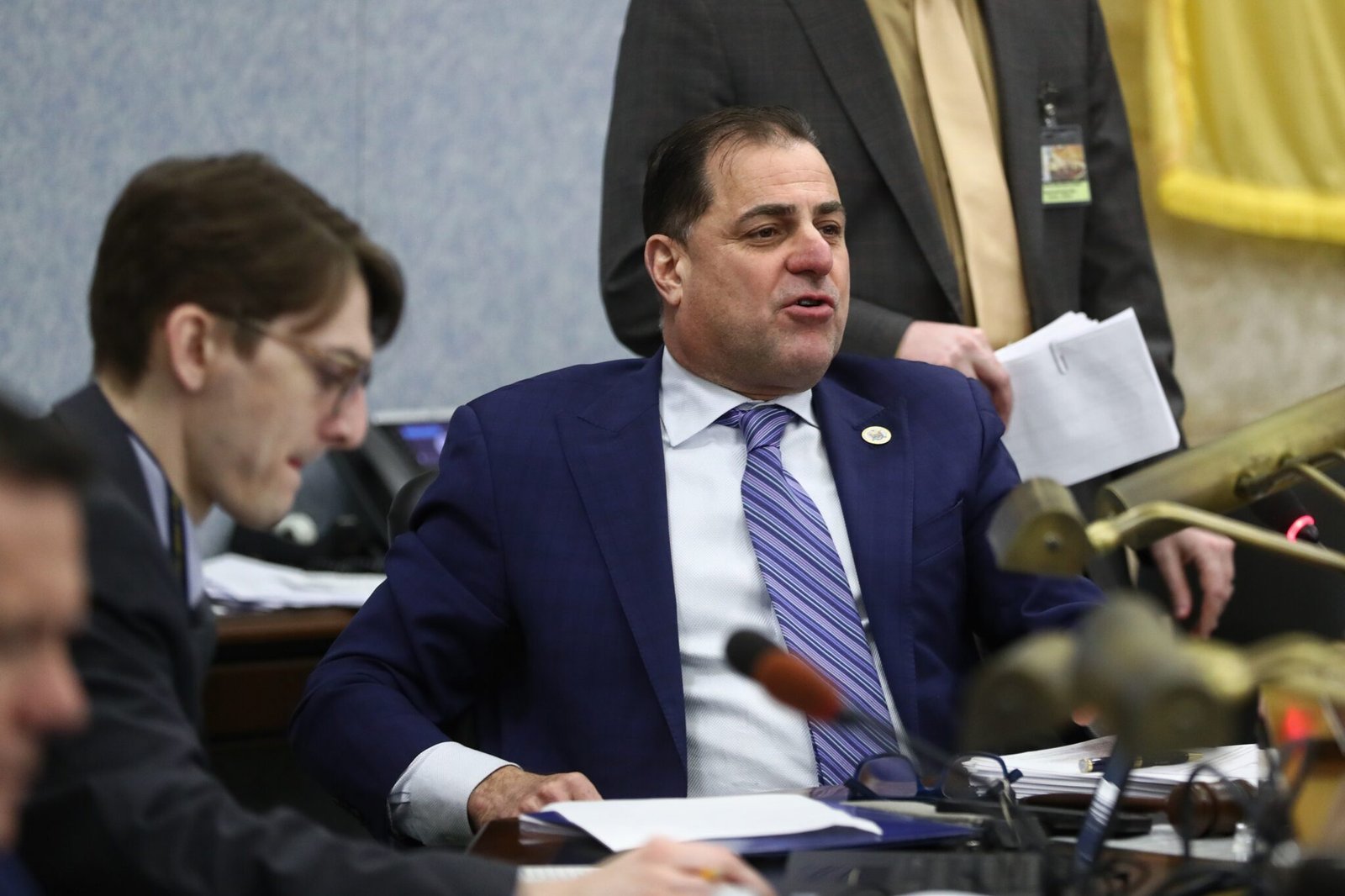
Across nearly six hours of testimony Tuesday, an array of witnesses told Senate lawmakers what investments they want to see in Gov. Mikie Sherrill’s first budget.
The testimony before the Senate Budget and Appropriations Committee brought an array of sometimes competing requests calling for changes to taxes facing New Jersey businesses, additional aid to some New Jersey school districts, and boosted health care funding to account for looming federal cuts expected to push more than 300,000 off Medicaid.
“The public’s input is important. We want to put in place a budget that contends with the difficult fiscal challenges we face, finds savings and efficiencies, protects the taxpayers, and makes the lives of our residents more affordable,” said Sen. Paul Sarlo (D-Bergen), the panel’s chair.
As part of her $60.7 billion budget plan, Sherrill, a Democrat who took office in January, has proposed capping a net operating loss deduction used by businesses to $1 million a year, reducing a separate deduction used by small businesses to write off losses, and charging a per-worker fee to employers with at least 50 employees on NJ FamilyCare, which is New Jersey’s Medicaid program.
Business groups cautioned those changes, which are expected to boost state revenue by $750 million, would make New Jersey businesses less competitive.
“Cost cutting alone without meaningful economy growth will not achieve stability. To generate that growth, we must do something that has been neglected for too long: creating an environment where businesses want to stay, expand, and advocate for New Jersey,” said Tom Bracken, president and CEO of the New Jersey Chamber of Commerce.
Treasury officials have said the use of net operating loss deductions surged after business tax apportionment changes signed into law in 2023, increases they said were not intentional.
Other witnesses urged the state to tax wealthy residents and corporations more heavily. Peter Chen, a senior policy analyst for progressive think tank New Jersey Policy Perspective, said the state could go even further.
“There’s more than we can do on the revenue side of the ledger. Developing more revenues, particularly from wealthy corporations and wealthy individuals, is still an untapped source of revenue for the state,” Chen said. “We’re talking about an environment where corporate profits reached a record level that year.”
Some praised the continuance of some school budget policies introduced last year. Those include 3% and 6% caps on state school aid cuts and hikes, respectively, a change in methodology that bases some special education assistance on enrollment rather than state averages, and the use of a multi-year average of property values to prevent steep aid swings following a reevaluation.
“We urge the Legislature to take the additional steps necessary to make these modifications permanent through legislation, but there is additional work that needs to be done to improve the equity and adequacy of New Jersey’s formula,” said Danielle Farrie, research director for the Education Law Center.
Though the caps on aid shifts have helped prevent steep reductions that spur school budget emergencies in the current fiscal year, officials in some school districts chafed at the 6% limit on state aid increases, charging it kept their schools underfunded.
Officials from the Evesham and Jefferson school districts on Tuesday told Senate lawmakers the 6% cap had compounded their budget woes by delaying state aid they are entitled to under the school funding formula, forcing them to cut school services or raise taxes locally, including a hike that added $734 to the average Evesham property tax bill last year.
“We have now gone over the fiscal cliff. Jefferson is not in this situation due to mismanagement. This is a structural problem, not a local one,” said Jefferson Schools Superintendent Jeanne Howe.
When he was governor, Phil Murphy in 2018 signed legislation, known by its number “S2,” phasing out adjustment aid meant to keep districts whole as the state implemented the funding formula enacted in 2008. Howe said her district had lost 60% of its state aid as a result of the bill in past years. Over that same time, enrollment dropped by 29%.
Cost cutting alone without meaningful economy growth will not achieve stability.
– Tom Bracken, president and CEO of the New Jersey Chamber of Commerce
Other witnesses urged support for New Jersey’s flagging public worker health plans. The state’s plans for school workers and local government employees have seen steep premium increases amid surging prescription drug use and an increasingly risky pool of workers.
In a Monday presentation, the state’s actuary told officials the School Employees Health Benefit Program is expected to run at a loss this year despite surcharges meant to rebuild its reserves. That plan faces double-digit increases and is expected to finish the year with a negative balance of $32.3 million, the actuary said.
Actuaries will unveil their rate expectations for local government workers’ health plan on Monday. That plan has fared worse than any other offered by the state amid an exodus of local governments with healthier workforces to cheaper options in the private market.
“The cost of health care for state and local government workers is unsustainable and has reached a crisis point. Addressing this issue must be a top priority of the budget, not only to protect workers, but to ensure the long-term fiscal health of our state,” said Anna-Marta Visky, New Jersey political and field director for the Communications Workers of America, which represents state workers.
The Treasury in May warned that the local government workers’ plan had entered a “death spiral” that would doom it absent an overhaul. Though the agency said circumstances for school workers’ health plan were not as dire, it warned it would walk the same path without measures to contain its growing costs.

Funding for hospitals and other health care providers also emerged as a recurring theme Tuesday, with witnesses concerned that federal Medicaid cuts would strain their budgets and could force staff or service cuts.
Davita Petty, director of policy and programs for the New Jersey Primary Care Association, urged legislators to raise reimbursement rates for uninsured health center visits.
After reimbursements from the state’s uncompensated care fund, health centers lose $140 for each of those visits, she said, and the more than 300,000 expected to lose Medicaid coverage due to federal changes could overwhelm centers under current rates.
“This is the moment where that safety net holds or begins to break because individuals who lose their insurance don’t disappear. They continue to seek care at their community health center,” Petty said. “However, if the gap between the cost of care and reimbursement widens while the number of uninsured patients rises, health centers will be forced to make difficult choices.”
Legislators must pass and Sherrill must sign a budget before June 30 to avoid a state government shutdown.
GET THE MORNING HEADLINES.



